
A CPU (Central Processing Unit) is a functional concept the logical role of executing program instructions. A microprocessor is the physical silicon chip that performs that role. Every modern CPU you use is built as a microprocessor, but the two terms describe different layers: one is architectural, the other is hardware.
If you search for the cpu vs microprocessor difference, you will likely find a confusing web of contradictory definitions. Many sources mistakenly claim that microprocessors are task-specific chips (confusing them with microcontrollers). Others use the terms completely interchangeably.
This guide corrects the record. We will break down the definitive modern 2026 definition: The difference between microprocessor and cpu is entirely based on the function vs hardware distinction.
Read on for a complete technical architecture breakdown, side-by-side comparisons, and the conceptual framework necessary to understand modern semiconductor design.
CPU Defined: The Functional Role, Not the Physical Chip
A Central Processing Unit (CPU) is the functional component of a computing system responsible for executing program instructions. It performs arithmetic, logic, control, and input/output operations. The term describes what a component does, not what it physically looks like or how it is manufactured.
The CPU concept is defined by its Instruction Set Architecture (ISA) such as x86 or ARM and governed by the Von Neumann Architecture model, which specifies three core functional blocks:
- The Arithmetic Logic Unit (ALU): Executes all mathematical and logical operations
- Control Unit (CU): Decodes instructions and coordinates execution sequence
- Registers: Ultra-fast on-chip storage holding data in active use
The term CPU dates to the 1940s. Early CPUs were not chips they were rooms filled with vacuum tubes, then cabinets of discrete transistors. The physical form changed dramatically over decades; the functional definition did not.
Microprocessor Defined: The Silicon Hardware That Runs the CPU Role
A microprocessor is a physical electronic component a single semiconductor integrated circuit (IC) that integrates all the functions of a CPU onto one silicon die. It is built from millions or billions of microscopic transistors etched onto silicon using photolithographic manufacturing processes.
The key word is physical. Where “CPU” answers the question “what does this do?”, “microprocessor” answers “what is this made of and how is it packaged?”
Correcting a persistent misconception: A microprocessor is not a task-specific chip. Microprocessors are general-purpose designed to run operating systems, applications, and arbitrary code. When a chip integrates a CPU core plus onboard RAM, ROM, and I/O peripherals for a single dedicated task, that is a microcontroller (MCU) a categorically different component used in embedded systems like automotive sensors or appliance controllers.
CPU vs Microprocessor Difference: The Function vs Hardware Distinction
The core difference between a CPU and a microprocessor lies in the distinction between a logical function and physical hardware. CPU describes the architectural role of processing data, while microprocessor describes the physical silicon chip that houses those processing capabilities.
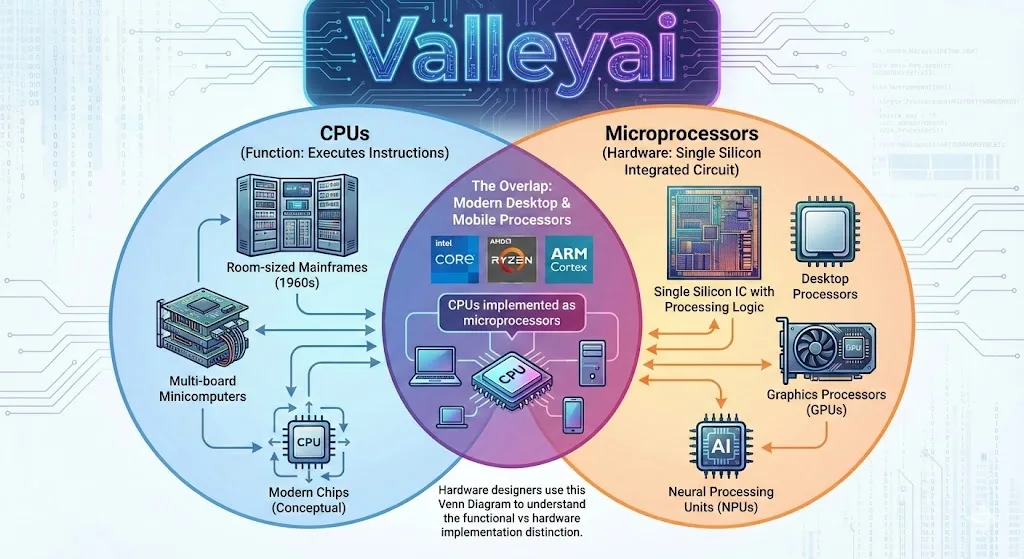
To understand this hardware implementation vs functional role distinction, hardware designers often use a Venn Diagram Comparison:
- Circle A (CPUs): Any system that executes instructions. (Includes modern chips, but also includes 1960s room-sized mainframe processors and multi-board minicomputers).
- Circle B (Microprocessors): Any single silicon integrated circuit containing processing logic. (Includes desktop processors, but also includes graphics processors (GPUs) and specialized neural processing units).
- The Overlap: Modern desktop and mobile processors (Intel Core, AMD Ryzen, ARM Cortex). These are CPUs implemented as microprocessors.
In a documented hardware design workflow for an IoT project, an engineer doesn’t buy a CPU. They buy a Microprocessor or System-on-Chip (SoC) to fulfill the CPU role on their printed circuit board (PCB).
Direct Comparison CPU vs Microprocessor Architecture
This comparison table highlights the conceptual vs physical layer attributes of both terms.
| Feature | Central Processing Unit (CPU) | Microprocessor (MPU) |
|---|---|---|
| Definition Layer | Conceptual / Functional | Physical / Hardware |
| Primary Meaning | The role of executing computing instructions. | A single integrated circuit (IC) made of silicon. |
| Components | ALU, Control Unit, Registers. | Transistors, logic gates, cache memory die layouts. |
| Historical Origin | 1940s (Vacuum tubes and relays). | 1971 (Intel 4004 – The first single-chip MPU). |
| Modern Context | “What does this device do?” | “How is this device physically manufactured?” |
| Form Factor | Historically room-sized; today microscopic. | Always a single semiconductor chip. |
Why the CPU vs. Microprocessor Distinction Matters in Practice
For most consumer conversations, the terms are interchangeable and that is fine. Where the distinction becomes operationally important is in hardware design and procurement.
A firmware engineer selecting components for an industrial control board does not search for a “CPU” they specify a microprocessor part number (such as an NXP i.MX series or a Texas Instruments Sitara) with defined pin counts, bus interfaces, and power envelopes. The CPU is the requirement; the microprocessor is the solution.
Similarly, a computer science student writing about “CPU scheduling algorithms” is discussing an abstract functional concept that applies equally to a 1970s mainframe and a 2025 AMD Ryzen chip. The algorithm operates on the CPU role the underlying microprocessor hardware is an implementation detail at that level of abstraction.
Understanding this layer separation also clarifies why a GPU can simultaneously be a microprocessor (it is a single-chip IC) and not a CPU (it does not fulfill the general-purpose instruction execution role of the CPU in a system).
Technical Analysis: Memory, Peripherals, and Architecture
Modern processor architecture dictates how memory and peripherals connect. While microprocessors handle the core logic and arithmetic via RISC or CISC instruction sets, they rely on external RAM and storage, unlike microcontrollers that integrate these into a single chip.
1. Instruction Set Architectures (ISA): RISC vs CISC
Whether a microprocessor utilizes a Complex Instruction Set Computer (CISC) architecture like Intel and AMDs x86, or a Reduced Instruction Set Computer (RISC) architecture like ARM, it is fulfilling the role of the CPU. High-resolution macro photography of die layouts reveals that RISC microprocessors often dedicate less silicon space to instruction decoding, allowing more room for L1/L2 cache compared to CISC designs.
2. Peripheral Integration & Latency
In lab environments, logic analyzer screenshots demonstrating bus communication latency highlight a key hardware reality: microprocessors must communicate with external memory. Because a true microprocessor does not contain massive amounts of internal working RAM, data must travel across the motherboard via the front-side bus (or modern interconnects like PCIe and Infinity Fabric).
3. The SoC Convergence and the Blurring Boundary
The System-on-Chip (SoC) represents the most significant architectural development in the CPU vs. microprocessor conversation. An SoC integrates a microprocessor (fulfilling the CPU role), a GPU, memory controllers, and increasingly an NPU all on a single package.
Apple’s M4 chip, released in 2024, exemplifies this: it contains a 10-core CPU cluster, a 10-core GPU, a 38-TOPS NPU, and unified memory architecture all within one package manufactured on TSMC’s 3nm process. Qualcomm’s Snapdragon X Elite similarly integrates a 12-core Oryon CPU, an Adreno GPU, and a Hexagon NPU rated at 45 TOPS.
In these designs, the question “is this a CPU or a microprocessor?” becomes a matter of which abstraction layer you are operating at. The chip is a microprocessor. The CPU cores within it fulfill the CPU functional role. The GPU cores fulfill a parallel processing role. The NPU fulfills an inference role. All of it is packaged as one physical semiconductor component.
For embedded and IoT contexts, the SoC has largely replaced the standalone microprocessor + discrete RAM architecture for anything requiring connectivity, display output, or machine learning at the edge.
Evolutionary Context: How Modern CPUs Became Microprocessors
Historically, a CPU consisted of multiple large circuit boards filling entire rooms. Thanks to Moore’s Law and advancements in semiconductor technology, all CPU functions were eventually miniaturized and placed onto a single integrated circuit, creating the modern microprocessor.
- The Discrete Component Era (Pre-1970): CPUs were massive. A single ALU could take up a whole cabinet of vacuum tubes.
- The Integrated Circuit Revolution: Engineers learned to etch transistors onto silicon wafers.
- The Intel 4004 (1971): Intel released the 4004 widely recognized as the first commercially available single-chip microprocessor successfully integrating the entire CPU functional block onto one 10µm silicon die containing 2,300 transistors. This moment defined the modern meaning of microprocessor.
- Moore’s Law in Action: Gordon Moore observed in 1965 that transistor density on integrated circuits doubled approximately every two years a trend that held remarkably consistent for five decades. By 2024, leading microprocessors contained over 100 billion transistors. The law has slowed at physical limits, but architectural innovations (chiplets, 3D stacking, new materials) continue driving capability improvements.
Alongside cores and integrated graphics, most current designs also include an NPU dedicated to AI inference.
2026 Architecture Landscape: What Modern Microprocessors Actually Look Like
The CPU-as-microprocessor model has evolved significantly. In 2026, a “microprocessor” in consumer or enterprise hardware
rarely means a standalone chip executing a single instruction stream. Several architectural shifts define the current landscape:
Heterogeneous Core Design
Modern microprocessors combine different core types on one die. Intel’s hybrid architecture pairs Performance cores (P-cores) with Efficiency cores (E-cores) on the same silicon. ARM’s big.LITTLE design, used across Qualcomm, MediaTek, and Apple silicon, does the same. The “CPU” functional role is now distributed across core clusters optimized for different workloads the physical microprocessor manages this dynamically via the operating system scheduler.
Neural Processing Units (NPUs) Inside the Microprocessor
Every major 2025–2026 consumer SoC now integrates a dedicated NPU alongside the CPU and GPU cores. Apple’s M4, Qualcomm’s Snapdragon X Elite, and AMD’s Ryzen AI 300 series all include NPUs rated in TOPS (Tera Operations Per Second) for on-device AI inference workloads. The microprocessor die now physically contains multiple distinct processing engines, each fulfilling a specialized functional role but the entire assembly remains, by definition, a microprocessor (a single integrated circuit).
Chiplet Architecture
AMD’s 3D V-Cache technology and Intel’s Foveros packaging stack multiple silicon dies vertically within one package. Strictly speaking, a chiplet-based product like an AMD Ryzen 9000 series processor contains multiple discrete silicon dies raising a precise question about whether it meets the “single IC” definition of a microprocessor. The industry consensus treats the packaged module as the functional unit, preserving the microprocessor classification at the product level.
Fabrication Nodes in 2026
Leading-edge microprocessors are manufactured at 3nm and 2nm process nodes (TSMC N3 and N2 families, Intel 18A). At these scales, individual transistors are measured in atoms. The physical implementation of the CPU concept has reached a density that early computer engineers could not have anticipated when the term “microprocessor” was coined in 1971.
Frequently Asked Questions (FAQs)
Is every CPU a microprocessor?
No, not every CPU in history is a microprocessor. Early CPUs used in computers like the ENIAC or early IBM mainframes were made of thousands of vacuum tubes or discrete transistors spread across multiple cabinets. However, in modern computing (post-1980s), virtually every CPU you interact with is physically built as a microprocessor.
Why is a CPU called a microprocessor?
A CPU is commonly called a microprocessor today because the functional role of the CPU is physically manufactured as a micro (microscopic transistor scale) processor (instruction execution engine) on a single silicon chip. In consumer technology, the terms have become functionally synonymous.
What is the difference between a microprocessor and a microcontroller?
A microprocessor contains only the core calculating functions of a CPU (ALU, Control Unit, Registers) and requires external RAM, ROM, and I/O ports to function. A microcontroller is an entire computer on a chip; it contains a less powerful CPU, plus memory (RAM/ROM) and I/O peripherals, built specifically for embedded, task-specific applications (like running a microwave or a car’s ABS system).
Is a GPU a microprocessor?
Yes. A GPU (Graphics Processing Unit) is a microprocessor it is a single integrated circuit built on silicon containing billions of transistors. However, a GPU is not a CPU. It does not fulfill the general-purpose instruction execution role that defines the CPU function. GPUs are optimized for massively parallel workloads (thousands of simultaneous simple operations), while CPUs handle sequential, complex instruction streams. A system contains both: the CPU microprocessor and the GPU microprocessor, each fulfilling a distinct functional role.
Why do modern devices use SoCs instead of standalone microprocessors?
Standalone microprocessors require external RAM chips, storage controllers, and I/O interface chips each connected via a PCB with physical traces that introduce latency and consume power. An SoC eliminates most of those external components by integrating them on one die, reducing latency, lowering power consumption, and shrinking the physical footprint. For smartphones, tablets, and laptops, this integration is what makes thin, fanless, battery-efficient devices possible. The trade-off is that individual components cannot be upgraded independently.

Kaleem
My name is Kaleem and i am a computer science graduate with 5+ years of experience in Computer science, AI, tech, and web innovation. I founded ValleyAI.net to simplify AI, internet, and computer topics also focus on building useful utility tools. My clear, hands-on content is trusted by 5K+ monthly readers worldwide.