
Binary code is a way to represent information with two distinguishable symbols or states, usually written as 0 and 1. The binary number system is a base-2 positional system, meaning each position represents a power of two. A single binary digit is called a bit. Encyclopaedia Britannica, Binary Number System
The history of binary has several connected parts. Earlier cultures used two-state patterns for poetry, symbolism, and calculation. Gottfried Wilhelm Leibniz later formalized binary as a mathematical system. George Boole connected binary values to logic, and Claude Shannon showed how that logic could control switching circuits. Engineers then used those principles in early computers.
Before tracing binary’s 5,000-year lineage, it helps to be clear on what binary code is and how it works inside a modern computer.
Where Did Binary Code Originate?
Binary code does not have one single origin. Earlier systems used two-state patterns, including short and long syllables in Pingala’s work and broken and unbroken lines in the I Ching. Gottfried Wilhelm Leibniz later formalized the modern binary number system using 0 and 1. Mechanical devices, relay circuits, and electronic computers applied binary principles to machines much later.
It is useful to separate four ideas:
- Binary-like representation: two categories, symbols, or states.
- Binary numeration: numbers represented with powers of two.
- Binary encoding: information mapped to patterns of two symbols.
- Physical binary: hardware states interpreted as 0 or 1.
These ideas are related, but they are not identical. The I Ching, Bacon’s cipher, Leibniz’s mathematics, Boolean logic, and computer memory belong to different stages of binary’s development.
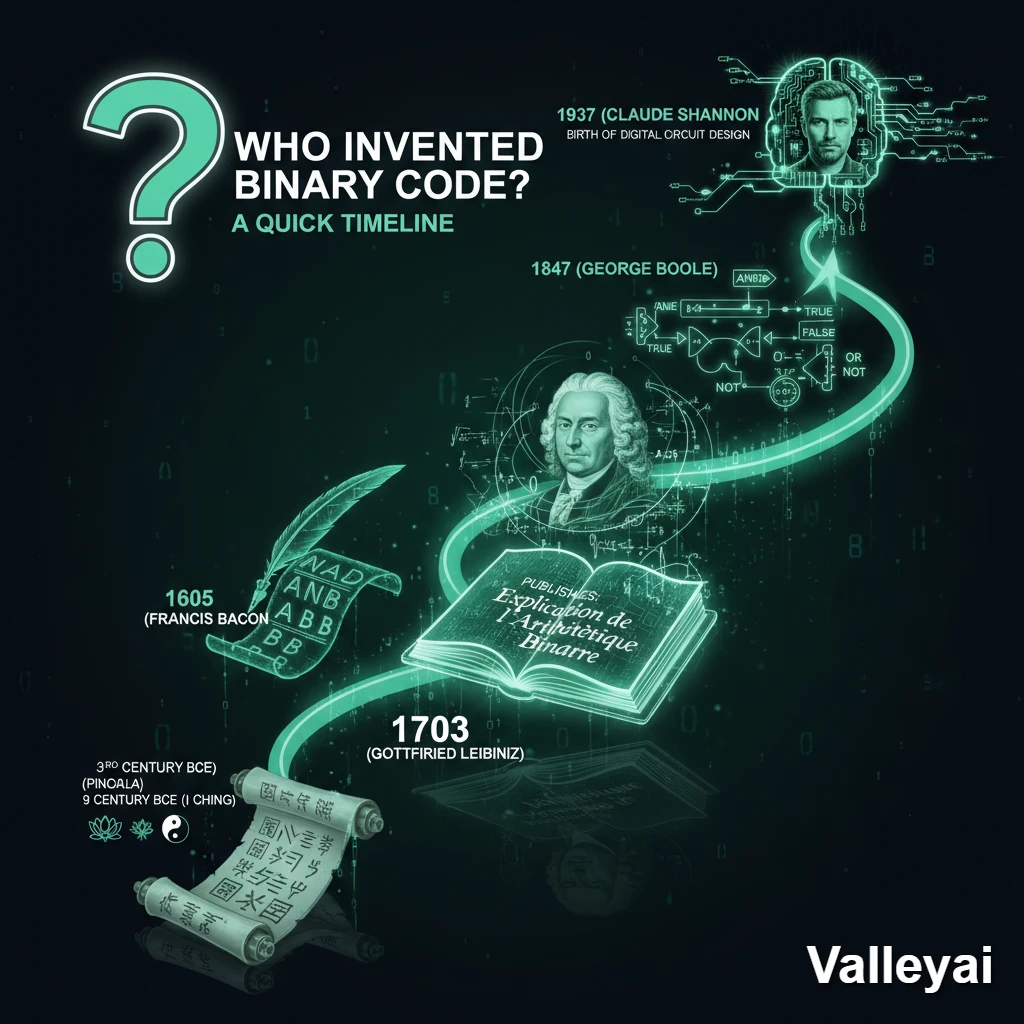
History of Binary Code: A Timeline
| Date or period | Development | Significance |
|---|---|---|
| Around the 3rd century BCE | Pingala analyzes short and long syllables in Sanskrit poetry | An early binary-like method for organizing combinations |
| Ancient Chinese tradition | The I Ching uses broken and unbroken lines in trigrams and hexagrams | A symbolic two-state system |
| 1605 | Francis Bacon describes a bilateral cipher | Two symbol classes encode written information |
| 1689–1703 | Leibniz develops and publishes work on binary arithmetic | Formalizes the modern binary number system |
| 1847 | George Boole develops Boolean algebra | Connects binary values with logical operations |
| 1937–1938 | Claude Shannon analyzes relay and switching circuits | Links Boolean logic with physical circuits |
| 1930s–1940s | Electromechanical and electronic computers use binary switching | Applies binary logic to practical computation |
The dates associated with Leibniz describe different stages of his work. Historical accounts connect his development of binary ideas with the late seventeenth century, while his major published treatment, Explication de l’Arithmétique Binaire, appeared in 1703.
Early Binary-Like Systems Before Leibniz
Several cultures used two-state patterns before anyone described modern computer code. These systems are best understood as binary-like precedents, not as formal base-2 computer systems.
Pingala’s Binary-Like Patterns in Sanskrit Meter
Pingala, an ancient Indian scholar associated with Sanskrit prosody, analyzed poetic meters using short syllables called laghu and long syllables called guru. Different combinations of the two syllable lengths could describe poetic patterns.
The method resembles binary enumeration because it organizes combinations from two possible states. However, historical comparisons should be careful: Pingala’s work concerned poetic meter, not a positional number system based on powers of two. Its importance lies in showing how two categories can generate and classify many combinations.
The I Ching and Two-State Symbolic Combinations
The Chinese I Ching, or Book of Changes, uses broken and unbroken lines to form trigrams and hexagrams. A hexagram contains six lines, each of which can have one of two forms. That creates 64 possible arrangements, the same number of combinations produced by six binary positions because (2^6 = 64).
The numerical similarity does not mean that the I Ching was using computer bits. Its lines had symbolic and philosophical meanings rather than serving as a modern positional numeral system. The comparison became historically significant because Leibniz later learned about the hexagrams through correspondence with the Jesuit missionary Joachim Bouvet.
Did Ancient Egyptians Use Binary?
Ancient Egyptian mathematics included doubling and halving techniques that resemble repeated powers of two. These methods could help with multiplication and the handling of fractions, but they were not a universal binary number system written with 0 and 1. British Museum, Mathematics in Ancient Egypt
The distinction matters. A calculation method may use doubling without becoming a formal base-2 positional system. Binary history includes many examples of two-state reasoning or repeated doubling, but Leibniz’s work gave binary numeration its systematic mathematical form.
Leibniz’s Formal Binary Number System
Gottfried Wilhelm Leibniz is generally credited with formalizing the modern binary number system. Earlier systems used two-state patterns, but Leibniz described a systematic way to represent every whole number using only 0 and 1.
In binary, each position represents a power of two:
| Binary place | Value |
|---|---|
| (2^0) | 1 |
| (2^1) | 2 |
| (2^2) | 4 |
| (2^3) | 8 |
| (2^4) | 16 |
For example, 1011₂ means:
- (1 \times 8)
- (0 \times 4)
- (1 \times 2)
- (1 \times 1)
The result is 11 in decimal. This positional structure separates binary numeration from an arbitrary string of zeros and ones.
What Leibniz Formalized—and Why the I Ching Mattered
Leibniz was interested in a universal system for representing ideas and reasoning. Binary appealed to him because complex numbers could be expressed through two digits and because logical distinctions could be represented through paired values.
Joachim Bouvet introduced Leibniz to information about the I Ching and its hexagrams. Leibniz saw a possible mathematical relationship between the hexagrams’ two line types and binary combinations. The I Ching influenced his thinking, but it did not supply the complete modern binary number system.
Leibniz’s work established binary as a formal mathematical system. Computers would not use that system in hardware for more than two centuries because the mechanical and electrical technology needed for reliable binary switching had not yet matured.
Binary Encoding and Mechanical Control Before Computers
Binary mathematics is only one part of binary’s history. Two-state systems can also represent text, instructions, or machine conditions. That broader process is called binary encoding when information is mapped to patterns made from two symbols or states.
Encoding is different from encryption. An encoding scheme represents information according to a known mapping, while encryption transforms information to restrict access to it.
Francis Bacon’s Two-Symbol Cipher
In 1605, Francis Bacon described a bilateral cipher that used two type styles or symbol classes to encode letters. Each letter could be represented by a five-character combination of A and B symbols.
A simplified example looks like this:
| Letter | Bacon-style pattern |
|---|---|
| A | AAAAA |
| B | AAAAB |
| C | AAABA |
Bacon’s cipher is not the same as modern numerical binary. Its symbols were categories in a cipher rather than the digits of a base-2 positional system. Its historical importance is that it showed how written information could be represented through two distinguishable symbol classes.
Later systems such as ASCII and Unicode used different technical methods to encode characters for digital devices. Bacon’s cipher is best described as an early two-symbol information system, not as the direct ancestor of every modern character standard.
The Jacquard Loom and Punched-Card Control
In 1801, Joseph Marie Jacquard’s loom used punched cards to control weaving patterns. A punched position and an unpunched position created two physical conditions that determined whether particular threads were lifted.
The loom demonstrated that a machine could follow instructions represented by physical states. Its cards did not store electronic bits, but they showed how patterns of two conditions could automate mechanical operations. Punched-card systems later influenced the development of machine-readable data and program instructions.
Boole’s algebra of 0 and 1 is the direct ancestor of the logic gates that every processor is built from today.
George Boole and the Logic of 0 and 1
In 1847, George Boole developed Boolean algebra, a system for working with logical values such as true and false. Digital systems commonly represent those values as 1 and 0.
Boolean algebra includes operations such as:
- AND: true only when both inputs are true.
- OR: true when at least one input is true.
- NOT: reverses a value, changing true to false or 1 to 0.
Boole was not designing modern computer processors. His contribution was mathematical: he created a formal way to describe logical relationships. Engineers later implemented those relationships with relays, switches, and electronic logic gates.
Leibniz showed how 0 and 1 could represent quantities. Boole showed how related values could represent logical conditions. That connection made binary useful for automated decision-making as well as calculation.
Claude Shannon Connects Boolean Logic to Switching Circuits
Claude Shannon connected Boolean algebra with physical switching circuits in his 1937 master’s thesis, later published in 1938 as A Symbolic Analysis of Relay and Switching Circuits. He demonstrated that logical operations could be represented through the behavior of electrical switches and relays.
A circuit could represent a binary state through conditions such as:
- Switch closed: current flows; interpreted as one state.
- Switch open: current is blocked; interpreted as the other state.
The exact assignment of 0 and 1 can vary by system. The important principle is that hardware can distinguish between two reliable conditions and use them to perform logical operations.
Shannon’s work helped establish the foundation of digital circuit design. His later work in information theory addressed the measurement and transmission of information, which is related to but distinct from his earlier analysis of switching circuits.
Those first machines held their binary states with vacuum tubes and later transistors, and that hardware shift decided how fast binary computing could scale.
How Binary Logic Entered Early Computers
Binary entered computing through several stages rather than through one single invention.
- Mechanical systems: punched cards represented physical instructions.
- Relay systems: open and closed circuits represented logical conditions.
- Electromechanical computers: relays performed automated calculations and switching operations.
- Electronic computers: vacuum tubes implemented switching functions at higher speeds.
- Solid-state systems: transistors later made binary switching smaller and more reliable.
Konrad Zuse’s Z1 and Z3 are important examples from the early history of programmable computing. The Z3, completed in 1941, used electromechanical relays and binary numerical operations.
The Atanasoff–Berry Computer used electronic switching and binary arithmetic in the late 1930s and early 1940s. ENIAC, completed in 1946, used vacuum tubes and decimal arithmetic in parts of its design, illustrating that early computers did not all adopt binary in exactly the same way.
This period turned binary from an abstract mathematical system into a practical method for storing, processing, and controlling information.
Because long binary strings are painful to read by eye, engineers compress them into hexadecimal notation when working with memory addresses and colour values.
How Binary Represents Text and Data
A bit is one binary digit: either 0 or 1. A byte is a group of bits used as a basic unit of digital storage. Modern systems commonly use eight-bit bytes, although the historical development of computer word sizes has varied.
Binary can represent more than numbers. A character-encoding standard maps letters, numbers, and symbols to numerical codes, which computers store as binary patterns.
ASCII, created for digital communication and computing systems, assigns numerical codes to characters such as letters, digits, punctuation marks, and control instructions. Unicode extends character representation to a much broader range of writing systems and symbols.
Binary numbers, character encodings, and machine code should not be treated as identical:
- A binary number represents a quantity in base 2.
- A character encoding maps text to numerical values.
- Machine code represents instructions that a processor can execute.
- A bit pattern may represent data, an instruction, a color value, or another type of information depending on the system interpreting it.
For example, the decimal number 666 is 1010011010₂, while 777 is 1100001001₂. The eight-bit string 11111111₂ equals 255 when interpreted as an unsigned binary number. The same bit pattern can have another meaning under a different data type or encoding.
Two-state signalling is also what lets the arithmetic logic unit add, subtract, and compare numbers using nothing but gates.
Why Binary Became Practical for Computer Hardware
Computers use binary because hardware can reliably distinguish between two states, such as low and high voltage or off and on. Detecting ten separate states would require narrower measurement ranges and could make errors more likely when signals are affected by electrical noise.
Binary also works naturally with Boolean logic. A circuit can combine, invert, and compare two-state signals using logic gates. Those operations form the basis of arithmetic, memory, control systems, and processor instructions.
Engineers experimented with other number systems, including ternary computing. The Soviet Setun computer, developed in the 1950s, used three-valued logic in an experimental design. Binary became the dominant approach because existing switching technologies, manufacturing systems, software practices, and standards developed around two-state logic.
Binary’s dominance is not guaranteed forever either — quantum computing swaps the bit for a very different unit, as this comparison of bits and qubits explains.
Frequently Asked Questions About Binary’s History
Who formalized the modern binary number system?
Gottfried Wilhelm Leibniz is generally credited with formalizing the modern binary number system. Earlier cultures used two-state patterns for symbolism, poetry, or calculation, but Leibniz described a systematic positional method using 0 and 1 to represent numbers. Binary encoding, Boolean logic, and electronic computer hardware developed later.
When was binary first used in computers?
Binary entered computing through several stages. Punched cards first represented mechanical instructions, while relay machines later used open and closed circuits for switching. Electromechanical computers such as Konrad Zuse’s Z3 used binary operations in the early 1940s. Electronic computers then implemented switching with vacuum tubes and later transistors.
What does 666 mean in binary?
If 666 is treated as a decimal number, its binary representation is 1010011010₂. The conversion works because the 1s mark the powers of two that add up to 666: 512, 128, 16, 8, and 2.
What is 777 in binary code?
If 777 is a decimal number, its binary representation is 1100001001₂. The 1s represent 512, 256, 8, and 1, which total 777. This is a numerical conversion, not a character-encoding result.
What does 11111111 mean in binary?
As an unsigned eight-bit binary number, 11111111₂ equals 255. The bit pattern can have a different meaning when interpreted as text, a signed number, a color value, or a machine instruction. Its meaning depends on the encoding and data type used by the computer.
Is the I Ching a binary code?
The I Ching uses broken and unbroken lines, so it has a two-state symbolic structure. Its hexagrams can also be compared mathematically with combinations of binary positions. However, it was not a computer code or a formal base-2 numeral system. The comparison describes a structural similarity rather than a direct historical identity.
Is Bacon’s cipher the same as computer binary?
No. Bacon’s cipher used two symbol classes to hide or represent letters, while computer binary uses two states to represent numbers, data, instructions, or physical conditions. Both rely on distinguishable alternatives, but they serve different purposes and follow different encoding rules.
What Changed at Each Stage of Binary’s History?
The history of binary code connects several developments that should be kept distinct:
- Early cultures used two-state patterns to organize symbols and combinations.
- Leibniz formalized binary as a positional number system.
- Bacon demonstrated how two symbol classes could represent written information.
- Boole created an algebra for logical values and operations.
- Shannon connected Boolean logic with switching circuits.
- Early computer designers used binary states in electromechanical and electronic systems.
- Modern standards use binary patterns to store text, instructions, numbers, images, and other data.
Binary did not emerge from one invention or one civilization. Its modern form developed when mathematical notation, information encoding, logic, and reliable hardware converged.

Kaleem
My name is Kaleem and i am a computer science graduate with 5+ years of experience in Computer science, AI, tech, and web innovation. I founded ValleyAI.net to simplify AI, internet, and computer topics also focus on building useful utility tools. My clear, hands-on content is trusted by 5K+ monthly readers worldwide.