
Most explanations of these three modes stop exactly where the useful part begins they tell you what each mode is, hand you a walkie-talkie analogy, and call it a day. That’s fine for a quiz. It’s useless when you’re designing a system, debugging a network, or trying to understand why your real-time application is behaving like it’s stuck in 1998.
This guide covers the definitions precisely. But it also covers what the definitions don’t tell you: how these modes behave inside actual protocols, where the engineering trade-offs live, and how to choose the right mode for a real system.
The Three Modes, Briefly Framed
Before going deep, here’s the essential distinction in one sentence each:
- Simplex: Data flows in one direction only. The sender sends; the receiver receives. That’s the entire relationship.
- Half-Duplex: Data flows in both directions, but not at the same time. Devices take turns.
- Full-Duplex: Data flows in both directions simultaneously. Both devices send and receive at the same time.
The difference between half-duplex and full-duplex is where most confusion lives and where the real engineering implications hide.

Simplex Mode — Data That Only Goes One Way
Simplex mode is a transmission mode in which data travels in a single, fixed direction from sender to receiver with no reverse channel. The receiving device has no mechanism to transmit back; it can only accept incoming data. This isn’t a limitation of the device; it’s a deliberate architectural choice.
Why Simplex Exists and Where It Makes Sense
Think about what FM radio actually requires. A broadcast tower transmits; your car radio receives. There’s no scenario where your car radio needs to send data back to the tower. Adding a return channel would require spectrum licensing, receiver-side transmitter hardware, and coordination logic all for zero functional benefit. Simplex is the right architecture when the receiver is stateless and acknowledgment is irrelevant.
The same reasoning applies to:
- Fire alarm systems: sensors transmit alert signals to a central panel; the panel doesn’t need to send data back to the smoke detector
- Television broadcasting: signal flows from broadcast tower to receiver; no return path needed
- Keyboard-to-computer input: in traditional PS/2 keyboard interfaces, data flows from keyboard to host; the host doesn’t transmit back on the same channel
- Paging systems: one-way alerts to pagers; no response mechanism exists
- Environmental monitoring sensors: temperature, pressure, or humidity sensors transmitting readings to a central logger
The Real Limitation of Simplex
No acknowledgment. No error recovery from the receiver side. If data is lost or corrupted in transit, the receiver has no way to request retransmission. This is acceptable in broadcast scenarios where the cost of a missed packet is low (a glitchy radio second) but catastrophic in transactional systems where data integrity is required.
Advantages:
- Simple implementation, no bidirectional channel management
- Lower hardware cost transmitter and receiver have dedicated, non-overlapping roles
- No collision risk only one device ever transmits
- Efficient for broadcast one transmitter, unlimited receivers
Limitations:
- No error acknowledgment or retransmission capability
- Cannot adapt to receiver state (receiver can’t signal “slow down” or “resend”)
- Impractical for interactive or transactional communication
- Rare in modern general-purpose networking; mostly found in specialized broadcast and sensor systems
Half-Duplex Mode The Engineering Trade-Off Nobody Explains Properly
Here’s what most guides don’t say clearly: half-duplex isn’t a worse version of full-duplex. It was the dominant mode in Ethernet networking for decades, and it remains the right choice in specific cost-constrained or legacy environments. The problem isn’t that half-duplex is primitive it’s that it’s frequently misunderstood.
Half-duplex mode allows bidirectional communication over a shared channel, but only one device can transmit at a time. When Device A is transmitting, Device B must wait. When Device B transmits, Device A waits. Both devices share the same channel, alternating access to it.
The Mechanism Behind the Turn-Taking
This isn’t just a convention it’s enforced by the physical and protocol layers. In half-duplex Ethernet, the mechanism is CSMA/CD (Carrier Sense Multiple Access with Collision Detection), specified in IEEE 802.3. The process works like this:
- Carrier Sense: Before transmitting, a device listens to the channel to check whether it’s idle
- Multiple Access: Any device on the shared channel can transmit when the channel is free
- Collision Detection: If two devices transmit simultaneously, both detect the resulting signal corruption
- Backoff: Both devices stop, wait a random interval (exponential backoff), then retry
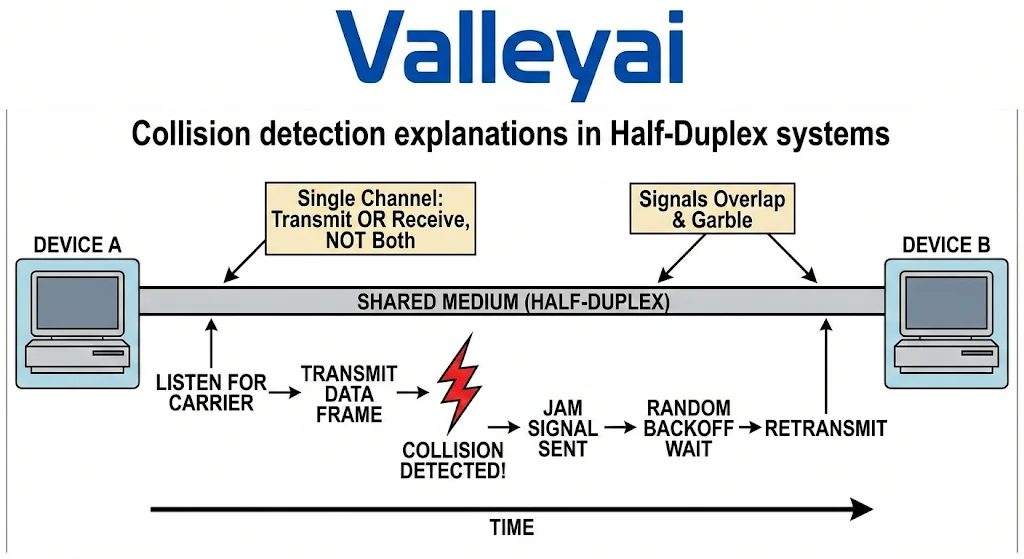
The exponential backoff is the part that causes real trouble. Under light load, collisions are rare and backoff delays are minimal. Under heavy load when multiple devices are contending for the same channel backoff intervals compound. A device that loses a collision retry may wait 10ms on the first attempt, 20ms on the second, 40ms on the third. This non-linear degradation is why half-duplex networks perform fine at 30% utilization and fall apart at 70%.
When troubleshooting latency spikes on a half-duplex link, the pattern is almost always the same: performance looks acceptable during off-peak hours, then degrades sharply during peak usage. The instinct is to blame bandwidth saturation, but the actual culprit is collision backoff accumulation. Upgrading bandwidth doesn’t fix it eliminating the collision domain does.
Real-World Half-Duplex Systems
- Walkie-talkies / Push-to-talk (PTT) radios: Both units can transmit and receive, but the PTT button enforces turn-based access. Radio operators say “over” to signal transmission completion without that convention, simultaneous transmission causes signal collision. This is half-duplex enforced by social protocol rather than hardware.
- CB radio (Citizen’s Band): Shared channel, turn-based access, no simultaneous transmission
- Legacy 10BASE-T and 100BASE-T Ethernet: Used CSMA/CD over shared coaxial or hub-based infrastructure before switching became affordable
- RS-485 bus communication: Industrial serial communication where multiple devices share a two-wire bus; half-duplex by design, with explicit direction control
- Intercom systems: Many basic intercom installations use half-duplex; pressing “talk” disables “listen” on the same unit
Advantages and Limitations of Half-Duplex
Advantages:
- Simpler channel infrastructure single shared medium, no separate transmit/receive paths required
- Lower cost than full-duplex in multi-device shared-medium environments
- Adequate performance for low-to-moderate traffic loads
- Backward compatible with legacy network infrastructure
Limitations:
- Collision risk in shared-medium environments; performance degrades non-linearly under load
- Turn-based transmission introduces latency a device must wait for the channel to be free
- CSMA/CD overhead (collision detection, backoff) consumes bandwidth and processing
- Fundamentally incompatible with real-time, latency-sensitive applications at scale
- Modern switched Ethernet has made half-duplex largely obsolete for general networking
Full-Duplex Mode Simultaneous Transmission, Separate Channels
Here’s the counter-intuitive part: full-duplex doesn’t “double” your bandwidth by magic it requires either separate physical channels or frequency/time division multiplexing to enable simultaneous bidirectional transmission. The performance gain is real, but it comes from eliminating collision overhead and enabling concurrent data flow, not from compressing more data into the same medium.
Full-duplex mode allows both devices to transmit and receive simultaneously. There’s no turn-taking, no collision detection, no backoff. Device A and Device B can both be sending data at the same time, over independent channels or multiplexed paths.
How Full-Duplex Actually Works Physically
For simultaneous bidirectional transmission to be possible, the transmit and receive paths must be separated. This happens through:
- Separate wire pairs — Modern twisted-pair Ethernet (100BASE-TX, 1000BASE-T) uses dedicated wire pairs for transmit and receive, enabling full-duplex without signal interference
- Frequency-division duplexing (FDD) — Used in cellular networks; uplink and downlink use different frequency bands simultaneously
- Time-division duplexing (TDD) — Used in some 5G deployments; uplink and downlink alternate in time slots so rapidly that they appear simultaneous at the application level
- Fiber optic pairs — Separate fibers for each direction; zero electrical interference between paths
- Echo cancellation — Some systems (notably DSL and certain radio systems) use the same medium in both directions simultaneously, using digital signal processing to subtract the local transmit signal from the received signal
The shift from half-duplex to full-duplex Ethernet in the 1990s and early 2000s wasn’t primarily a protocol change it was an infrastructure change. Hubs (shared medium, half-duplex) were replaced by switches (dedicated per-port channel, full-duplex). The protocol overhead of CSMA/CD became unnecessary the moment each device got its own dedicated channel.
Real-World Full-Duplex Systems
- Modern switched Ethernet (100BASE-TX, Gigabit Ethernet) — Full-duplex by default; each device has dedicated transmit and receive pairs
- Telephone networks (PSTN) — Traditional landline phone calls are full-duplex; both parties can speak simultaneously (even if social convention makes us take turns)
- Fiber optic links — Separate fibers in each direction; full-duplex at the physical layer
- Cellular data (LTE, 5G) — FDD or TDD implementations enable full-duplex data transfer
- TCP/IP connections — RFC 793 specifies TCP as a full-duplex protocol; data can flow in both directions simultaneously over a single connection
- WebSockets — RFC 6455 defines WebSockets as a full-duplex application-layer protocol; both client and server can send messages independently without waiting for a request-response cycle
Advantages and Limitations of Full-Duplex
Advantages:
- No collision risk separate channels eliminate contention
- No turn-taking latency devices transmit without waiting
- Higher effective throughput simultaneous bidirectional data flow
- Essential for real-time, latency-sensitive applications (VoIP, video conferencing, live streaming)
- Standard in modern networking infrastructure
- Full-duplex switched ethernet became possible partly because chip density allowed complex switching logic to fit on affordable hardware
Limitations:
- Requires separate transmit/receive channels higher infrastructure cost in some environments
- More complex hardware (dedicated wire pairs, FDD/TDD logic, echo cancellation circuitry)
- Overkill for simplex use cases unnecessary complexity where one-way transmission is sufficient
- In TDD implementations, the “simultaneous” nature is an approximation; actual alternation happens at sub-millisecond timescales
Where These Modes Actually Live in Real Protocols
This is the section most guides skip entirely and it’s where the definitions become useful.
Transmission modes aren’t abstract categories. They manifest in specific, observable ways inside protocols and hardware that engineers interact with every day. Understanding where each mode lives helps diagnose problems, make architectural decisions, and evaluate whether a system is behaving as designed.
Half-Duplex in Ethernet: CSMA/CD and the Collision Domain Problem
Half-duplex Ethernet, governed by IEEE 802.3, uses CSMA/CD to manage shared channel access. A collision domain is the set of devices that share a single half-duplex channel any two of them transmitting simultaneously causes a collision.
In hub-based networks, every connected device is in the same collision domain. A 10-device hub means 10 devices competing for one channel. As the number of devices grows, collision frequency increases, backoff intervals lengthen, and effective throughput drops sharply.
The switch eliminated this problem. A managed switch creates a separate collision domain for each port — effectively giving each device its own dedicated channel. With dedicated channels, CSMA/CD becomes unnecessary, and the switch can negotiate full-duplex mode with connected devices. This is why modern networks are full-duplex by default.
Mixing half-duplex and full-duplex devices on the same network segment is one of the most common sources of unexplained latency in legacy networks. If a switch port auto-negotiates full-duplex with one device but falls back to half-duplex with a legacy device on the same segment, the half-duplex device’s collision backoff can affect the perceived performance of the entire segment. The fix isn’t bandwidth it’s replacing or isolating the half-duplex device.
Full-Duplex in TCP/IP and WebSockets
TCP, defined in RFC 793, is a full-duplex protocol at the transport layer. A single TCP connection has independent transmit and receive streams the client can be uploading data while simultaneously downloading data over the same connection. This is why large file transfers and real-time acknowledgments can coexist on a single TCP connection without blocking each other.
HTTP/1.1, however, is effectively half-duplex at the application layer. A client sends a request and must wait for the server’s response before sending another request on the same connection. The underlying TCP connection is full-duplex, but HTTP/1.1’s request-response model imposes a turn-based constraint on top of it.
HTTP/2 addresses this through multiplexing multiple request-response streams share a single TCP connection, interleaved at the frame level. This isn’t true full-duplex in the purest sense, but it eliminates the head-of-line blocking that makes HTTP/1.1 behave like half-duplex under load.
WebSockets, defined in RFC 6455, are genuinely full-duplex at the application layer. After the initial HTTP handshake upgrades the connection to WebSocket, both client and server can send messages independently, at any time, without waiting for a request-response cycle. Before WebSockets, real-time web applications used HTTP long-polling which is architecturally half-duplex: the client sends a request, the server holds it open until data is available, responds, and the client immediately sends another request. WebSockets reduced real-time application latency from hundreds of milliseconds (polling interval + response time) to tens of milliseconds (direct push).
Simplex in Hardware: UART Configuration
UART (Universal Asynchronous Receiver-Transmitter) is one of the most common hardware serial communication interfaces, used in microcontrollers, embedded systems, and industrial equipment. UART supports all three transmission modes through hardware configuration:
- Simplex: Only TX (transmit) or RX (receive) pin is used; the other is left unconnected or disabled. The device either transmits or receives never both.
- Half-Duplex: TX and RX share a single wire (often through a tri-state buffer); direction is controlled by a direction-enable signal. RS-485 commonly uses this configuration.
- Full-Duplex: Separate TX and RX pins are used simultaneously; both can be active at the same time. RS-232 uses this configuration.
When configuring UART for simplex operation (TX-only), a common mistake is leaving the RX interrupt handler enabled in firmware. The RX pin, floating or connected to a pull-up resistor, generates noise events that trigger phantom interrupts. On low-power embedded systems, this can cause measurable CPU cycle waste and unpredictable behavior. Disabling the RX interrupt handler explicitly not just leaving it unregistered is the correct approach. The specifics vary by microcontroller; consult your hardware datasheet.

Choosing the Right Transmission Mode — A Decision Framework
There’s no universally “better” transmission mode. The right choice depends on the specific constraints of your system. Most guides don’t offer this they describe the modes and leave the decision to you. Here’s a structured way to think through it.
Start With the Communication Pattern
Before evaluating performance or cost, identify the fundamental communication requirement:
| Communication Pattern | Appropriate Mode | Reasoning |
|---|---|---|
| Data flows only from A to B; B never responds | Simplex | No return channel needed; adding one adds cost with no benefit |
| A and B exchange data, but never simultaneously; low-to-moderate traffic | Half-Duplex | Shared channel adequate; collision overhead acceptable at low utilization |
| A and B exchange data simultaneously; latency-sensitive or high-throughput | Full-Duplex | Dedicated channels eliminate collision overhead; required for real-time applications |
| Broadcast from one source to many receivers | Simplex | Receivers are stateless; no acknowledgment mechanism needed |
| Interactive, real-time communication (VoIP, video, gaming) | Full-Duplex | Simultaneous bidirectional data flow is non-negotiable |
| Industrial sensor network with shared bus, cost constraints | Half-Duplex (RS-485) | Shared medium reduces wiring cost; CSMA/CD or explicit direction control manages access |
The Decision Matrix
| Criterion | Simplex | Half-Duplex | Full-Duplex |
|---|---|---|---|
| Directionality | One-way only | Bidirectional, alternating | Bidirectional, simultaneous |
| Latency | Lowest (no coordination needed) | Higher (turn-taking + collision backoff) | Lowest (no waiting) |
| Throughput | Limited to one direction | Shared between directions (time-multiplexed) | Independent in each direction |
| Infrastructure Cost | Lowest | Low-to-medium (shared medium) | Higher (separate channels or multiplexing) |
| Collision Risk | None | Present in shared-medium environments | None (dedicated channels) |
| Error Recovery | None from receiver side | Possible (ACK/NACK over same channel) | Full bidirectional error recovery |
| Complexity | Lowest | Medium | Higher |
| Modern Relevance | Specialized (broadcast, sensors) | Legacy + industrial/embedded | Standard in modern networking |
| Typical Applications | FM radio, fire alarms, keyboards | Walkie-talkies, RS-485, legacy Ethernet | Ethernet, TCP/IP, telephone, WebSockets |
When to Choose Simplex
Choose simplex when:
- The receiver has no need to respond (broadcast, monitoring, alerting)
- Infrastructure cost must be minimized (single-wire, single-direction)
- The system is one-to-many (one transmitter, unlimited receivers)
- Error recovery is handled at a higher layer or is not required
When to Choose Half-Duplex
Choose half-duplex when:
- Bidirectional communication is needed but simultaneous transmission is not
- Infrastructure cost is a constraint (shared medium reduces wiring)
- Traffic load is low-to-moderate (collision overhead is acceptable)
- You’re working with legacy systems or industrial bus protocols (RS-485, older Ethernet)
- Push-to-talk or explicit direction control is acceptable in the application
When to Choose Full-Duplex
Choose full-duplex when:
- Real-time, latency-sensitive communication is required (VoIP, video conferencing, gaming)
- High-throughput simultaneous bidirectional data transfer is needed
- Collision overhead is unacceptable (high-traffic networks)
- Modern networking infrastructure is available (switched Ethernet, fiber, cellular)
- Application-layer protocols require simultaneous messaging (WebSockets, TCP-based real-time systems)
Modern Systems Through the Lens of Transmission Modes
These three modes didn’t stop being relevant when networking moved past coaxial cable. They’re still the underlying framework for understanding how modern systems handle data flow the implementations just got more sophisticated.
5G networks use both FDD (Frequency-Division Duplexing) and TDD (Time-Division Duplexing) to implement full-duplex communication at scale, per 3GPP specifications. FDD assigns separate frequency bands to uplink and downlink, enabling truly simultaneous transmission. TDD alternates between uplink and downlink time slots at millisecond timescales functionally full-duplex from the application’s perspective, technically half-duplex at the physical layer.
Fiber optic networks achieve full-duplex through physical separation one fiber strand carries light in each direction. There’s no electrical interference between paths, making fiber one of the cleanest full-duplex implementations at the physical layer.
Satellite communication often uses asymmetric full-duplex a wide downlink channel (high bandwidth, broadcast-style) combined with a narrow uplink channel (acknowledgments, requests). The asymmetry reflects the communication pattern: the satellite sends large amounts of data; the receiver sends small control signals back. This is full-duplex in mode but simplex-like in practice for the high-bandwidth direction.
Most guides treat these modes as historical categories. They’re not. Every network interface negotiation, every protocol handshake, every hardware serial configuration involves a choice explicit or implicit about transmission mode. Understanding the trade-offs at the fundamental level makes those choices deliberate rather than accidental.
Frequently Asked Questions:
What is the key difference between half-duplex and full-duplex?
Half-duplex allows bidirectional communication but only one direction at a time devices take turns using a shared channel. Full-duplex allows simultaneous bidirectional communication both devices transmit and receive at the same time over separate channels or multiplexed paths. The distinction is simultaneity: half-duplex alternates, full-duplex operates concurrently.
Why is full-duplex considered better than half-duplex?
Full-duplex eliminates collision overhead and turn-taking latency, enabling higher effective throughput and lower latency particularly under heavy load. That said, “better” is context-dependent. Full-duplex requires separate channels or multiplexing infrastructure, which increases cost and complexity. For low-traffic, cost-constrained, or legacy environments, half-duplex remains appropriate.
What are the most common real-world examples of simplex communication?
FM radio, television broadcasting, fire alarm systems, paging systems, and environmental monitoring sensors all use simplex transmission. The common thread: the receiver is stateless and has no need to send data back to the transmitter.
What are the most common real-world examples of half-duplex communication?
Walkie-talkies (push-to-talk radios), CB radio, legacy hub-based Ethernet, RS-485 industrial bus communication, and basic intercom systems. These systems share a channel and alternate transmission direction.
What are the most common real-world examples of full-duplex communication?
Modern switched Ethernet, telephone calls (PSTN and VoIP), TCP/IP connections, WebSocket connections, fiber optic links, and cellular data (LTE, 5G). Simultaneous bidirectional communication is the standard in modern networking.
What OSI layer do transmission modes operate at?
Transmission modes are primarily defined at OSI Layer 1 (Physical Layer), which governs signal direction and channel characteristics. They also have implications at Layer 2 (Data Link Layer), where protocols like CSMA/CD manage channel access in half-duplex environments. Higher-layer protocols (TCP at Layer 4, WebSockets at Layer 7) can implement full-duplex behavior independently of the physical layer mode.
How does CSMA/CD relate to half-duplex?
CSMA/CD (Carrier Sense Multiple Access with Collision Detection), specified in IEEE 802.3, is the protocol mechanism that manages half-duplex Ethernet. It governs how devices detect channel availability, transmit, detect collisions, and back off before retrying. CSMA/CD is unnecessary in full-duplex environments where each device has a dedicated channel which is why modern switched Ethernet doesn’t use it.
When would you use simplex instead of half-duplex or full-duplex?
Use simplex when the communication is inherently one-directional and the receiver has no need to respond broadcast systems, monitoring sensors, alerting systems, and paging. Adding a return channel in these scenarios increases cost and complexity with no functional benefit.
Is HTTP full-duplex or half-duplex?
HTTP/1.1 behaves as half-duplex at the application layer a client sends a request and waits for a response before sending another. HTTP/2 uses multiplexing to allow multiple concurrent request-response streams, reducing head-of-line blocking. WebSockets (RFC 6455) are genuinely full-duplex at the application layer — both client and server can send messages independently without a request-response cycle.
Can UART be configured for simplex, half-duplex, and full-duplex?
Yes. UART supports all three modes through hardware configuration. Simplex uses only the TX or RX pin. Half-duplex shares TX and RX on a single wire with direction control (common in RS-485). Full-duplex uses separate TX and RX pins simultaneously (common in RS-232). Specific configuration details vary by microcontroller and driver implementation — consult your hardware documentation.
The choice between simplex, half-duplex, and full-duplex isn’t a trivia question it’s an architectural decision with real consequences for latency, throughput, cost, and complexity. The mode that’s right for a fire alarm is wrong for a video conferencing system, and the mode that ran Ethernet for two decades is the wrong choice for a modern switched network. Understanding the mechanism behind each mode not just the label is what makes that decision deliberate.

Kaleem
Kaleem is a Computer Science graduate (Virtual University of Pakistan) and the founder and editor of Valley AI, where he publishes in-depth, tested guides on computer hardware, artificial intelligence, and how the internet works. Every guide is researched from primary sources, tested hands-on where possible, and updated when the facts change.