
If you search for the cpu vs microprocessor difference, you will likely find a confusing web of contradictory definitions. Many sources mistakenly claim that microprocessors are task-specific chips (confusing them with microcontrollers). Others use the terms completely interchangeably.
This guide corrects the record. We will break down the definitive modern 2026 definition: The difference between microprocessor and cpu is entirely based on the function vs hardware distinction.
Read on for a complete technical architecture breakdown, side-by-side comparisons, and the conceptual framework necessary to understand modern semiconductor design.
What is a Central Processing Unit (CPU)?
A Central Processing Unit (CPU) is the primary functional component of a computer responsible for executing program instructions. It processes data by performing basic arithmetic, logic, controlling, and input/output operations. Think of the CPU as a conceptual job title or the functional role of the brain within a computing system.
At a functional level, the conceptual CPU is governed by its Instruction Set Architecture (ISA), such as x86 or ARM. Under the classic Von Neumann Architecture, a CPU fundamentally consists of:
- The Arithmetic Logic Unit (ALU): Performs all mathematical and logical operations.
- The Control Unit (CU): Directs the operation of the processor by decoding instructions.
- Registers: High-speed storage areas that hold immediate data.
The term CPU has existed since the 1940s. Early CPUs were not single chips; they were massive cabinets filled with vacuum tubes, and later, multiple boards filled with discrete transistors.
What is a Microprocessor?
A microprocessor is a physical electronic component that integrates the functions of a central processing unit onto a single semiconductor integrated circuit (IC). Built from silicon and containing millions (or billions) of microscopic transistors, it is the physical hardware implementation of the CPU concept.
Correcting a Major Misconception:
A microprocessor is not a task-specific processor. Microprocessors are designed for general-purpose compute (like running a desktop OS). When a chip is designed for a single specific task and integrates its own memory and input/output peripherals on the same die, it is called a Microcontroller (MCU). Microprocessors rely on external RAM and storage.
CPU vs Microprocessor Difference: The Function vs Hardware Distinction
The core difference between a CPU and a microprocessor lies in the distinction between a logical function and physical hardware. CPU describes the architectural role of processing data, while microprocessor describes the physical silicon chip that houses those processing capabilities.
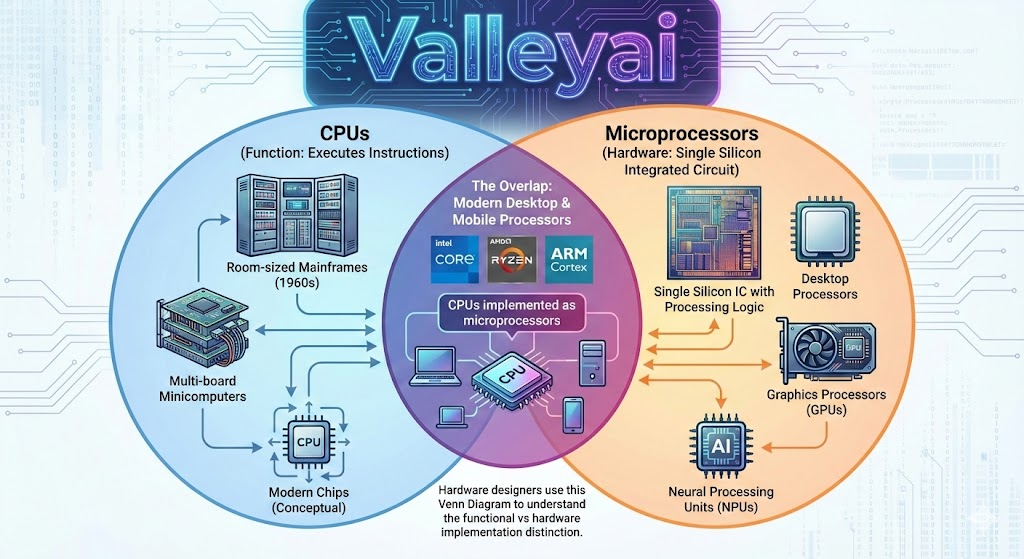
To understand this hardware implementation vs functional role distinction, hardware designers often use a Venn Diagram Comparison:
- Circle A (CPUs): Any system that executes instructions. (Includes modern chips, but also includes 1960s room-sized mainframe processors and multi-board minicomputers).
- Circle B (Microprocessors): Any single silicon integrated circuit containing processing logic. (Includes desktop processors, but also includes graphics processors (GPUs) and specialized neural processing units).
- The Overlap: Modern desktop and mobile processors (Intel Core, AMD Ryzen, ARM Cortex). These are CPUs implemented as microprocessors.
In a documented hardware design workflow for an IoT project, an engineer doesn’t buy a CPU. They buy a Microprocessor or System-on-Chip (SoC) to fulfill the CPU role on their printed circuit board (PCB).
Direct Comparison CPU vs Microprocessor Architecture
This comparison table highlights the conceptual vs physical layer attributes of both terms.
| Feature | Central Processing Unit (CPU) | Microprocessor (MPU) |
|---|---|---|
| Definition Layer | Conceptual / Functional | Physical / Hardware |
| Primary Meaning | The role of executing computing instructions. | A single integrated circuit (IC) made of silicon. |
| Components | ALU, Control Unit, Registers. | Transistors, logic gates, cache memory die layouts. |
| Historical Origin | 1940s (Vacuum tubes and relays). | 1971 (Intel 4004 – The first single-chip MPU). |
| Modern Context | “What does this device do?” | “How is this device physically manufactured?” |
| Form Factor | Historically room-sized; today microscopic. | Always a single semiconductor chip. |
Technical Analysis: Memory, Peripherals, and Architecture
Modern processor architecture dictates how memory and peripherals connect. While microprocessors handle the core logic and arithmetic via RISC or CISC instruction sets, they rely on external RAM and storage, unlike microcontrollers that integrate these into a single chip.
1. Instruction Set Architectures (ISA): RISC vs CISC
Whether a microprocessor utilizes a Complex Instruction Set Computer (CISC) architecture like Intel and AMDs x86, or a Reduced Instruction Set Computer (RISC) architecture like ARM, it is fulfilling the role of the CPU. High-resolution macro photography of die layouts reveals that RISC microprocessors often dedicate less silicon space to instruction decoding, allowing more room for L1/L2 cache compared to CISC designs.
2. Peripheral Integration & Latency
In lab environments, logic analyzer screenshots demonstrating bus communication latency highlight a key hardware reality: microprocessors must communicate with external memory. Because a true microprocessor does not contain massive amounts of internal working RAM, data must travel across the motherboard via the front-side bus (or modern interconnects like PCIe and Infinity Fabric).
3. The SoC Convergence
Today, the line blurs with the System-on-Chip (SoC). An Apple silicon chip (like the M3) is technically an SoC. It contains a microprocessor (serving as the CPU), a GPU, and unified memory all on one package.
Evolutionary Context: How Modern CPUs Became Microprocessors
Historically, a CPU consisted of multiple large circuit boards filling entire rooms. Thanks to Moore’s Law and advancements in semiconductor technology, all CPU functions were eventually miniaturized and placed onto a single integrated circuit, creating the modern microprocessor.
- The Discrete Component Era (Pre-1970): CPUs were massive. A single ALU could take up a whole cabinet of vacuum tubes.
- The Integrated Circuit Revolution: Engineers learned to etch transistors onto silicon wafers.
- The Intel 4004 (1971): Intel released the 4004, successfully shrinking the entire CPU functional block into one physical microprocessor chip.
- Moore’s Law in Action: Over the next 50 years, transistor density doubled roughly every two years, leading to the hyper-powerful multi-core microprocessors we use today.
Frequently Asked Questions (FAQs)
Is every CPU a microprocessor?
No, not every CPU in history is a microprocessor. Early CPUs used in computers like the ENIAC or early IBM mainframes were made of thousands of vacuum tubes or discrete transistors spread across multiple cabinets. However, in modern computing (post-1980s), virtually every CPU you interact with is physically built as a microprocessor.
Why is a CPU called a microprocessor?
A CPU is commonly called a microprocessor today because the functional role of the CPU is physically manufactured as a micro (microscopic transistor scale) processor (instruction execution engine) on a single silicon chip. In consumer technology, the terms have become functionally synonymous.
What is the difference between a microprocessor and a microcontroller?
A microprocessor contains only the core calculating functions of a CPU (ALU, Control Unit, Registers) and requires external RAM, ROM, and I/O ports to function. A microcontroller is an entire computer on a chip; it contains a less powerful CPU, plus memory (RAM/ROM) and I/O peripherals, built specifically for embedded, task-specific applications (like running a microwave or a car’s ABS system).
Can a CPU exist without a microprocessor?
Yes, conceptually and historically. A CPU is a logical architecture. You could theoretically build a fully functioning CPU today using physical relays, breadboards, or Minecraft redstone logic gates. It would be a CPU, but it would not be a microprocessor (since it isn’t on a single semiconductor integrated circuit).
Are all modern CPUs microprocessors?
Yes, all modern consumer and enterprise CPUs (from Intel core desktop processors to ARM smartphone chips) are physically implemented as microprocessors. The miniaturization required for modern computing speed and efficiency demands single-chip IC architectures.

Kaleem
My name is Kaleem and i am a computer science graduate with 5+ years of experience in Computer science, AI, tech, and web innovation. I founded ValleyAI.net to simplify AI, internet, and computer topics also focus on building useful utility tools. My clear, hands-on content is trusted by 5K+ monthly readers worldwide.