
Pick the microphone for the room and the job. A stage vocal microphone struggles in a noisy kitchen, and a studio condenser struggles on a loud stage. Price fixes neither mismatch.
The rule is simple. Match the transducer and the polar pattern to the job. Transducer means the part that turns sound into electricity. Polar pattern means the directions the microphone hears best. Get those two choices right, and the rest becomes fine tuning.
| Job | Transducer | Pattern | Reason |
|---|---|---|---|
| Video calls at a desk | Electret or MEMS headset | Cardioid | Voice stays close and room noise stays low |
| Home recording | Large diaphragm condenser | Cardioid | Detail and quiet sources come through cleanly |
| Loud stage | Dynamic moving coil | Cardioid | High volume causes no distortion and handling stays easy |
| Calls on the move | MEMS array in a phone | Omnidirectional elements | Speech arrives from shifting angles |
Sound becomes electricity: the shared mechanism
Sound travels as rapid pressure changes in air. A microphone diaphragm is a thin surface that moves with those changes. A microphone diaphragm behaves like an eardrum. Air pressure pushes it back and forth, and the microphone turns that motion into a changing electrical signal.
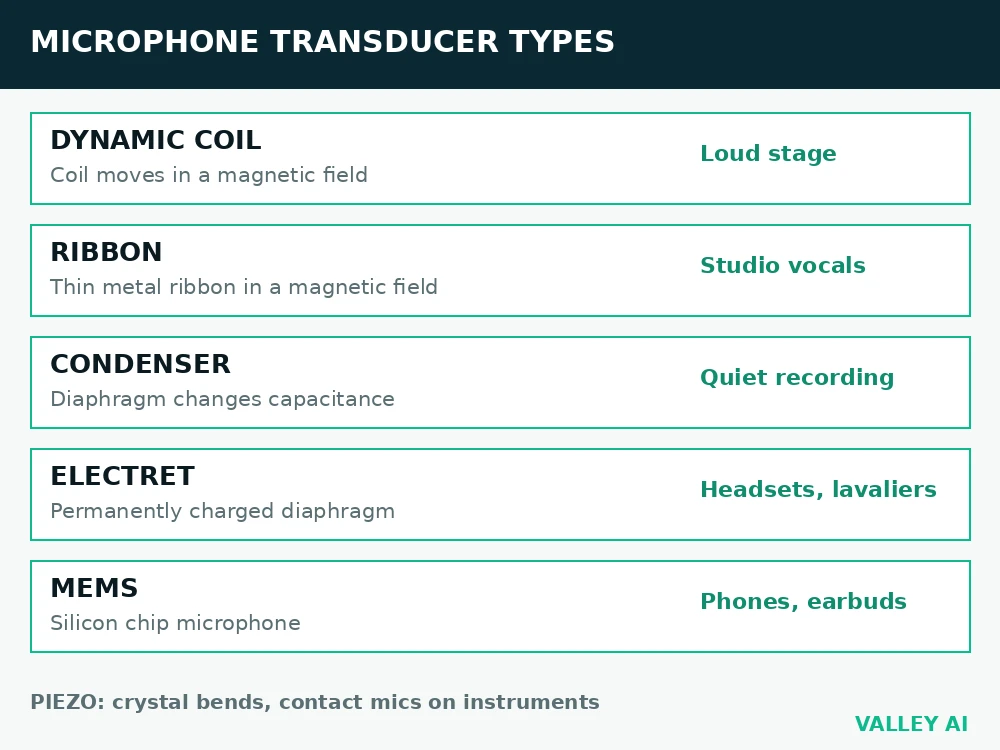
Every microphone type differs in the step that turns motion into signal. One design moves a coil through a magnetic field. Another design changes the spacing inside a capacitor. A third design bends a crystal. A fourth design moves a charged silicon membrane. The result in each case is a small analog voltage that rises and falls with the sound wave.
In a computer setup, a microphone sits among modern computer input devices that turn a physical action into data a computer can use. The capsule produces the signal, a preamp raises it, and an analog to digital converter turns it into numbers. Each later section follows one part of that chain.
Dynamic microphones: coil and ribbon
A moving coil microphone fixes a small coil to the back of its diaphragm and suspends that coil inside a magnetic field. Sound moves the diaphragm, the coil moves with it, and the motion induces a voltage in the coil. The design needs no external power, survives drops and rough handling, and takes very loud sources without distorting.
Britannica describes a microphone as a device that converts sound waves into electrical signals, and the moving coil design is the oldest practical version of that idea. Its page on the microphone gives the basic definition that every later design matches. Stage vocals, drums, and guitar amplifiers are the natural home of the moving coil microphone.
A ribbon microphone swaps the coil for a thin strip of metal suspended in a magnetic field. Air moves the ribbon directly, so the output is low and the pattern is figure eight by nature. Ribbon microphones suit studio vocals and quiet instruments, and they demand a quiet preamp with plenty of gain plus gentle handling.
Piezoelectric designs work differently again. A crystal produces voltage when it bends, which suits contact microphones stuck to an instrument body. Carbon microphones powered early telephones and now survive only as a historical footnote.
Condenser microphones: a capacitor that listens
A condenser microphone builds a capacitor from two plates. The diaphragm is one plate and a fixed backplate is the other. A charge held on those plates stays steady while the diaphragm sits at rest. Sound moves the diaphragm, the gap changes, and the capacitance changes with it. That change becomes the audio signal.
What is phantom power? Phantom power is 48 volts nominal, called P48, sent from an interface or mixer down the same balanced cable that carries the audio back. The microphone uses that voltage to charge its capsule and run its internal electronics. A dynamic microphone wired correctly ignores it.
Large diaphragm condensers capture fine detail and quiet sounds that a dynamic microphone misses. That sensitivity cuts both ways. Room echo, computer fans, and handling noise all enter the recording with the same clarity. A condenser microphone earns its place in a quiet room with the gain set carefully.
MyNewMicrophone compares dynamic and condenser designs head to head, and its verdict matches the physics. Dynamics take punishment and loud sources. Condensers take detail and quiet sources.
Electret and MEMS: the microphones inside your devices
An electret microphone keeps the condenser idea and removes the external charging voltage. Its diaphragm material holds a permanent charge from manufacture, so the capsule needs no polarizing supply. A tiny built in amplifier needs power of its own, and that power arrives as a low voltage through the same jack that carries the audio. Headsets, lavaliers, and low cost microphones use electret capsules.
A MEMS microphone shrinks the whole capsule onto a silicon chip. The diaphragm and the amplifier sit in one small package made with chip fabrication methods. That construction gives consistent performance at very low cost, which is why phones, earbuds, laptops, and smart speakers all carry MEMS microphones. A phone often carries several of them, and processing combines their signals to suppress background noise on calls.
Why does a phone microphone sound thinner than a studio microphone? A phone microphone is a few millimeters wide, so its diaphragm moves a tiny amount of air, and noise processing trims the signal further to keep calls intelligible. A studio condenser diaphragm is centimeters wide and feeds a quiet preamp with no call processing in the way.
Headset microphones often reach the computer over Bluetooth, and the details of how Bluetooth works explain why call audio sounds narrower than music playback. The radio link carries the voice in both directions at once, and the codec switches to a lower quality mode for that two way job.
Polar patterns: where the microphone listens
Polar pattern describes sensitivity by direction. A cardioid microphone hears best from the front and rejects sound from the rear. An omnidirectional microphone hears all directions about equally. A figure eight microphone hears front and back and rejects the sides. The pattern decides how much room enters the recording.
Why does a voice get louder and bassier when you move close to a cardioid microphone? The proximity effect boosts low frequencies as the source gets within a few centimeters of a directional microphone, so distance becomes a tone control. Singers use it on purpose. Podcasters hold a steady distance to keep tone steady.
Pattern choice follows the room. Cardioid suits an untreated room with noise behind the speaker. Omnidirectional suits a roundtable where voices sit on all sides. Figure eight suits two speakers facing each other across one microphone. Some condenser microphones switch patterns with a control on the body, while most low cost microphones stay fixed on cardioid. Cardioid response also widens at low frequencies, so rejection is strongest in the vocal range.

From capsule to file: the signal chain
Capsule output is tiny, measured in millivolts. A preamp raises that voltage toward line level, the standard level that mixers and converters expect. An analog to digital converter then samples the voltage thousands of times per second and stores each sample as a number. Those numbers become the audio file.
Sample rate sets how many samples the converter takes per second. A rate of 44,100 samples per second, the compact disc standard, captures frequencies up to about half that rate. Video work commonly uses 48,000 samples per second. Bit depth sets how finely each sample is measured. Sixteen bit audio gives about 96 decibels of dynamic range, since each bit adds roughly 6 decibels. Twenty four bit audio adds headroom, so a quiet passage and a loud peak can share one take without constant gain riding.
Gain staging ties the chain together. Too little gain leaves a weak signal that hisses when boosted later. Too much gain clips the loudest peaks, and clipping turns smooth waves into flat tops with harsh distortion. Set gain so the loudest peak stays below clipping with room to spare.
A video call pairs the microphone with a camera that turns light into a moving image, and the explanation of how a webcam works covers that camera half. A noisy room hurts the audio half first, because echo and fan noise need no light to reach the microphone.
Reading the spec sheet
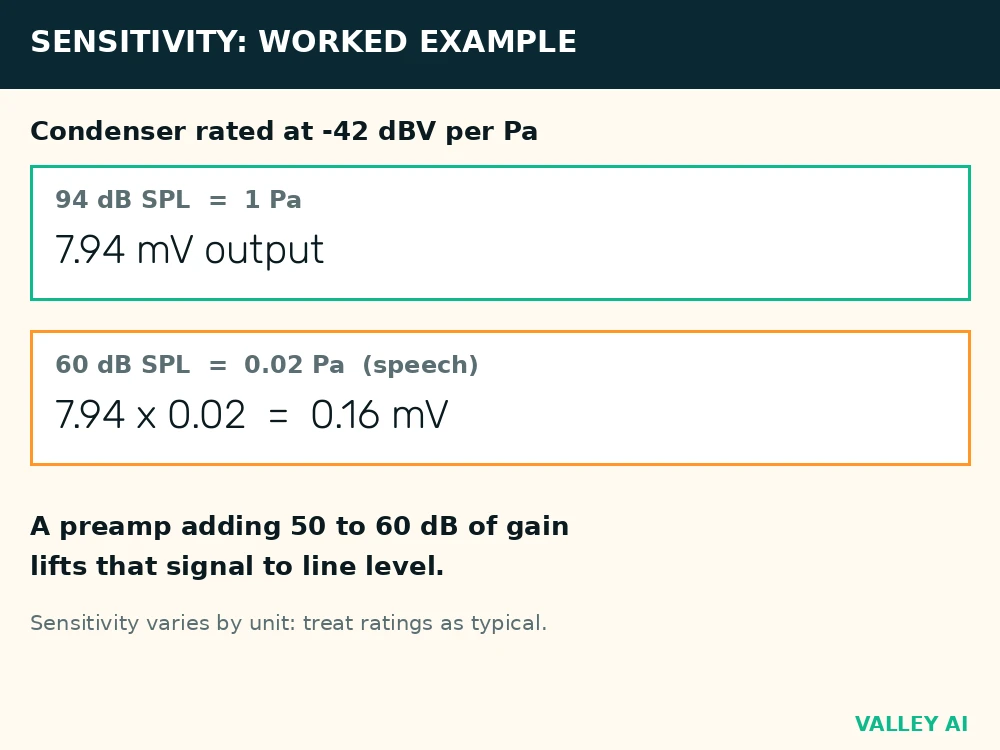
Sensitivity states the output a microphone gives at a fixed loudness. The reference is 1 pascal of pressure, which equals 94 decibels sound pressure level. Ratings use dBV per pascal, and a number closer to zero means a hotter output. A rating of negative 42 dBV per pascal converts to millivolts per pascal with one formula. Divide negative 42 by 20, raise 10 to that power, and multiply by 1,000. The result is 7.94 millivolts per pascal.
Worked example with inputs named. Take a condenser rated at negative 42 dBV per pascal, giving 7.94 millivolts at 94 decibels sound pressure level, which is 1 pascal. Conversational speech near 60 decibels sound pressure level is 0.02 pascals. Multiply 7.94 by 0.02 to get about 0.16 millivolts. A preamp adding roughly 50 to 60 decibels of gain lifts that signal to line level for recording. Published sensitivity figures vary from unit to unit, so treat any rating as a typical figure.
Frequency response plots output against frequency. A flat line means even pickup across the range. A rise in the upper mids adds presence to a voice. A roll off below 100 hertz cuts rumble from desks and handling. Maximum SPL states the loudest sound the microphone takes before distortion passes a stated limit. Self noise states the microphone’s own hiss in A weighted decibels, and a lower number means a quieter microphone. Self noise matters most in quiet rooms, where hiss has nowhere to hide.
Checks you can run without instruments
Four checks reveal more than a spec sheet paragraph. Run them in a normal room with the microphone you already own, and listen on headphones so small changes stay audible.
- Walk around test. Speak steadily while walking slowly around the microphone. Note where your voice fades and where it returns. That map is the polar pattern in action.
- Phantom power check. A condenser microphone that produces nothing may lack power. Confirm the phantom switch on the interface is on and the cable runs XLR end to end.
- Distance test. Record one sentence at 5 centimeters, then 15 centimeters, then 30 centimeters. Compare the three takes for loudness and tone, and pick the distance that suits your voice.
- Room test. Clap once and record ten seconds of silence. Echo in the clap and hiss in the silence show what treatment or gain changes the room needs first.
Conclusion
Buy for your loudest regular job and your noisiest regular room. Order a cardioid dynamic microphone for a loud stage or an untreated room, and a cardioid condenser microphone for a quiet recording room. For calls on the move, pick a MEMS or electret headset. Run the walk around test on the first day, and return a microphone that fails the job it was bought for.
Frequently asked questions
Can a condenser microphone work without phantom power?
Some condenser microphones carry an internal battery compartment or take power over a USB connection, and electret designs run on plug-in power from a jack. A studio condenser with only an XLR output needs phantom power from an interface or mixer, or it produces no signal.
Do I need a separate audio interface for a USB microphone?
A USB microphone holds its own preamp and converter inside the body, so it connects straight to a computer with no extra hardware. An interface becomes necessary when the microphone ends in an XLR connector, since that output needs external gain and conversion.
Why does my microphone pick up keyboard typing?
Typing reaches the microphone through the air and through vibration in a shared desk. A shock mount breaks the desk path, moving the keyboard back weakens the air path, and aiming a cardioid microphone away from the keyboard lowers the pickup further.
Can I use a stage microphone for home recording?
A stage dynamic microphone records at home without trouble, and its lower sensitivity keeps room noise down. Expect less fine detail than a studio condenser gives, and place the microphone closer to the source to compensate for the lower output.
Does a pop filter change how a microphone sounds?
A pop filter blocks the burst of air behind hard consonants, which stops the low thump those bursts cause. A single mesh layer has almost no audible effect on tone, while a dense double layer can soften the highest frequencies slightly.

Kaleem
Kaleem is a Computer Science graduate (Virtual University of Pakistan) and the founder and editor of Valley AI, where he publishes in-depth, tested guides on computer hardware, artificial intelligence, and how the internet works. Every guide is researched from primary sources, tested hands-on where possible, and updated when the facts change.