

Current becomes motion: the moving-coil mechanism
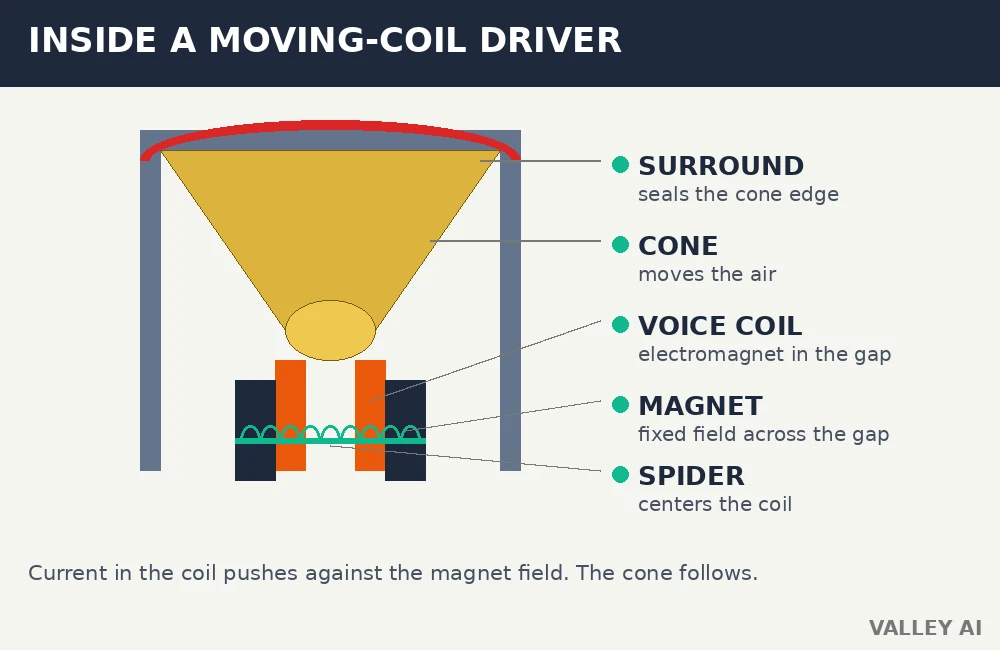
An amplifier sends a changing current into the voice coil, and that current makes the coil act as an electromagnet.
Around the coil, a permanent magnet holds a fixed field across a narrow gap.
As the signal current rises, the coil’s field pushes against the fixed field, and the coil moves forward. When the current reverses, the coil moves back.
Glued to the coil, the cone moves with it. It works like a piston, pushing air forward on one half of the cycle and pulling it back on the other. That pressure pattern reaches the ear as sound.
Why does the driver need a magnet at all? A coil without a fixed field has nothing to push against, so the signal current would heat the wire and move nothing.
A speaker is one of the output devices that turn a computer’s audio signal into sound a listener can hear.
The inverse transducer is the microphone. It turns sound into a signal, while a speaker turns a signal into sound.
Sweetwater describes the voice coil as an electromagnet whose field changes with the signal.
Inside a driver: coil, magnet, cone, spider, surround, basket
Six parts hold the driver in alignment, and a fault in any one of them shows up in the sound.
- Voice coil: copper or aluminum wire wound on a former, hanging in the magnetic gap
- Magnet: usually ferrite or neodymium, fixed to the basket, shaping the field across the gap
- Cone (diaphragm): a light, stiff surface that moves the air, made from paper, polypropylene, aluminum, or composites
- Spider: a corrugated disc behind the cone that centers the coil and pulls it back to rest
- Surround: a flexible ring at the cone edge that seals the front from the back while letting the cone travel
- Basket (frame): a rigid chassis holding every part in alignment
Heat sets the power limit for most drivers.
Cone material changes two properties at once: mass and stiffness. A heavier cone needs more force for the same motion, while a cone that flexes adds its own resonances to the sound.
A coil that rubs the gap wall betrays itself as distortion at low volume. The usual causes are a knock that shifted the coil or debris in the gap.
Why size tracks pitch: driver sizes and frequency ranges
Low notes move a lot of air, and a small surface must travel far to move the same volume.
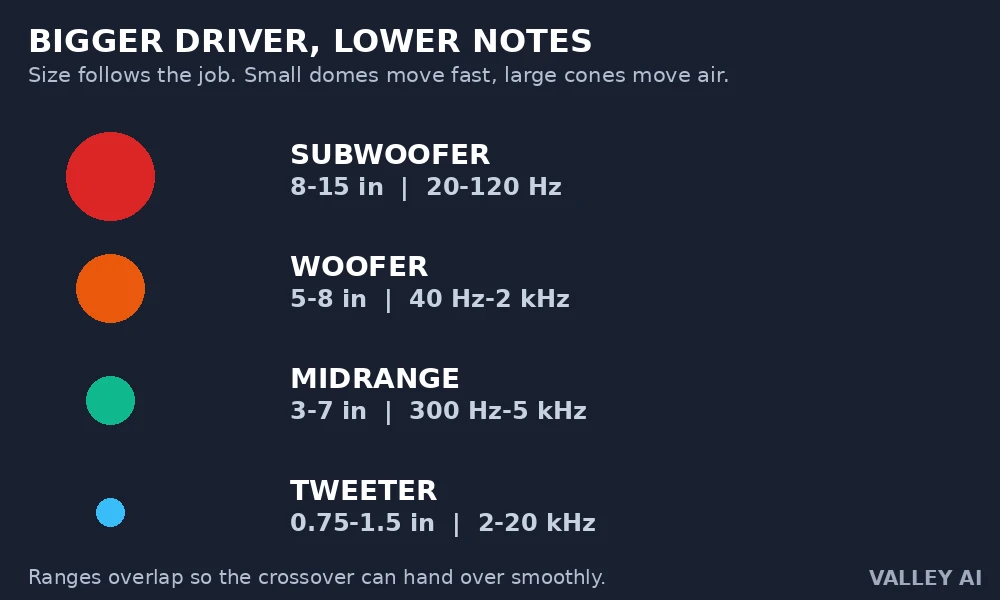
Why can one cone not cover the whole range? A large cone carries the mass and travel that bass needs, and that same mass cannot start and stop fast enough for treble. A small dome starts and stops quickly, and it moves too little air for bass.
The arithmetic shows the mismatch. A 50 Hz note in air at 343 meters per second has a wavelength of 6.86 meters, from 343 divided by 50. A cone far smaller than that wavelength still radiates bass by moving a large volume of air with each stroke.
| Driver type | Typical diameter | Typical range | Job |
|---|---|---|---|
| Subwoofer | 8 to 15 inches | about 20 to 120 Hz | Deep bass in music and film sound |
| Woofer | 5 to 8 inches | about 40 Hz to 2 kHz | Bass and lower midrange in a two-way or three-way box |
| Midrange | 3 to 7 inches | about 300 Hz to 5 kHz | Voices and instruments in a three-way box |
| Tweeter | 0.75 to 1.5 inches (dome) | about 2 kHz to 20 kHz | Treble detail |
Ranges overlap by design. Overlap gives the crossover a band where two drivers share the load, and the crossover decides where each driver takes over.
Crossovers: splitting one signal between drivers
SVS describes a crossover as a set of filters that routes each frequency band to the driver built for it.
A capacitor in series blocks low frequencies, so it forms a high-pass filter for the tweeter. An inductor in series blocks high frequencies, so it forms a low-pass filter for the woofer.
The slope figure gives the rolloff speed past the crossover point, in decibels per octave. First-order filters roll off at 6 dB per octave, second-order at 12, third-order at 18, and fourth-order at 24.
In a typical two-way box, the handover sits near 2 kHz.
Filters shift phase, so drivers near the crossover point can cancel each other if their outputs arrive out of step. Designers offset that shift with the crossover topology and with the physical alignment of the drivers.
A crossover guards the tweeter against bass energy. Bass into a small dome would drive it past its travel limit, and the high-pass filter keeps that energy out.
The box shapes the bass: sealed vs ported
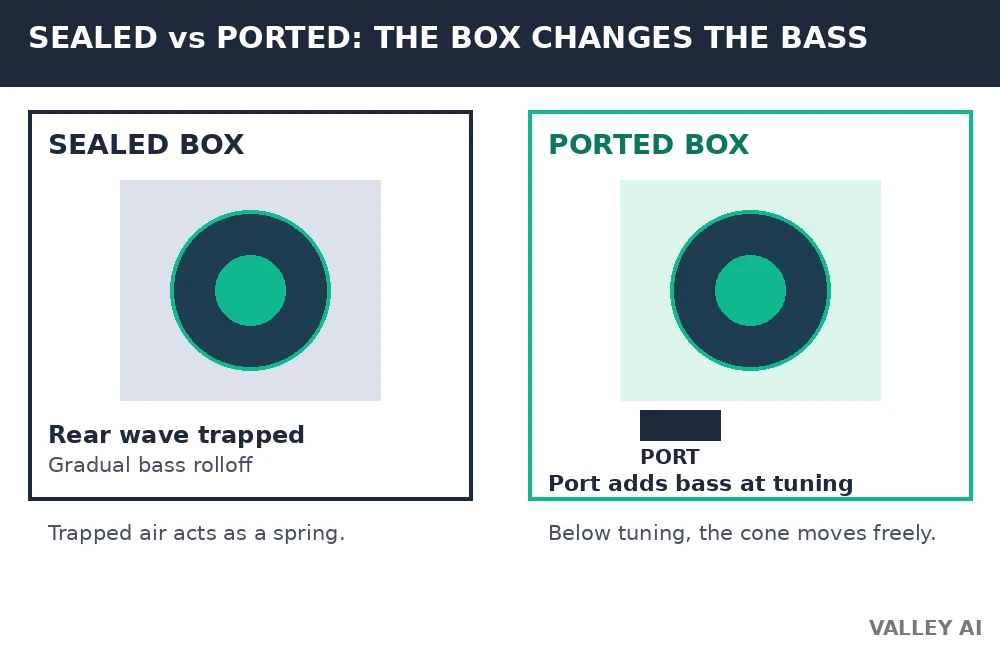
Why does the box change the bass at all? Sound from the back of the cone is out of phase with sound from the front, so an open-backed driver would cancel its own bass. The box traps the rear wave and stops that cancellation.
A sealed box traps the rear wave in a fixed volume of air. The trapped air acts as a spring behind the cone, which tightens the bass and sets a gradual rolloff below resonance.
Ported boxes add a tuned tube that releases the rear wave in phase with the front wave near the tuning frequency. The port output adds to the front output in that band, which extends the bass beyond what the same size sealed box reaches.
Below the tuning frequency, the port stops helping and the cone moves almost freely. Driving the speaker hard in that region can push the cone past its travel limit. A ported box needs a high-pass filter or careful volume control for deep bass.
A rolled towel in the port shows the port at work. Play a bass-heavy passage with the port blocked and listen for the low end thinning out. Pull the towel out. The low end returns.
Matching a speaker to an amplifier and a room
Sensitivity puts a number on loudness per watt: the decibel level one watt produces at one meter.
The arithmetic for a listening seat runs in two steps. Start with 88 dB sensitivity at 1 W at 1 m. Feeding 50 W adds 10 times log10(50), about 17 dB, giving about 105 dB at 1 m. Moving the seat to 3 m subtracts 20 times log10(3), about 9.5 dB, giving about 95.5 dB at the seat.
Impedance is the load the amplifier sees, and most home speakers sit near 8 ohms or 4 ohms nominal. A 4 ohm speaker draws higher current than an 8 ohm speaker at the same voltage. The amplifier must be rated for that load.
Nominal means an average across the range. The real value swings with frequency, dipping near bass resonance.
Power handling is a heat and travel limit, not a loudness rating. A 100 W speaker on a 20 W amplifier plays within its limits, and its loudness still depends on sensitivity and distance.
A brief battery check confirms polarity on a passive speaker. Touch a 1.5 V battery to the terminals for a moment and watch the cone jump. It jumps one way when the leads match the terminal marks and the other way when they are swapped. Keep the contact short, and use this check on a passive speaker only, never on a powered speaker.
The balance control finds a dead driver without instruments. Play a familiar passage, move the balance fully left, then fully right, and listen for a missing band. A silent tweeter leaves the sound dull on one side, while a silent woofer leaves it thin.
Placement changes the bass the listener hears. A speaker near a wall gains bass reinforcement, and a speaker in a corner gains more. Moving the speaker a short distance out from the wall trims that gain.
A wireless speaker receives its audio over Bluetooth, and an internal amplifier then drives the driver.
Conclusion
Pick the box and driver sizes for the room, and confirm the amplifier rating against the speaker load. Run the battery, balance, and port checks before settling the placement.
Those checks take minutes, and they settle questions that spec sheets leave open.
Frequently asked questions
Can I plug a passive speaker straight into a phone or laptop?
No. A headphone output delivers milliwatts, far below the power a passive driver needs to move air. Use a powered speaker with a built-in amplifier, or connect the passive speaker through an amplifier.
Do speaker cables change the sound?
Cable gauge matters only at the extremes. An undersized or overlong run adds resistance that trims power, mainly to low-impedance speakers. A normal 14 or 16 gauge run of room length keeps that loss below audibility, and exotic materials add nothing measurable.
What happens if one speaker in a pair is wired the wrong way round?
The two cones move in opposite directions, and their low frequencies cancel in the room, leaving bass thin while higher notes sound nearly normal. Swapping the leads on one speaker restores the shared motion.
Why does the same speaker sound different in a shop and at home?
Demo rooms use treatment and placement chosen for the display, while a living room adds bare walls, hard floors, and furniture that reflect and absorb unevenly. Matching the home placement to the shop distance from the wall recovers much of the demo sound.

Kaleem
Kaleem is a Computer Science graduate (Virtual University of Pakistan) and the founder and editor of Valley AI, where he publishes in-depth, tested guides on computer hardware, artificial intelligence, and how the internet works. Every guide is researched from primary sources, tested hands-on where possible, and updated when the facts change.