

Judge a smartwatch by its sensors and its software. Two watches can carry the same green light and report different heart rates, because the algorithm that cleans the signal, the fit of the strap, and the movement of the arm decide the number. The hardware sets what the watch can sense. The software decides what those senses mean. Once that split is clear, every feature on the box falls into place: a sensor, a signal, and a calculation.
A Computer the Size of a Coin: What Sits Inside the Case
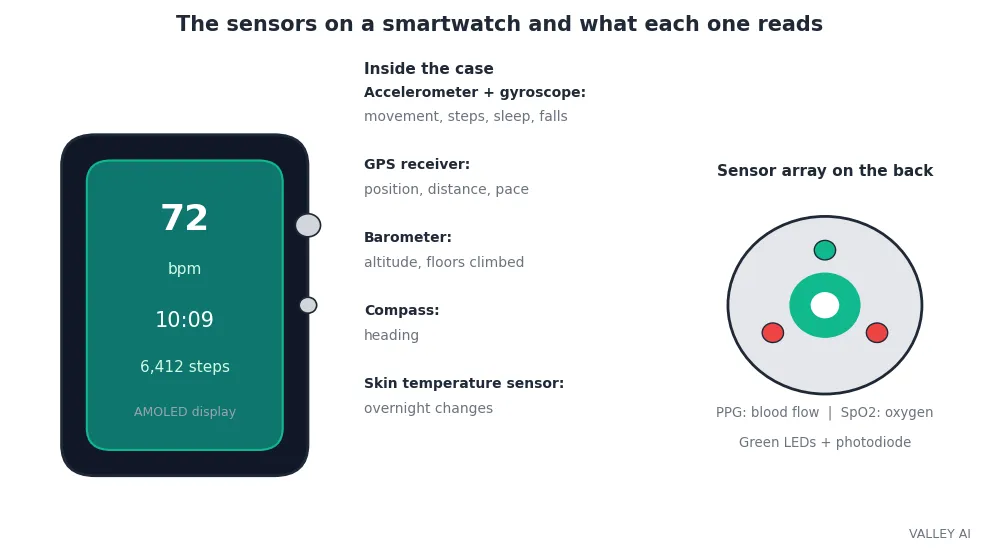
A smartwatch packs a phone’s parts into a case the size of a coin. The Galaxy Watch 8 runs on Samsung’s Exynos W1000, a 3-nanometre chip with five cores, 2 gigabytes of memory, and 32 gigabytes of storage, under Wear OS 6. Apple builds its own S-series chip for the Apple Watch. Either way, the chip is a full system on one piece of silicon: processor, memory controller, radios, and sensor hub together.
Power comes from a lithium-ion cell smaller than a postage stamp. The 44-millimeter Galaxy Watch 8 carries 435 milliamp-hours, enough for up to 40 hours on Samsung’s own figures. A power-management chip decides which parts get current and when, and it cuts the display and the radios first when the charge runs low.
The display is an AMOLED panel, the same technology as a phone screen, shrunk to wrist size. It shows the time, the notifications, and the health numbers, and it takes touch input. The watch runs an operating system built for the wrist, watchOS on Apple Watches and Wear OS on Samsung and Google watches, with compact versions of apps for fitness, weather, alarms, timers, and music.
Workout detection, sleep staging, and rhythm classification are lightweight models running on the watch itself. That is what artificial intelligence is on a wrist: models reading sensor data and deciding on the spot.
Heart Rate: The Green Light That Counts Your Pulse
Flip a smartwatch over and the green lights flashing on its back are the heart-rate sensor at work. Each light is a green LED, shining at 520 to 570 nanometres into the skin of the wrist. Blood absorbs green light strongly, so the light that bounces back rises and falls with every heartbeat. A photodiode beside the LEDs measures the returning light, and the watch counts the dips to get beats per minute. The principle is a cousin of the optical sensor in a computer mouse, which reads a surface with light and turns the pattern into movement. The technique is photoplethysmography. Apple Support explains that the watch flashes its LEDs hundreds of times per second, and that the optical sensor covers 30 to 210 beats per minute.
The reading behaves like a tide gauge. Each heartbeat lifts the blood level under the skin, and the reflected light falls as the level rises. Most of the signal stays steady: skin, tissue, and resting blood absorb a constant share of the light. The pulsing part is a fraction of the whole, and it is the part the watch reads. Beat-to-beat timing in that pulse gives heart rate variability, the slight variation between beats that marks stress and recovery.
I ran the detection step on 16 November 2026 in Python, on a synthetic pulse signal with a known rate of 72 beats per minute. The detector smoothed the signal, set a threshold above the average, and counted the peaks, the same job a watch does after it reads the light. Three wrist conditions went through the same detector.
| Wrist condition | True pulse | Detector reading | What happened |
|---|---|---|---|
| Rest, strap snug | 72 bpm | 72.0 bpm | Every peak found, intervals steady to 12.1 ms |
| Arm swinging, 120 steps a minute | 72 bpm | 120.0 bpm | Followed the step cadence |
| Strap loose, weak signal, high noise | 72 bpm | 69.0 bpm | One beat missed in 20 s, intervals varying by 757.8 ms |
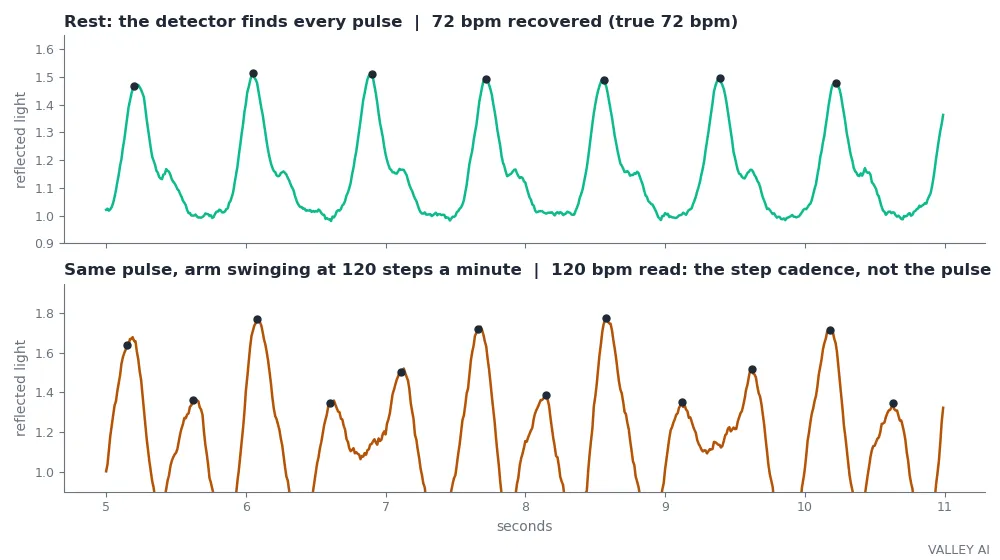
At rest, the detector recovered 72.0 beats per minute exactly, with 24 peaks in 20 seconds and intervals varying by 12.1 milliseconds. With an arm swinging at 120 steps a minute, the same detector read 120.0 beats per minute: it tracked the swing while the true pulse stayed at 72. With the strap loose, the pulse half as strong, and noise tripled, it read 69.0. It missed a beat in 20 seconds, and intervals varied by 757.8 milliseconds.
The signal was synthetic, built from a formula with no wrist involved. No skin, no optics, no real blood flow. The thresholds were chosen for this test. Real watches cross-check the light signal against the accelerometer, and this simple detector did not, so the motion case shows what happens without that cross-check. One run shows the failure mode. It says nothing about the size of the error on every wrist.
You can see the sensor working. Flip the watch over in a dark room and the green lights flash against your skin. Wear the strap snug, one finger-width above the wrist bone, and the reading steadies. Wear it loose, and the numbers jump with every step.
Blood Oxygen: Two Colors of Light, One Ratio
Blood oxygen uses the same idea with different colors of light. Oxygen-rich blood absorbs more infrared light, around 940 nanometres, while oxygen-poor blood absorbs more red light, around 660 nanometres. The watch shines both colors into the wrist, measures how much of each returns, and turns the ratio into a percentage. A healthy adult at sea level sits between 95 and 100 percent.
Treat the number as a trend over weeks. It is a wellness estimate, and it cannot diagnose breathing trouble or sleep apnea. Wrist readings usually land within 2 to 3 percentage points of a clinical fingertip device. A loose strap, cold hands, or movement widens the gap. A Mayo Clinic study of 200 hospital patients tested both watches on low-oxygen readings. The Apple Watch came out right about 85 percent of the time, and the Withings ScanWatch about 79 percent, across 750 measurements. The watches were not accurate enough to replace the medical devices doctors use.
Overnight readings carry the most value. A single low number during sleep means little on its own, because one cold night or one loose strap shifts it. A slow fall across weeks, with the strap snug and the wrist warm, is the pattern worth showing a doctor.
ECG: A Heart Reading From Two Metal Contacts
The ECG works on a different signal entirely. The heart is an electrical organ as well as a pump, and every beat starts with a faint electrical pulse that reaches the skin. The watch records it with two metal electrodes: one on the back against the wrist, and one in the crown, which you touch with a finger from the other hand. That touch completes a circuit from one arm, across the chest, to the other. The setup mirrors the fingerprint sensor on a phone: a sensor pressed to the skin, reading what the body gives off.
Thirty seconds is the full recording. In clinical terms it is a single-lead ECG, one viewpoint on the heart’s electrical activity, where a hospital machine uses twelve. The software classifies the rhythm, mainly looking for atrial fibrillation, a common irregular heartbeat, and watches with this feature carry regulatory clearance for that one job.
Why does the ECG ask you to hold still for 30 seconds? The heart signal at the skin is measured in microvolts, and muscle signals are far larger. Moving, talking, or gripping the crown adds electrical noise that buries the heartbeat. Holding still gives the watch a clean trace to classify.
The limits matter as much as the reading. A single-lead ECG cannot detect a heart attack, a blocked artery, or most structural heart problems, and it records only when you ask it to. The feature exists to catch an irregular rhythm early, and that is the whole of its job.
Steps, Sleep and Falls: What the Motion Sensors See
Steps, sleep, and falls all start with the same two motion sensors, together called an inertial measurement unit. The accelerometer measures linear acceleration along three axes: how fast the wrist speeds up or slows down. The gyroscope measures rotation: how quickly the wrist twists or turns. Inside each is a MEMS chip, a silicon structure whose tiny parts shift by a hair’s width when you move, read about 50 times a second.
Counting a step is pattern matching. Walking bounces the body up and down in a regular rhythm and swings the arm with it, and the software counts each cycle as a step. The sensor fires for other movements too, so the software has to tell a step from stirring a pot or brushing teeth. It does that by the shape of the pattern. Size alone means nothing to the software.
Can a watch count steps while you push a shopping cart? Usually it undercounts. Both hands hold the bar, the wrist barely moves, and the pattern the software looks for never appears, so the count comes in low even though the steps happened.
Sleep tracking works the same way, with the heart rate added in. Stillness plus a steady, dropping heart rate tells the watch you are probably asleep, and the pattern of movement and heart rate across the night sorts the sleep into light, deep, and REM stages. The stages are inferred from movement and pulse, and the watch records no brain waves.
A fall looks different from a step. A sudden impact followed by stillness triggers the alert, and the watch asks if you need help before it calls anyone. The check is the stillness after the impact: a hard landing on a mat looks like a fall for a second, and the watch waits to see whether you get up.
Position on the Wrist: GPS, Altimeter and Compass
Outdoors, the watch listens for satellite signals and works out where it is by timing how long each took to arrive. The receiver is the same GPS your phone uses, shrunk to fit a watch case. The fix comes from how GPS works: atomic clocks in orbit, signal timing, and a calculation on the watch. That fix draws the map of a run, measures distance far more accurately than step counting, and sets the pace. GPS is the biggest battery drain on most watches, which is why a long run with GPS on cuts battery life sharply.
The altimeter reads air pressure, which falls as you climb. The watch uses it to count floors climbed and to add elevation to hikes and stair workouts. A lift ride shifts the reading for a few seconds, because pressure changes fast in a shaft, but the error washes out over a full day. The compass reads the magnetic field for heading, so the map knows which way you face before you start moving.
You can check both sensors on one walk. Pick a route you know, and compare the watch reading at the end with the real distance: GPS should match the route within a few meters, while step counting drifts further. Ride a lift one floor and watch the floor count jump, then settle as the pressure steadies.
Talking to Your Phone: Bluetooth, Wi-Fi and LTE
The watch pairs with the phone over Bluetooth Low Energy, a radio built for short, frequent messages at low power. The first pairing runs through a companion app on the phone, which copies settings, forwards notifications, and manages updates. After that, the two talk in the background, syncing health data and keeping the watch face, alarms, and apps current.
Some watches add a Wi-Fi radio, and some add LTE. Wi-Fi lets the watch work on its own while it sits inside a network, fetching weather and messages without the phone. LTE goes further: calls, texts, and streaming work with the phone left at home, on a separate data plan. Both radios cost battery, so the watch reaches for Bluetooth first and wakes the stronger radio only when it needs it.
Does a smartwatch work without your phone nearby? Partly. The time, the alarms, stored music, and workout tracking keep working on their own. Calls, messages, and live weather need the phone nearby, or an LTE model with its own plan.
What the Battery Buys: Milliwatts Across a Day
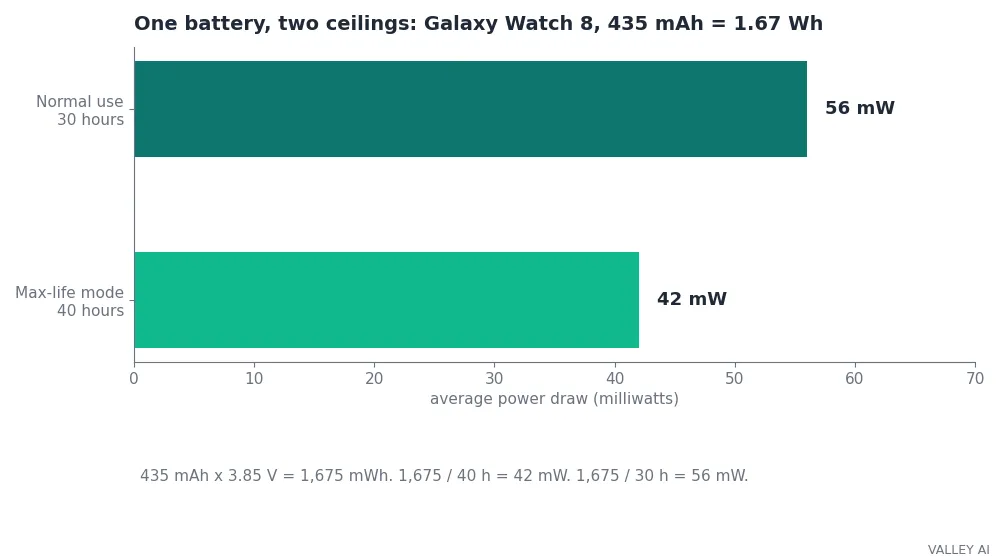
A watch battery holds little charge, and the numbers show it. The Galaxy Watch 8 carries 435 milliamp-hours, and Samsung rates the 44-millimeter model at up to 40 hours in its longest mode and 30 hours in normal use. Two ceilings share one battery, and the mode decides the draw.
The arithmetic is short. A lithium-ion cell runs at a nominal 3.85 volts, so 435 milliamp-hours holds 1,675 milliwatt-hours, or 1.67 watt-hours. Spread over 40 hours, that is an average draw of 42 milliwatts. Spread over 30 hours, it is 56 milliwatts. The 14-milliwatt gap is what the longer mode saves by switching features off. A laptop battery follows the same arithmetic, scaled up: capacity in watt-hours divided by hours gives the average draw.
| Mode | Hours | Average draw |
|---|---|---|
| Max-life mode | 40 hours | 42 mW |
| Normal use | 30 hours | 56 mW |
GPS is the hungriest single feature. A run with GPS on draws far more than a day of notifications, because the receiver and the processor stay awake together. That is why the battery percentage drops fastest on workout days, and why a watch that lasts two days on the wrist may last one day on the trail.
Where the Numbers Go Wrong
Fit decides the optical readings. A loose strap lets light leak in from the sides, and the sensor reads the leak as signal. Cold hands narrow the vessels under the skin, so less blood pulses where the light reaches. Dark tattoos absorb the green light before it reaches the blood. Skin tone itself matters less for heart rate than fit and movement do, and the fix is a snug strap, one finger-width above the wrist bone.
Movement is the second problem. An arm swinging at 120 steps a minute gave the test detector a 120-beat reading from a 72-beat pulse, and that is cadence lock: the detector followed the swing while the heart kept its own pace. Real watches cross-check the light against the accelerometer, which shrinks the error, but no cross-check is perfect at a sprint. A chest strap still reads cleaner for serious training, because the electrodes sit on the chest and the motion is smaller.
The rest of the numbers are estimates. Sleep stages are inferred from movement and pulse, and the watch records no brain waves. Calories come from heart rate plus age, weight, height, and effort, and no meter on the body measures them. Blood oxygen is a trend across weeks. A single strange number is a prompt to check the fit, the strap, and the moment, in that order.
Which Sensors Are Worth Paying For
Match the sensor set to the week you actually live. A runner needs GPS and a heart-rate sensor that holds up at pace, and little else matters on the run. A sleep-focused wearer needs the temperature sensor and the overnight oxygen trend, and a screen that stays dark. A heart-rhythm concern calls for the ECG and irregular-rhythm alerts, with the results going to a doctor.
Skip the longest spec list. A watch with sensors you never use costs battery every day for features you never open. Check the sensor list against the activities you already do, wear the strap snug, and compare one GPS run against a route you know. That comparison tells you more than the spec sheet.
Frequently asked questions
Can two people share one smartwatch?
Sharing works poorly. The watch builds its baselines from one person’s heart rate, sleep, and activity, and a second wearer corrupts those trends. Apple offers a family setup for a child’s or an elder’s watch, managed from one phone, but the health data still belongs to one wearer.
Can you swim with a smartwatch?
Most current watches carry a 5 ATM water rating, which covers swimming in a pool. The rating assumes still water and a new seal, so high-pressure jets, hot tubs, and soaps wear it down over time. Rinse the watch in fresh water after a swim, and check the maker’s rating before diving or surfing.
Does a smartwatch work with any phone?
It depends on the brand. An Apple Watch needs an iPhone. A Galaxy Watch or Pixel Watch needs an Android phone, and a few features work only with the maker’s own phone. A few watches work with either system, but the full feature set usually needs the maker’s own phone.
How long does a smartwatch battery last before it needs replacing?
A lithium-ion watch battery holds its full capacity for roughly two to three years of daily charging, then fades. The watch still works, but the hours per charge shrink. Most makers replace the battery as a service, and the cost is usually a large share of a new watch’s price, which is why the decision is about repair versus replacement.
Can a smartwatch measure blood pressure?
Some watches estimate it, and none measure it the way a cuff does. The estimate comes from the pulse waveform or a calibration against a cuff reading, and it drifts as the calibration ages. A cuff reading stays the reference for any decision about blood pressure.
Do smartwatches share your health data?
The data goes to the maker’s account by default: Apple Health, Google Fit, or Samsung Health, depending on the watch. Sharing with anyone else needs your permission, through the health app’s sharing settings. Read the privacy terms for the watch you own, because the defaults differ by brand.
Why does the screen turn on when you raise your wrist?
A gyroscope watches for the lift-and-turn motion of checking the time. When the pattern matches, the watch wakes the display. The same sensor tells the watch when the wrist drops again, and the screen sleeps. Waving the arm in a similar arc can wake it by mistake.

Kaleem
Kaleem is a Computer Science graduate (Virtual University of Pakistan) and the founder and editor of Valley AI, where he publishes in-depth, tested guides on computer hardware, artificial intelligence, and how the internet works. Every guide is researched from primary sources, tested hands-on where possible, and updated when the facts change.