
A headset is a speaker and a microphone sharing one link.
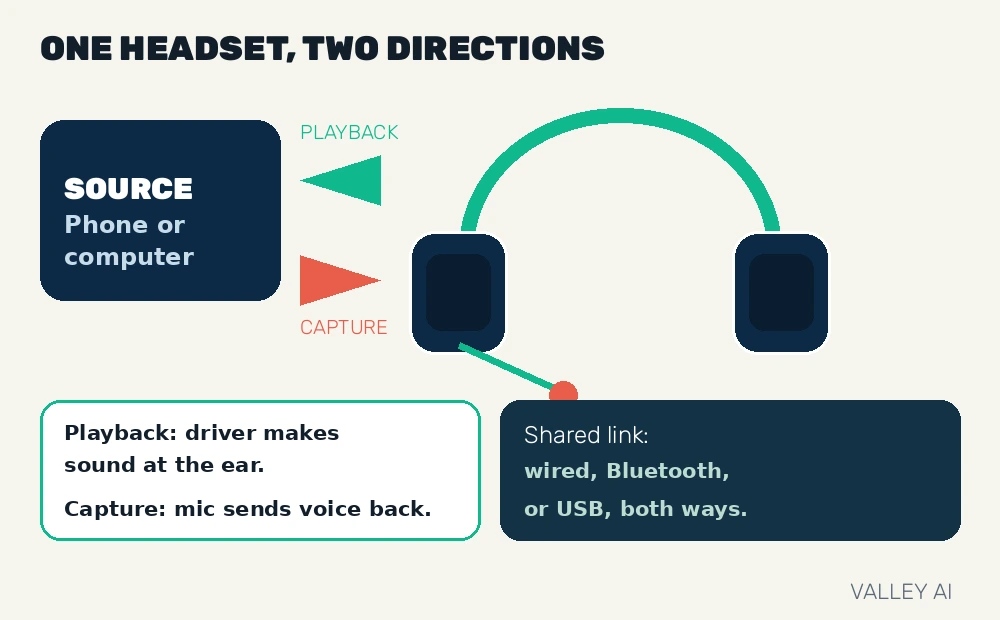
Sound travels one way into the ear. Voice travels the other way out of it. One cable or one wireless link carries both directions. That two-way job sets every design choice that follows.
The two-way rule decides the purchase
Every headset carries two signal paths at once. Playback runs from the source device to the earcup driver. Capture runs from the microphone back to the source device. Other output devices play sound only, so a headset needs a second path that they do not need.
| Link | Signal path | Main limit |
|---|---|---|
| Wired 3.5 mm | Analog audio over a TRRS plug | A jack is present on fewer new phones |
| Bluetooth | Coded digital audio over a wireless link | Call mode lowers music quality |
| USB | Digital audio to a converter in the headset | A free USB port is required |
Wired suits a desk. Bluetooth suits moving between rooms. USB suits a computer.
How the earcup driver turns signal into sound
A dynamic driver works from a coil, a diaphragm, and a magnet. Current in the coil changes with the audio signal. The changing current moves the coil inside the magnetic field. The coil pushes the diaphragm. Air pressure waves leave the diaphragm and reach the ear.
Most consumer headsets use dynamic drivers, with over-ear cups often near 40 mm in diameter. Larger diaphragms move more air at low frequencies. Size sets a ceiling on air movement. It does not set sound quality on its own.
Calculation 1. Inputs are 40 mm and 50 mm drivers. Radii are 20 mm and 25 mm. Area follows pi times radius squared. The areas are about 1,257 and 1,963 square mm. Dividing 1,963 by 1,257 gives about 1.56. The larger diaphragm covers roughly 56 percent more area.
Balanced armature drivers use a different mechanism. A small reed sits between two magnets. Current in a coil around the reed makes the reed vibrate. A rod links the reed to a tiny diaphragm. Each armature is tuned to a narrow frequency band. Speaker drivers split frequencies with a crossover network, while a headset with armatures assigns each band to its own tuned unit. Some headsets pair a dynamic driver for bass with armatures for higher bands.
Planar magnetic drivers form a third type. A thin diaphragm carries a printed conductor pattern. Magnets on both sides drive the whole surface at once. Planar designs appear in fewer headsets. They often ask for more amplifier power than dynamic drivers of similar size.
Compare two headsets at the same phone volume setting before judging bass. A louder headset can sound fuller for volume reasons alone. Matching the volume keeps the comparison tied to the driver and the fit.
How the microphone turns voice into signal
Headset microphones use two main builds. MEMS microphones are tiny silicon units soldered onto a circuit board. Electret condenser microphones use a charged diaphragm facing a back plate. Both turn air pressure into an electrical signal. Both send that signal back over the shared link.
Placement shapes what the microphone hears. A boom arm holds the microphone close to the mouth. Voice level falls fast as distance grows. A boom keeps voice loud relative to sound from farther away. Headsets without a boom rely more on processing.
Beamforming arrays add a second or third microphone and compare timing. Sound from the mouth reaches each microphone at a slightly different moment. Sound from the side reaches them in a different pattern. Processing favors the mouth pattern and weakens the rest. Microphone capture follows the same pressure-to-signal principle, with the headset adding placement and array processing for calls.
What makes a headset mic pick up less room noise than a phone mic?
Distance and direction do most of the work. A boom microphone sits centimeters from the mouth, so voice arrives far louder than sound from across a room. Array processing then favors that direction. A phone microphone sits farther away and hears voice and room sound at closer levels.
Record a short voice memo in a noisy room before keeping a headset. Speak at a normal level. Play the memo back and judge voice clarity against background sound. A foam cover over a boom microphone cuts wind bursts outdoors.
How ANC cancels noise before it reaches the ear
Passive isolation comes first and needs no electronics. A sealed earcup blocks sound physically. Sealed cups block higher frequencies well. Low-frequency drone passes through a seal with little loss. ANC exists for the sound that the seal lets through.
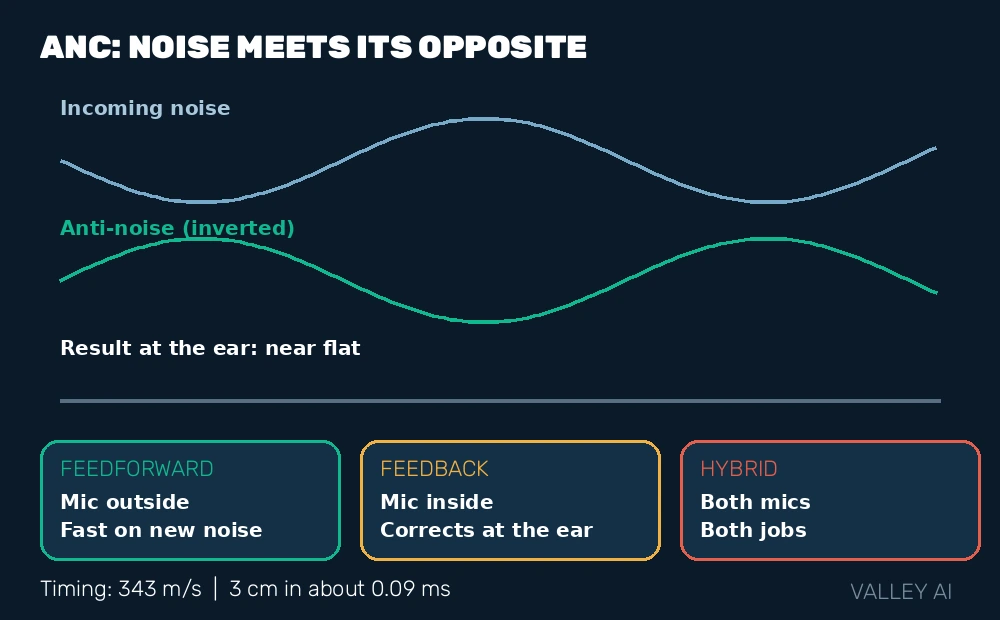
ANC builds an inverted copy of incoming noise and plays it at the ear. The inverted wave meets the original wave the way a negative number meets its positive match, and the sum drops toward zero. Engineers call the effect destructive interference. It works best on steady, repeating sound, such as an engine drone or traffic hum.
Feedforward ANC reads noise with a microphone outside the cup. Feedback ANC reads the result with a microphone inside the cup, close to the ear. Hybrid ANC uses both microphones at once. The outside microphone reacts fast to new noise. The inside microphone corrects what remains at the ear.
Calculation 2. Inputs are a sound speed of about 343 meters per second at near 20 degrees Celsius and an earcup distance of 3 centimeters. Dividing 0.03 meters by 343 gives about 0.000087 seconds, or about 0.09 milliseconds. The ANC loop must sense, invert, and play its anti-noise inside a window far shorter than 1 millisecond. FreeCodeCamp describes the same inverted-wave principle in its explainer on how noise-cancelling headphones work.
Why does ANC quiet an engine drone but leave a voice partly audible?
Steady sound gives the loop a predictable pattern to invert. A voice changes pitch and level many times per second, so the loop cannot predict each change. Sudden sounds pass before the loop can build a matching copy. ANC trims voices, it rarely erases them.
Transparency mode reverses the goal for a moment. Outside microphones feed surrounding sound back into the earcup on purpose. Announcements and traffic become audible without removing the headset. Switch ANC on and off beside a steady fan to hear the difference directly.
How the link carries both directions
Bluetooth sends audio as coded digital data. A codec packs the audio for the wireless link. SBC ships on nearly every Bluetooth device as the baseline codec. AAC suits Apple devices. LDAC carries a higher bitrate than SBC on supported Android devices. Two ceilings apply: a strong driver cannot recover detail a low-bitrate codec already dropped, and a high-bitrate codec cannot push a small driver past its own limits.
Latency comes from coding, transmission, and buffering together. Video lip sync suffers when delay grows past roughly 100 milliseconds on many headsets, with exact figures varying by codec and device. Low-delay codecs cut the coding part of that delay. Wired links skip coding entirely.
Why does music sound thinner during a phone call on the same Bluetooth headset?
Calculation 3. Inputs are a music profile at 48,000 samples per second in stereo and a hands-free call profile at 16,000 samples per second in mono. Music carries 2 times 48,000, or 96,000 samples per second. A call carries 16,000 samples per second. Dividing 96,000 by 16,000 gives 6 to 1. The call profile must carry voice and microphone audio in both directions over one narrow link, so music quality drops while the call runs. Exact rates vary by headset and phone.
Wired headsets split the same job across plug contacts. A TRRS plug carries left audio, right audio, microphone, and ground on four contacts. One plug serves both directions with no coding and no battery. USB headsets send digital audio to a converter inside the headset or the adapter. The converter turns digital data into analog sound at the earcup.
Play one song, then start a call without changing the volume. Music quality shifts the moment the call profile takes over.
Power, fit, and the checks you can run
Battery power runs the wireless radio, the DSP, and ANC together. A passive wired headset draws no battery power for basic playback. Bluetooth and ANC stop when the battery runs out. ANC use and high volume shorten run time.
Sidetone feeds a small amount of microphone signal back into the earcup. Hearing a little of your own voice keeps speech at a normal level. Without sidetone, sealed cups make voices sound muffled to the speaker, and speakers tend to talk louder.
Impedance and sensitivity describe how loud a headset plays from a given source. Impedance, measured in ohms, describes resistance to the audio signal. Higher impedance asks for more voltage to reach the same loudness. Sensitivity, measured in decibels per milliwatt, describes loudness per unit of power.
- Seal check: press each cup gently toward the ear and listen for bass rising as the seal closes.
- Microphone check: record a voice memo at normal speaking level and play it back.
- ANC check: switch ANC on and off beside a steady hum and compare the same sound.
- Link check: start a call during music playback and listen for the profile shift.
EDN Asia explains balanced armature use in ANC earphones in its piece on creating ANC earphones with balanced armatures. Dyson Canada covers the ANC principle from the listener side in its explainer on how noise-cancelling headphones work.
Picking one without overpaying
Start from the main daily job. All-day calls favor a boom microphone and hybrid ANC, because voice clarity and steady drone control matter most across long calls. Commuting favors Bluetooth with hybrid ANC and a secure fit. Desk work favors USB, because the port is fixed and the converter choice stays consistent.
Pay for ANC when steady low-frequency noise fills the day. Skip ANC when calls happen in a quiet room and the budget is tight. Pay for a higher-bitrate codec when the phone supports it and music matters. Skip codec chasing when the main use is voice calls, since the call profile sets quality during calls.
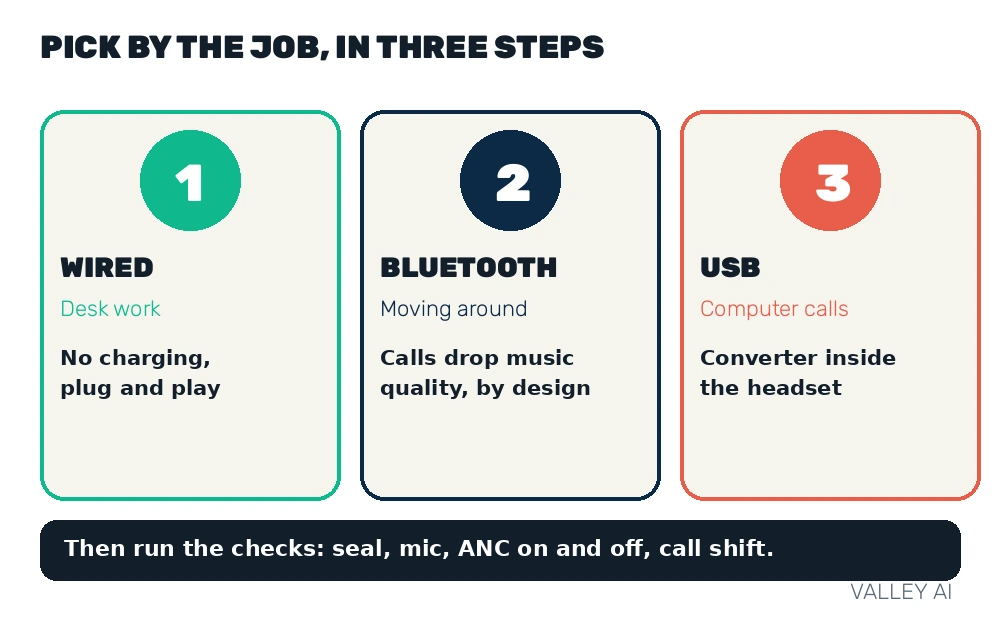
Run the four checks above inside the return window. Test the seal, the microphone, ANC on and off, and the call profile shift. Keep the headset that passes the checks for the main daily job.
Frequently asked questions
Can one headset stay connected to a phone and a laptop at the same time?
Multipoint pairing allows some Bluetooth headsets to hold two connections at once. Audio plays from one device at a time.
Why does one earcup sometimes go quiet while the other keeps playing?
A loose cable, a worn plug contact, or a balance setting shifted to one side causes most single-earcup faults. Try a different cable or port first, then check the balance slider.
Does ANC count as hearing protection?
ANC lowers perceived noise, but it is not rated hearing protection. Hearing protection carries a tested noise reduction rating for loud workplaces. Use rated ear protection around loud machinery.
Why do some phones need an adapter for a wired headset?
Some phones dropped the 3.5 mm jack entirely, so a wired headset needs a USB-C or Lightning adapter with a converter inside.
How do you keep ear cushions in good shape?
Wipe cushions with a dry cloth after use and keep them away from heat and direct sun. Replace cushions when the surface cracks, flattens, or stops sealing around the ear.
What causes a faint hiss when ANC is switched on?
The hiss comes from the ANC circuit itself, including microphone and amplifier noise that becomes audible in a quiet room. A faint hiss in silence is normal on many designs. Loud hiss or crackling points to a fault.

Kaleem
Kaleem is a Computer Science graduate (Virtual University of Pakistan) and the founder and editor of Valley AI, where he publishes in-depth, tested guides on computer hardware, artificial intelligence, and how the internet works. Every guide is researched from primary sources, tested hands-on where possible, and updated when the facts change.