
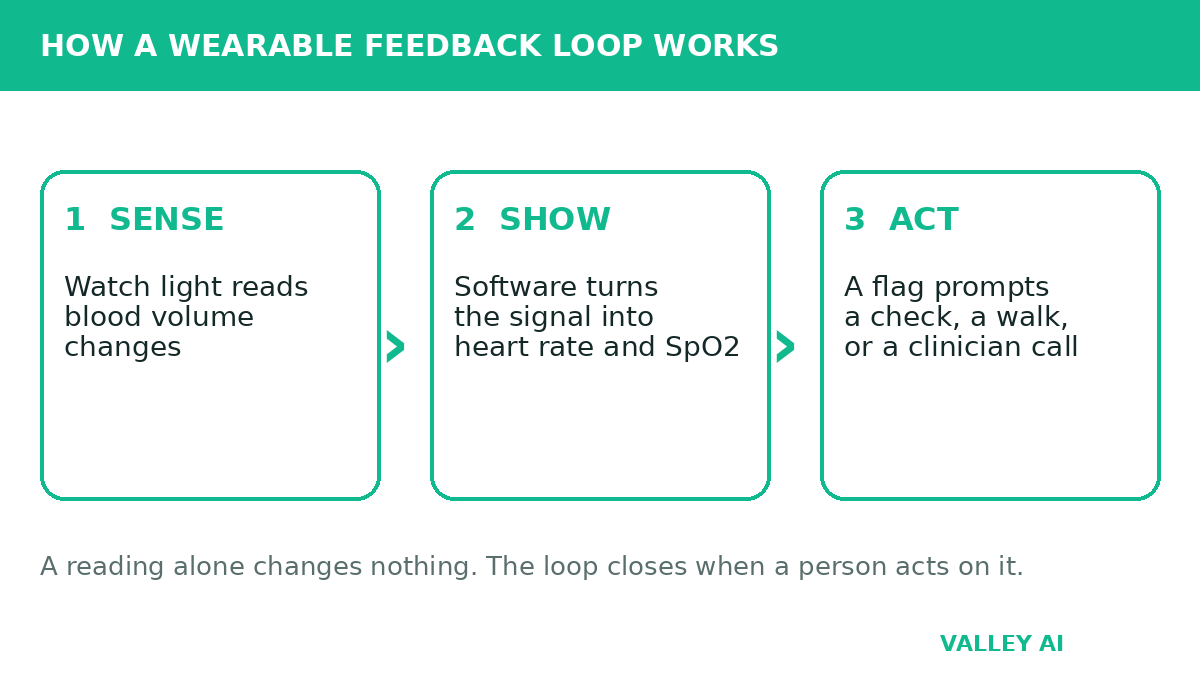
Technology has positively affected wellness by expanding access to care through telemedicine, enabling continuous self-monitoring via wearables, and reducing mental health stigma via apps. The gain sits in a loop that repeats every day. A sensor measures. Software turns the reading into a pattern. A person or a clinician acts on that pattern.
How has the development of technology positively affected our wellness?
Wellness technology covers four working systems. Sensors measure the body. Remote visits remove travel from care. Software supports mental health between sessions. AI tools flag patterns in medical scans. Trackers and fitness apps changed daily movement patterns after step counts became visible on a phone screen.
1. The Quantified Self: Physical Health and Wearable Tech
The most visible manifestation of well-being advancements is the rise of the Quantified Self. Gone are the days when health was a black box only deciphered during an annual checkup. Today, wearable devices and IoT health devices provide a continuous stream of biomarkers.
How do wearable devices contribute to well-being?
Wearable devices contribute to well-being by creating a feedback loop that encourages behavioral change. When a user sees their heart rate variability (HRV) drop or their sleep quality decline, they can make immediate lifestyle corrections. This technology impacts physical health through:
- Activity and Metabolic Tracking: Devices like the Apple Watch, Whoop, and Oura Ring track metrics far beyond step counting. They monitor blood oxygen saturation (SpO2), respiratory rate, and skin temperature, alerting users to potential illnesses often before symptoms appear.
- Chronic Disease Management: For diabetics, Continuous Glucose Monitors (CGMs) have revolutionized life. These devices send real-time blood sugar readings to health monitoring apps, eliminating the need for painful finger pricks and helping prevent dangerous hypoglycemic events.
- Cardiac Health: Modern smartwatches utilize photoplethysmography (PPG) and electrical sensors to detect Atrial Fibrillation (AFib), a major cause of stroke, alerting users to seek medical attention immediately.
A wrist sensor measures heart rate with light. A green LED shines into the skin, and a photodetector reads how much light blood absorbs with each pulse. Software converts that pulsing signal into beats per minute, and a second reading gives blood oxygen as a percentage, called SpO2. A reading of 72 beats per minute means 72 pulses counted in one minute. A SpO2 reading of 97 percent means 97 percent of the measured hemoglobin carries oxygen. Researchers call phone and watch signals of this kind digital biomarkers: sleep length, resting heart rate, typing speed, and movement patterns studied as early signs of a change in health. A watch flag for an irregular rhythm is a prompt for a clinical ECG check. It does not diagnose a heart condition on its own.
How does technology improve physical health? It shifts the focus from guessing to knowing. Fitness apps like Strava or Peloton use game elements and social groups to keep exercise routines going.
2. The Mental Health Revolution: Accessibility and Anonymity
Perhaps no sector has benefited more from digital transformation than mental healthcare. Technology has lowered the barrier to entry, offering privacy and immediacy that traditional therapy often lacks.
What are the benefits of technology in mental health?
Technology benefits mental health through immediacy, anonymity, and lower cost. Platforms like BetterHelp cut barriers to licensed care, while CBT-based apps deliver daily coping tools.
- Democratized Access: Online therapy platforms like BetterHelp and Talkspace connect users with licensed professionals via video, text, or voice, often at a lower cost than in-person visits.
- Self-Management Tools: Mindfulness apps such as Headspace offer guided meditation, and sleep apps such as Calm offer sleep stories and breathing exercises. Separate CBT-based apps deliver structured thought exercises for anxiety and stress, based on cognitive behavioral therapy principles.
- AI Companions: AI-driven chatbots like Wysa and Woebot offer immediate “triage” support. While they do not replace human therapists, they provide coping tools at 2:00 AM when human support is unavailable.
What are some examples of health and wellness apps?
- Mindfulness: Insight Timer, Headspace.
- CBT & Therapy: Sanvello, BetterHelp.
- Sleep Hygiene: Sleep Cycle, Calm.
3. Breaking Barriers: Accessibility and Telemedicine
Geography is no longer a determinant of the quality of care one receives. Telemedicine has bridged the rural-urban divide, ensuring that specialized care is available to populations that were previously underserved.
How has technology made healthcare more accessible?
It has decoupled healthcare from physical infrastructure. Through remote care services, patients can consult specialists hundreds of miles away without the burden of travel.
- Virtual Consultations: Routine check-ups, prescription refills, and dermatology assessments can be handled via video calls, reducing wait times and hospital overcrowding. Those calls carry health data, so clinics must protect health data in transit and in storage.
- Remote Patient Monitoring (RPM): Elderly patients or those with heart conditions can use connected blood pressure cuffs and scales that automatically send data to their doctors. This allows physicians to intervene remotely if metrics trend in a dangerous direction, preventing hospital readmissions.
- Health Literacy: The internet has democratized medical knowledge. While misinformation is a risk, access to verified medical journals and reputable health portals empowers patients to advocate for their own care.
Remote monitoring follows a fixed path. A cuff or scale takes a reading, a phone app forwards it, and a clinician dashboard shows the trend. An alert fires only when a reading crosses a threshold the care team set in advance. That threshold is the difference between monitoring and noise: without it, a dashboard becomes a list of numbers nobody watches.
| Care Type | In-Person | Telemedicine |
| Consult | Travel required | Video, no travel |
| Monitoring | Periodic | Continuous RPM |
| Cost | Higher | Reduced overhead |
4. Preventive and Predictive Healthcare: The Role of AI
Care is shifting from Sick Care to true Health Care, driven largely by AI in healthcare. Artificial Intelligence processes vast datasets to surface patterns that are hard to spot across thousands of cases.
Can technology help with preventing diseases?
Yes, within limits. Preventive healthcare technology uses predictive analytics to flag risk based on genetic, lifestyle, and environmental data, and a clinician still decides what the flag means.
- Early Diagnostics: AI tools in radiology flag possible early signs of cancer in mammograms and CT scans for a radiologist to review, which can shorten the time from scan to follow-up.
- Genomic Medicine: Affordable DNA sequencing and analysis allow individuals to understand their genetic predispositions to conditions like Alzheimer’s or BRCA-related cancers, enabling them to take preemptive lifestyle or medical actions.
- Predictive Analytics: Hospitals use AI to predict patient deterioration (such as sepsis) hours before clinical signs are obvious, allowing for life-saving early intervention.
Hospitals apply AI in healthcare beyond imaging, to triage queues, scheduling, and record summaries.
Which wellness tool fits which need
Wellness tools belong to a wider set of types of technology, and each tool fits a different need. Pick the need first, then the tool. A tracker bought for sleep will not serve a diabetes routine, and a therapy app will not replace a specialist visit.
| Need | Tool type | What it sends | Limit to check |
| Daily activity | Fitness tracker | Steps, heart rate, sleep | Accuracy falls during fast wrist movement |
| Diabetes management | Continuous glucose monitor | Glucose every 5 minutes | Interstitial lag behind blood glucose |
| Specialist access from home | Telemedicine visit | Video consult, prescriptions | No physical exam in the visit |
| Support between therapy sessions | Digital mental-health tool | Exercises, mood logs, messages | Not a substitute for a licensed therapist |
| Safe living at home | Fall sensor, medication dispenser | Alerts to a family member or care team | Alerts depend on connectivity and battery |
A worked calculation: what continuous monitoring adds
A continuous glucose monitor in the Dexcom G7 class samples every 5 minutes. That sampling rate is the input to a simple calculation, run on 5 November 2026. One day holds 24 times 60 minutes, which is 1,440 minutes. Dividing 1,440 by 5 gives 288 readings a day. Over a week, 288 times 7 gives 2,016 readings. A comparison routine of 4 finger-prick checks a day gives 28 checks a week. The ratio is 2,016 divided by 28, which is 72 to 1. That ratio measures data volume only. A monitor reads glucose in interstitial fluid, which lags blood glucose by several minutes, so a fast fall still needs a blood check. The calculation shows why continuous data changes care: a clinician sees a curve across the night, where a finger-prick routine sees four points in a day.
5. Beyond the Basics: Niche and Emerging Wellness Tech
While apps and wearables are mainstream, technology is positively affecting wellness in specific, high-impact niches that are often overlooked.
VR for Wellness and Pain Management
VR for wellness is moving beyond gaming. Virtual Reality is effectively used for:
- Pain Management: VR immerses patients in soothing environments, distracting the brain from pain signals. It is used for burn victims and chronic pain management as a non-opioid alternative.
- Exposure Therapy: VR provides a safe, controlled environment for treating PTSD and phobias, allowing patients to confront triggers gradually.
Environmental Wellness and Smart Homes
Our immediate environment dictates our health. Smart home technology contributes to environmental wellness through:
- Air Quality Monitoring: Smart purifiers detect and eliminate allergens and VOCs (Volatile Organic Compounds).
- Circadian Lighting: Smart lighting systems adjust color temperature throughout the day to match natural sunlight, regulating the body’s melatonin production for better sleep.
Assistive Tech for the Aging Population
Technology empowers the elderly to age in place safely. Fall detection sensors, automated medication dispensers, and voice-activated assistants (like Alexa or Google Home) reduce isolation and ensure safety without intrusive 24/7 human monitoring.
6. A Framework for Digital Wellness: The 3 A’s
To truly understand how has the development of technology positively affected our wellness, we can view it through a strategic framework. Technology improves health through the 3 A’s:
- Awareness: Data turns invisible biological processes (heart rate, sleep cycles, glucose levels) into visible, actionable insights.
- Access: Digital platforms remove geographic, financial, and social barriers to professional care and medical information.
- Action: Gamification, push notifications, and automated systems nudge users toward healthier behaviors and adherence to treatment plans.
7. The Future of Technology in Wellness
As we look forward, the integration of technology and biology will keep moving from worn devices toward devices inside the body. What is the future of technology in wellness?
- Digital Twins: We will likely have a virtual “copy” of our physiology. Research teams are building virtual copies of a patient physiology to test drugs or lifestyle changes in simulation before a real trial, which could lead to more personalized health solutions if the models prove reliable.
- Implantables: Biosensors placed under the skin will provide clinical-grade data continuously, eliminating the need to remember to wear a watch or charge a device.
- Emotion AI: Research prototypes try to read emotion from voice and facial signals, with the aim of offering timely mental-health prompts. Emotion reading from a voice alone remains unreliable, so any prompt from such a tool needs a human check.
The current AI boom across industries shapes which wellness tools reach clinics first, since hospital buyers follow deployments that already work at scale.
Frequently asked questions
Do I need a subscription to use a wearable’s health features?
Basic step counts and heart-rate readings usually work without a paid plan, while sleep analysis, readiness scores, and long trend histories often sit behind a subscription. Check the free tier on the maker’s own feature list before buying, since the subscription cost can exceed the device price over two years.
Why do two devices show different heart-rate readings?
Wrist sensors read light through skin, and skin tone, fit, tattoo ink, and arm movement all change the signal. Two devices sample at different rates and smooth the result differently, so a gap of a few beats per minute during exercise is normal. A resting reading taken while still gives the closest comparison between devices.
Can a telemedicine visit handle an emergency?
A video visit cannot handle chest pain, heavy bleeding, breathing difficulty, or stroke signs. Those symptoms need emergency services at once, since a video call provides no physical exam, no oxygen, and no immediate treatment. Telemedicine fits routine follow-ups, prescription reviews, and stable conditions that a clinician has already assessed.
Is a continuous glucose monitor useful for someone without diabetes?
A monitor without diabetes shows glucose curves after meals and overnight, which can inform food and exercise choices. It does not diagnose diabetes, and a single high reading after a meal is not a diagnosis. Anyone acting on monitor data for a medical decision should discuss the readings with a clinician first.
How do I stop a wellness app from nudging me constantly?
Open the app notification settings and switch off streak reminders, goal prompts, and marketing messages, while keeping alerts that matter, such as a medication reminder or a clinician message. If the app offers no granular controls, the phone system settings can silence the app while leaving phone calls and messages untouched.
Conclusion: Striking the Balance
Pick one measurable need before buying any wellness tool: sleep, activity, glucose control, or access to a specialist. Then check three things: its sensor, its alert recipient, and what a clinician must confirm before you act on a reading.
Start with the tool that covers that one need, use it for two weeks, and bring its trend screen to your next clinician visit. A second device bought before the first one proves useful adds data without adding a decision.

Kaleem
Kaleem is a Computer Science graduate (Virtual University of Pakistan) and the founder and editor of Valley AI, where he publishes in-depth, tested guides on computer hardware, artificial intelligence, and how the internet works. Every guide is researched from primary sources, tested hands-on where possible, and updated when the facts change.