
A litigation associate opens a brief drafted with help from a generative AI research tool at 11 p.m., two hours before a filing deadline. The tool cited a case that looked perfect right court, right subject matter, a docket number that read as entirely plausible. It didn’t exist. The only reason that fabricated citation never reached a judge is that the associate pulled it up independently on Westlaw before hitting send.
That single moment explains why this topic matters more than a list of AI product names ever could. Artificial intelligence now touches nearly every stage of legal work, from surfacing relevant case law in seconds to forecasting how a specific judge tends to rule on a motion. But “AI in legal research” and “AI in legal analytics” are not one capability wearing two names. They solve different problems, run on different data, and fail in different ways.
This breakdown covers how each type actually works, where research and analytics overlap, which named tools do which job, and because this is the part most guides skip how to verify AI-generated research before it ever reaches a filing.
What Is AI-Powered Legal Research?
AI-powered legal research is the use of machine learning and natural language processing systems to search, summarize, and retrieve case law, statutes, and secondary sources using plain-language queries instead of exact keyword matching. Instead of typing a Boolean string like negligence /p “duty of care” & breach, a researcher can ask, “What’s the standard for duty of care in a slip-and-fall case in Ohio?” and receive a synthesized answer with supporting citations attached.
This is different from technology-assisted review, a related but distinct application usually deployed in e-discovery to flag relevant documents inside massive document sets. Technology-assisted review classifies and ranks existing documents by relevance. Generative legal research tools synthesize new written answers from retrieved text. Both get lumped under “legal AI” constantly. They aren’t performing the same task.
Legal analytics is a third, separate category again. It doesn’t primarily retrieve documents it analyzes patterns across past outcomes to forecast something: how a judge tends to rule, how long a motion type typically takes, or which arguments succeed most often in a given jurisdiction.
Where Legal Research AI Ends and Legal Analytics AI Begins
Most explanations of “AI in legal research and analytics” treat both halves of that phrase as one continuous capability. They’re not. The clearest way to see the split is by function, input data, and output type.
| Dimension | Legal Research AI | Legal Analytics AI |
|---|---|---|
| Core function | Retrieves and summarizes existing legal text | Forecasts outcomes based on historical patterns |
| Primary input | Case law, statutes, secondary sources, filings | Judge rulings, motion outcomes, docket history |
| Output type | Synthesized answer with citations | Probability, trend, or behavioral prediction |
| Underlying method | NLP plus retrieval-augmented generation | Statistical pattern modeling on litigation data |
| Example tools | Westlaw CoCounsel, Lexis+ AI, Harvey | Gavelytics and similar litigation analytics platforms |
| Typical user question | “What does the law say about X?” | “How is Judge X likely to rule on Y?” |
Both categories sit under the broader umbrella of legal technology, but treating them as interchangeable blurs a distinction that matters when picking a tool. A research platform won’t tell you how a specific judge rules on summary judgment motions. An analytics platform won’t draft a memo summarizing relevant precedent.
How AI Actually Processes Case Law and Legal Documents
Retrieval-augmented generation is a method that grounds AI-generated answers in real retrieved documents rather than text produced purely from memorized training data, and it’s the mechanism most modern legal research tools rely on to reduce fabrication risk. Instead of generating an answer from whatever a language model absorbed during training, a retrieval-augmented system searches a verified legal database first, pulls the most relevant case law and statutory text, and then generates a response grounded in that retrieved material with citations traceable back to the source documents.
That’s meaningfully different from asking a general-purpose chatbot a legal question, which draws from broad training data with no guarantee the cited case actually exists. Westlaw CoCounsel and Lexis+ AI both run on proprietary, curated legal databases rather than the open web, which is part of why vendor-built research tools tend to fabricate less often than general AI chatbots used for the same task.
The practical effect is speed compression. A task that once required hours of Boolean querying and manual reading now returns a synthesized, cited answer in under a minute. Thomson Reuters has quantified this effect at roughly 240 hours saved per attorney annually a number worth treating as directional rather than universal, since actual time savings shift heavily by practice area and matter complexity.
Inside Predictive Litigation Analytics: What the Models Actually Use
A litigation analytics platform doesn’t guess at how a judge rules. When a platform generates a prediction that a particular judge grants roughly 30% of motions to dismiss in contract disputes, that figure comes from mining thousands of that judge’s past rulings not from a language model summarizing general legal trends.
Predictive litigation analytics relies on structured historical data: past rulings, motion outcomes, time-to-resolution figures, and sometimes opposing counsel’s litigation history, run through statistical pattern-matching models rather than generative language models. That’s a meaningfully different technology stack than the retrieval systems powering research tools, even though both get marketed under the same “legal AI” label.
Gavelytics is one named example that builds judicial behavior profiles from ruling history, giving litigators a probability-based view of how a specific judge or court tends to handle particular motion types before a single brief gets filed.
The limitation worth stating plainly: these models predict tendencies, not certainties. A judge’s ruling pattern from the last five years says nothing definitive about how a genuinely novel legal theory will land in front of them.
Mapping AI to Each Stage of the Traditional Research Process
Most legal research still follows a four-stage sequence issue analysis, secondary source review, statutory research, and case law research and AI now plays a distinct role at each stage rather than functioning as a single tool bolted onto the end.
- Issue analysis. Generative AI helps frame the legal issue and generate initial search queries in plain language, particularly useful for junior associates still learning to spot the controlling question.
- Secondary source review. AI research assistants summarize treatises, practice guides, and law review commentary faster than manual skimming, surfacing sections most relevant to the fact pattern.
Statutory and codified law research. Natural language queries retrieve relevant statutes and regulations without requiring exact section-number knowledge upfront. - Case law research. This is where retrieval-augmented generation does the heaviest lifting pulling and synthesizing case law with citations in place of manual Boolean searching.
Most law school research guides still present AI as an add-on tacked onto the end of this process. Treating it as integrated at every stage, rather than a final shortcut, is what actually changes how fast the work moves.
Westlaw CoCounsel, Lexis+ AI, and Harvey: What Each Tool Actually Does
| Tool | Built By | Primary Use | Data Foundation |
|---|---|---|---|
| Westlaw CoCounsel | Thomson Reuters | Research, drafting, document review | Westlaw’s proprietary case law database |
| Lexis+ AI | LexisNexis | Research, brief analysis, drafting | LexisNexis’s licensed legal content library |
| Harvey | Harvey AI | Research and contract analysis for large firms | Firm-specific data plus licensed legal content |
| Gavelytics | Gavelytics | Judicial behavior prediction | Structured court docket and ruling history |
On active matters, research-AI and analytics-AI tools rarely get used in isolation from each other. A litigator drafting a motion will often pull precedent from a research tool like Lexis+ AI, then check the assigned judge’s ruling tendencies in an analytics platform before deciding how aggressively to argue a particular point. Treating these as competing categories misses how they actually get deployed together on the same case file.
LexisNexis survey data puts research assistance and drafting benefits among the most commonly cited reasons attorneys adopt generative AI tools in the first place which tracks with how these platforms get positioned in practice, not just in marketing.
When AI Legal Research Gets It Wrong
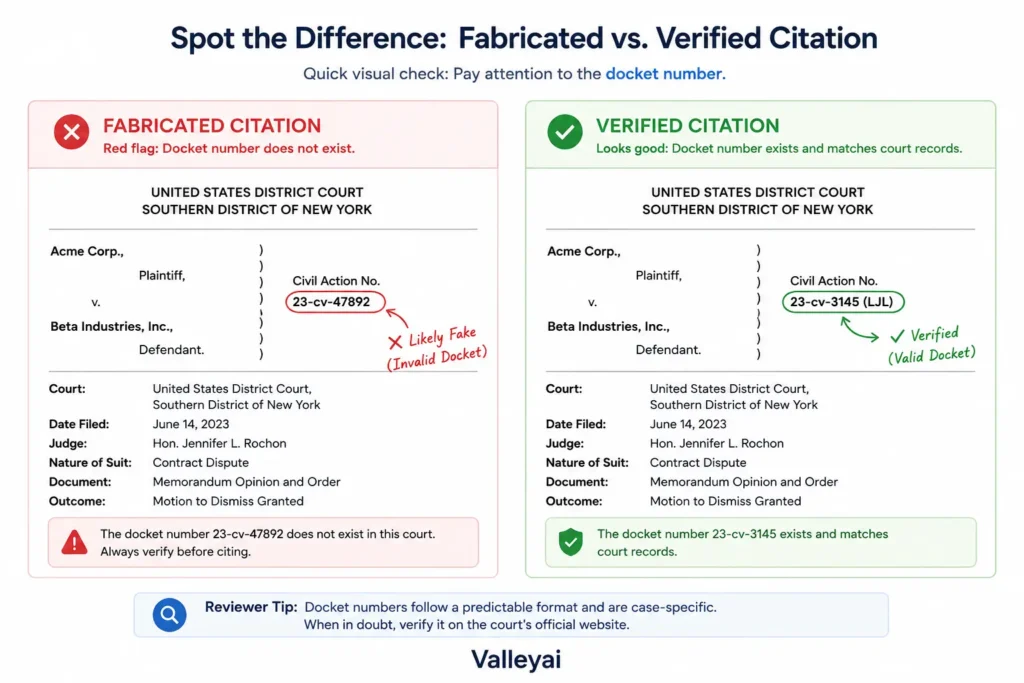
A fabricated citation rarely looks fake. It usually has the right court, a real-sounding party name, correct Bluebook formatting, and a docket or reporter number that simply doesn’t correspond to any real case. That’s the actual pattern reviewers need to know how to catch not a vague sense that “AI can sometimes be wrong.”
AI hallucination in legal research happens because generative language models are fundamentally predicting the next plausible sequence of words, not verifying that a specific case exists in a legal database, unless a retrieval-augmented system is actively grounding that output in a real document. Even RAG-grounded tools aren’t immune. A poorly matched retrieval step can still surface a real case that doesn’t actually support the point it’s being cited for.
Because inaccurate citations can lead to sanctions, malpractice exposure, or a case getting dismissed on procedural grounds, AI-generated legal research and analytics output should always be independently verified by a licensed attorney before it’s relied on in any filing or client-facing document. This isn’t boilerplate caution courts have already sanctioned attorneys for filing briefs containing AI-fabricated case citations, and that trend is not slowing down.
How to Verify AI-Generated Legal Research Before You Rely On It
Verifying AI-generated legal research means confirming that every cited case actually exists, says what the AI claims it says, and remains good law a process that takes minutes when done systematically, not hours.
- Pull every citation independently in a primary legal database rather than trusting the tool’s internal citation link.
- Check for negative treatment confirm the case hasn’t been overturned, reversed, or superseded, since AI tools don’t always flag current legal status.
- Read the actual holding, not just the AI’s summary. Models occasionally cite a real case for a proposition it doesn’t actually support.
- Cross-check quoted language against the original opinion text; paraphrased “quotes” are a known failure point.
- Flag anything the tool can’t source back to a specific document. An answer with no traceable citation is a signal to verify manually before use.
This section reflects practical guidance, not legal advice. Attorneys remain responsible for independently verifying any AI-assisted research before filing, consistent with applicable bar association guidance on the use of AI in legal practice.
Boolean Search vs. Natural Language AI Search: When Each Wins
Natural language AI search tends to outperform Boolean search when the researcher isn’t certain of the exact terminology a court used, or when the question spans multiple legal concepts at once situations where a rigid keyword string misses relevant results entirely. Boolean search still wins for narrow, terminology-precise tasks, like pulling every case in a jurisdiction citing a specific statute section, where an AI-generated paraphrase adds noise instead of precision.
Neither method replaces the other completely. Most experienced researchers default to natural language for exploratory work and switch to Boolean for surgical, citation-specific pulls.
Frequently Asked Questions
Is AI legal research accurate enough to rely on?
AI legal research is generally accurate for locating relevant case law and summarizing established legal principles, but accuracy drops on novel legal questions or narrow jurisdictional nuances where retrieval data is thinner. Treat AI output as a strong first draft, not a finished, citation-verified work product ready for filing.
Can lawyers get in trouble for using AI in legal research?
Yes. Several courts have sanctioned attorneys for submitting filings containing AI-fabricated citations that were never independently verified. The issue isn’t the tool itself it’s filing unverified output. Bar associations increasingly expect attorneys to confirm AI-assisted research before relying on it in court documents.
Do courts allow AI-generated legal research in filings?
Most courts allow AI-assisted research as long as a licensed attorney reviews and verifies the final work product before filing. Some federal judges now require explicit certification confirming that AI-generated content was checked for accuracy, reflecting growing concern over unverified citations appearing in briefs.
How does AI reduce legal research time?
AI reduces research time mainly by replacing manual Boolean querying and document-by-document reading with synthesized, cited answers generated in seconds. Thomson Reuters has measured this at roughly 240 hours saved per attorney annually, concentrated largely in case law discovery and secondary source review.
Is legal analytics the same as legal research AI?
No. Legal analytics predicts outcomes using historical ruling and motion data, while legal research AI retrieves and summarizes existing legal text. Gavelytics, for example, forecasts judicial tendencies but doesn’t draft or summarize legal memos the way Lexis+ AI does the two solve different problems entirely.
Deciding Where AI Actually Fits Your Workflow
Choosing between research-AI and analytics-AI isn’t really a choice most litigation teams need to make eventually, they need both working together. Deciding where to invest first comes down to one question: is slow case law discovery the bottleneck, or is unpredictable judge behavior the bigger risk on your matters? Research-AI closes the first gap fastest. Litigation analytics changes how motions get framed before they’re even drafted, which matters more for repeat-player litigators appearing before the same judges regularly.
What doesn’t change, regardless of which tool sits on top of the workflow, is the verification step. Every citation still needs a human check before it reaches a judge. That part of the job isn’t getting automated any time soon and treating it as optional is how AI-assisted research turns into a sanctions story instead of a productivity one.

Kaleem
Kaleem is a Computer Science graduate (Virtual University of Pakistan) and the founder and editor of Valley AI, where he publishes in-depth, tested guides on computer hardware, artificial intelligence, and how the internet works. Every guide is researched from primary sources, tested hands-on where possible, and updated when the facts change.