
AI no longer influences consumers only in the background. Predictive systems have long ranked products, targeted ads, and estimated purchase intent. Generative AI now speaks directly with consumers, compares options, summarizes research, and recommends what to do next.
That shift changes more than shopping speed. AI can influence what consumers notice, which alternatives they see, how much research they perform, and whether a recommendation feels trustworthy.
AI Changes the Path to a Purchase
AI and consumer behavior describes how artificial intelligence influences consumer attention, preferences, product discovery, evaluation, purchasing decisions, and post-purchase experiences. Predictive AI forecasts likely interests or actions, while generative AI creates answers, comparisons, summaries, and recommendations that can directly shape a decision.
AI does not always create a new preference. Often, AI changes which products become visible and how those products are framed. A consumer may still want a durable laptop, affordable insurance, or a particular style of clothing. The recommendation system influences which options appear relevant first.
The result is a shift from consumers navigating a large information environment to consumers receiving an AI-filtered version of that environment.
The IAB Tech Lab’s “Attention Rewired” analysis connects this change with AI-generated summaries, altered search behavior, advertising transparency, and the growing importance of user control.
If that distinction is unfamiliar, our full guide to generative AI covers the architectures and use cases behind the models discussed below.
Predictive AI and Generative AI Play Different Roles
| Type of AI | Primary function | Consumer-facing example | Main behavioral effect |
|---|---|---|---|
| Predictive AI | Forecasts likely interests or actions | Ranking products based on browsing history | Shapes visibility and timing |
| Recommendation systems | Selects or ranks options | “You may also like” suggestions | Narrows the choice set |
| Generative AI | Produces new text, comparisons, or explanations | A chatbot comparing three products | Reduces research effort |
| Conversational commerce | Connects dialogue with shopping or service | Asking an assistant which model fits a need | Turns discovery into an interactive exchange |
Predictive AI often works quietly. Generative AI makes the decision process visible because the consumer can ask questions and receive a direct response.
The two systems increasingly work together. Predictive models may identify relevant products, while generative AI explains those products in natural language. That explanation can increase confidence, even when the underlying ranking remains difficult to inspect.
The Five-Stage AI Consumer Decision Loop
AI affects consumer behavior across five connected stages. The greatest change is not that AI automates one task. AI can influence the entire loop, from the first recognized need to the feedback generated after purchase.
1. Need recognition
AI can introduce products, problems, or possibilities before a consumer begins an active search. Personalized advertising, content recommendations, and predictive offers may make a need feel more immediate.
A recommendation for travel equipment can turn a vague interest into a planned purchase. A personalized financial product offer can make a consumer consider an option that was not previously on the shortlist.
The benefit is relevance. The risk is that the platform may define relevance using inferred behavior rather than the consumer’s stated priorities.
Discovery only works when the underlying product data is accurate, which depends on how AI manages e-commerce catalogs behind the storefront.
2. Product discovery
AI search and recommendation systems filter discovery. Instead of scanning many pages, consumers may receive a short list, generated summary, or conversational answer.
AI does not necessarily eliminate traditional search; it can mediate traditional search by deciding which information reaches the consumer first. A consumer might never visit several brand websites if an AI system summarizes their products in one response.
That creates a new visibility problem for brands. Product information, reviews, structured data, availability, and third-party references may influence a recommendation before a consumer reaches a company-owned website.
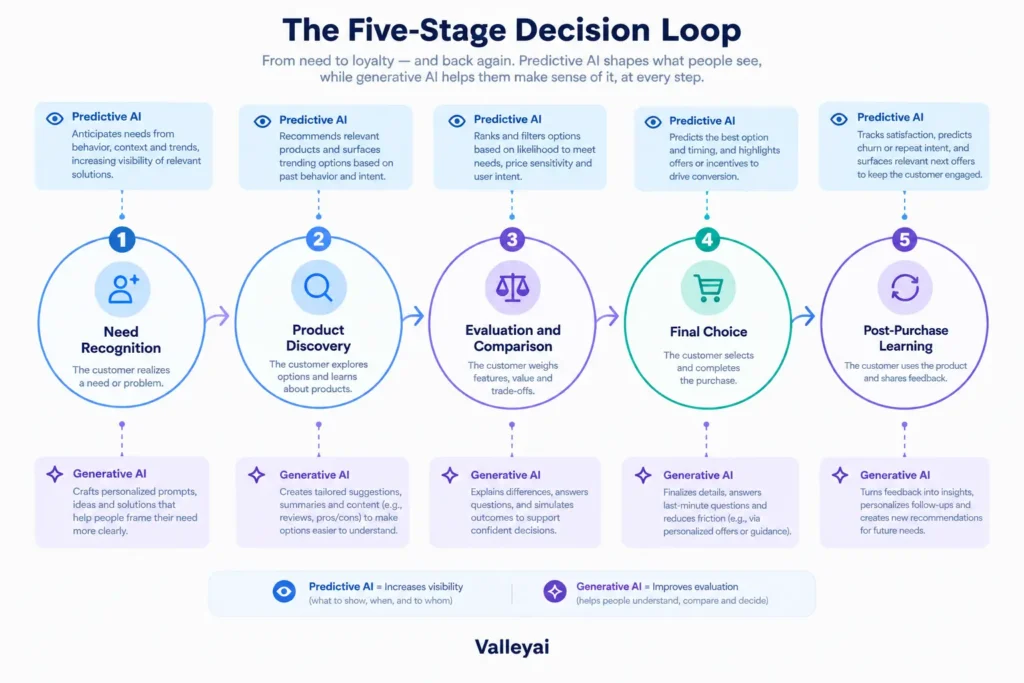
3. Evaluation and comparison
Generative AI can reduce choice overload by summarizing specifications, identifying trade-offs, and translating technical information into plain language. The University of Virginia Darden School of Business analysis describes AI-assisted shopping as a form of augmented decision-making rather than a complete replacement for consumer judgment.
The trade-off is comparison depth. A short answer may help a consumer decide faster, but it may also hide less prominent alternatives, uncertain information, or criteria the consumer did not think to request.
A useful question is not simply, “Did AI provide an answer?” Ask, “What did the answer leave out?”
4. Final choice
At the choice stage, AI can influence perceived fit, urgency, price attractiveness, and confidence. A recommendation that sounds personalized may feel more objective than an advertisement, even when commercial incentives affect the ranking.
AI can also encourage impulse buying by reducing the friction between interest and purchase. Faster decisions are not automatically worse decisions, but speed becomes risky when the product is expensive, difficult to return, or difficult to evaluate after purchase.
5. Post-purchase learning
The consumer journey continues after checkout. AI may guide setup, answer support questions, recommend accessories, process returns, or interpret feedback.
Post-purchase behavior also teaches the system. Returns, complaints, repeat purchases, product ratings, and customer-service conversations can improve future recommendations. A brand that measures only clicks may miss whether AI-assisted customers were satisfied, returned the product, or remained loyal.
Trust depends heavily on how a recommendation was produced, so it helps to understand the machine learning methods that generate it.
Why Consumers Trust Some AI Recommendations
Consumers tend to trust an AI recommendation when the recommendation feels relevant, understandable, accurate, and appropriate to the situation. Trust is not a permanent property of the system. Trust changes by product category and consequence of error.
A consumer may accept AI advice about a restaurant but seek human or expert input before choosing medical equipment, legal services, or an expensive financial product.
Trust usually improves when the system:
- Explains why an option was recommended
- Shows meaningful alternatives
- Uses current and verifiable product information
- Allows the user to correct preferences
- Separates sponsored placement from organic relevance
- Provides human support when the decision is complex
Generative AI creates a special trust problem: fluent language can make weak information sound reliable. A confident comparison is not proof that the underlying product data is complete or current.
AI recommendations versus human recommendations
AI recommendations offer scale, speed, and consistency across large product catalogs. Human recommendations can provide context, empathy, accountability, and knowledge of unusual circumstances.
Neither source is automatically superior. AI works well for narrowing routine choices and organizing information. Human advice remains valuable when personal context, emotional stakes, uncertainty, or accountability matter.
When Personalization Becomes Influence
Personalization becomes manipulative when consumers cannot understand the influence, challenge the recommendation, or access meaningful alternatives.
Personalization uses data to make content, offers, or products more relevant. Manipulation adds a power imbalance: the system knows more about the consumer’s likely response than the consumer knows about the system’s incentives.
The Duke Fuqua analysis of AI and consumer manipulation highlights concerns involving platform information advantage, behavioral influence, impulse buying, surveillance, product quality, and possible price discrimination.
The distinction is practical:
| Helpful personalization | Manipulative influence |
|---|---|
| Explains relevance | Hides why the option appeared |
| Shows alternatives | Narrows choice without disclosure |
| Allows correction | Treats inferred preferences as fixed |
| Discloses commercial influence | Blends advertising with neutral advice |
| Supports deliberate choice | Exploits urgency or vulnerability |
Privacy is part of the same issue. Consumers need to know what data informs a recommendation, how long the data is retained, and whether the data is used for purposes beyond the immediate interaction.
Privacy, advertising, and consumer-protection obligations vary by jurisdiction and use case. Organizations should obtain qualified legal or compliance advice before deploying high-impact personalization or automated decision systems.
How Consumers Can Verify AI Product Advice
Use this five-question check before acting on an AI-generated recommendation:
- What was the recommendation based on?
Ask whether the system used your stated requirements, previous behavior, sponsorship, popularity, inventory, or another factor. - What alternatives were excluded?
Request a comparison with different brands, price points, specifications, and trade-offs. - What information should be verified?
Check price, availability, warranty terms, compatibility, return conditions, and current specifications on an official source. - Can you correct the system’s assumptions?
Tell the AI what matters most and what does not. A useful system should revise the recommendation rather than defend its first answer. - Does the decision require human review?
For high-cost, sensitive, or consequential choices, consult qualified professionals or independent sources.
An AI recommendation should be treated as a research assistant, not an unquestionable decision-maker.
These changes sit inside a wider shift in AI in business applications, where customer-facing models are only one part of the operating stack.
What Brands Should Change in AI-Mediated Customer Journeys
Brands cannot rely only on website traffic when AI answers questions before a website visit occurs. Product information must remain accurate, structured, consistent, and easy for both consumers and AI systems to interpret.
A responsible brand response includes:
- Maintain clear product specifications, pricing, availability, and policies
- Make important differences between products easy to compare
- Monitor how third-party and AI systems describe the brand
- Separate sponsored recommendations from organic relevance
- Provide human escalation for complex complaints and high-value purchases
- Measure satisfaction, returns, support volume, repeat purchases, and loyalty
- Let consumers correct personalization assumptions
- Audit recommendations for missing alternatives or unfair ranking patterns
The most useful AI customer experience is not the one that removes every decision. It is the one that removes tedious comparison while keeping meaningful choice visible.
When AI compresses the marketing funnel, trust becomes more valuable than raw exposure. A brand may receive fewer direct visits but still win the decision if its information is accurate, its product is suitable, and its reputation survives the AI summary.
The Consumer Trust and Control Test
Use this test to evaluate any AI-mediated consumer experience.
1. Explainability
Can the consumer understand why the system produced the recommendation? A detailed technical explanation is not always necessary. A plain-language reason is often enough: price range, stated preferences, compatibility, location, or previous selection.
2. Alternative visibility
Does the system show more than one credible path? Consumers do not need an endless catalog, but they need enough alternatives to recognize trade-offs.
3. User control
Can the consumer change the assumptions, reject personalization, reset the profile, or ask for a different ranking? A recommendation system that cannot be corrected treats an estimate as a fact.
4. Commercial disclosure
Can the consumer tell whether a recommendation is sponsored, affiliate-linked, promoted by inventory needs, or influenced by a commercial relationship?
5. Data boundaries
Does the consumer know what information is being used? Sensitive or unexpected data use can damage trust even when the recommendation appears relevant.
6. Human escalation
Can a person intervene when the automated answer is wrong, incomplete, or unsuitable? Human support matters most when the purchase has high financial, emotional, or practical consequences.
A system that fails several parts of this test may still be convenient, but convenience alone does not make the experience consumer-friendly.
What AI and Consumer Behavior Means Next
Predictive AI shaped consumer behavior by ranking, targeting, and forecasting. Generative AI adds a direct conversational layer that can explain, compare, persuade, and recommend.
The central question is no longer whether AI influences consumers. It is whether consumers can see that influence and retain enough control to make an informed choice.
Brands should measure outcomes beyond clicks. Consumers should verify recommendations beyond fluent wording. The strongest AI experiences will be those that make decisions easier without making the decision-maker invisible.
This article combines published institutional commentary, current industry evidence, and original analysis. Examples are illustrative unless identified as survey findings. AI systems, advertising practices, and privacy requirements change over time, so organizations should verify current technical, regulatory, and compliance requirements before acting on the recommendations.

Kaleem
Kaleem is a Computer Science graduate and the founder of Valley AI (valleyai.net), where he publishes in-depth, tested guides on computers, AI, and internet technologies. Every guide is researched from primary sources and updated regularly.