

A quadcopter has no wings, no tail, and no control surfaces. It stays in the air on four spinning propellers, and it steers by spinning them at different speeds.
That sounds too simple to work, and in one sense it is. A four-rotor aircraft is unstable by nature. A person could not adjust four motor speeds fast enough to hold it level, so the drone does the job itself. A small computer reads its sensors hundreds of times a second and corrects each motor before the tilt grows.
Thrust holds the drone up, motor mixing points it, the flight controller keeps it level, sensors tell it where it is, and the battery sets how long it can stay there.
Lift: Why Four Spinning Propellers Hold a Drone Up
A propeller is a spinning wing. It pushes air down, and the air pushes back up on the propeller. That push is thrust, and four propellers make enough of it to lift the whole aircraft.
Hovering is a balance. Total thrust must equal weight, gram for gram. A DJI Mini 4 Pro weighs 249 grams, which is 2.44 newtons of weight. Each of its four motors must produce 0.61 newtons, about 62 grams of lift, to hold still in the air. More thrust climbs, less thrust descends.
Four rotors solve a problem one rotor cannot. A spinning propeller twists the body in the opposite direction, the same reaction that makes a helicopter need a tail rotor. Two of a quadcopter propellers spin clockwise and two spin counter-clockwise, and the twisting forces cancel. Opposite corners turn together, so the balance holds in every direction.
Quadcopters became practical only when the parts got small. MEMS gyroscopes and accelerometers from smartphones, lithium batteries, and fast microcontrollers arrived together, and a stable four-rotor aircraft went from a lab project to a product on a shelf. The Parrot AR.Drone brought the design to the mass market in 2010, and the DJI Phantom made camera drones simple in 2013.
The rotation pattern is printed on the drone itself. Look near each motor for a small curved arrow. Two arrows point one way, two point the other, and the diagonal pairs match. A propeller mounted on the wrong motor fights the pattern, and the drone flips on takeoff.
The Motor Mix: Four Numbers That Steer a Quadcopter
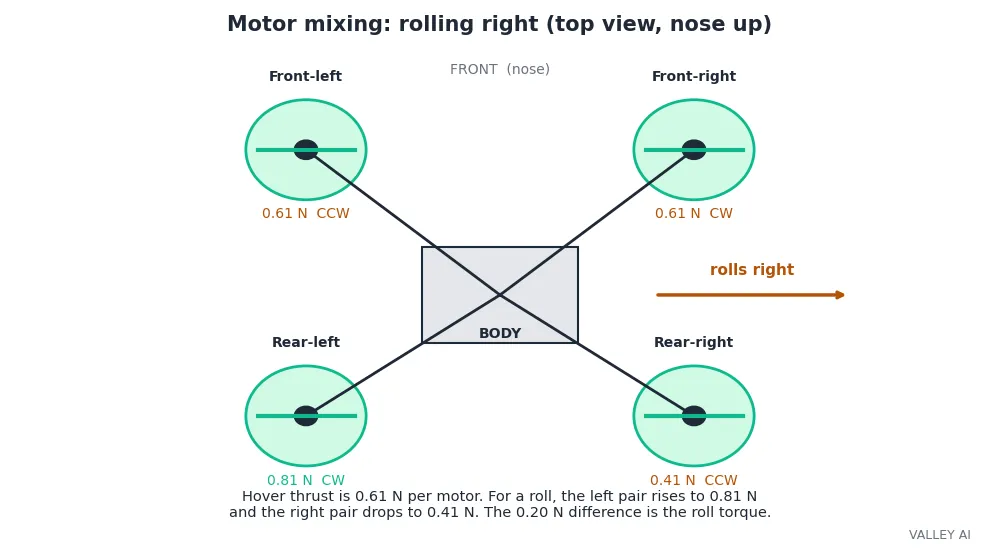
Steering a quadcopter means changing four speeds at once. The flight controller keeps a running total for each motor: hover thrust, plus or minus a share of roll, pitch, and yaw. That arithmetic is called motor mixing.
| Movement | Front-left (CCW) | Front-right (CW) | Rear-left (CW) | Rear-right (CCW) | What happens |
|---|---|---|---|---|---|
| Hover | 0.61 N | 0.61 N | 0.61 N | 0.61 N | Total thrust equals weight; the drone holds still. |
| Roll right | 0.81 N | 0.41 N | 0.81 N | 0.41 N | The left side lifts, the drone tilts right and slides that way. |
| Pitch forward | 0.41 N | 0.41 N | 0.81 N | 0.81 N | The rear lifts, the nose drops, and the drone moves forward. |
| Yaw clockwise | 0.71 N | 0.51 N | 0.51 N | 0.71 N | The torque balance breaks on purpose and the nose turns. |
The roll numbers come from a worked example on a 249-gram quadcopter. A roll to the right needs the left pair at 0.81 newtons and the right pair at 0.41 newtons, a difference of 0.20 newtons per side. With the motors 0.12 metres from the centre, that difference makes 0.048 newton-metres of torque. The roll inertia is about 0.0014 kilogram square metres, so the angular acceleration is 34.3 radians per second squared, close to 2,000 degrees per second squared. The arm length and the inertia are chosen model inputs, stated here so the arithmetic can be checked.
Each motor is a brushless DC motor, driven by an electronic speed controller, or ESC. The ESC turns battery power into the three-phase current the motor needs and changes it in milliseconds. Digital protocols such as DShot carry the speed command from the flight controller to the ESC. Motors carry a KV rating, the revolutions per minute each volt produces with no load. High KV motors suit small propellers and racing, low KV motors suit large propellers and long flights.
Can a quadcopter fly on three motors? A standard quadcopter cannot. Losing one motor removes a quarter of the thrust and breaks the torque balance, and the flight controller has no spare pair to make up the difference. Hexacopters carry six motors partly so one failure still leaves a working set.
The Flight Controller: A Computer That Flies the Drone
The flight controller is a small circuit board with a processor and sensors. It runs one loop: sense, decide, act. It reads the gyroscopes, compares the tilt with the target, works out a correction, and sends new speeds to the ESCs. The loop repeats hundreds to thousands of times a second, which is why the corrections stay invisible.
Correction follows a PID rule. P reacts to the current error, I fixes slow drift, and D calms fast change. A driver steering on a straight road works the same way: the wheel turns in proportion to how far the car sits from the line, eases off as the car swings back, and corrects a steady pull from a crosswind. One analogy covers the mechanism; the test in the next section shows the numbers.
Stick movements set targets, climb, tilt, or turn, and the controller translates each target into four motor speeds. The sticks send a position, much as the sticks on a game controller send a position the console turns into motion.
Firmware decides how much of the flying the pilot does. DJI drones run closed firmware. Open-source options include Betaflight for FPV racing, and ArduPilot and PX4 for mapping and commercial work.
The Stabilization Test: Running the Control Loop on a Gust
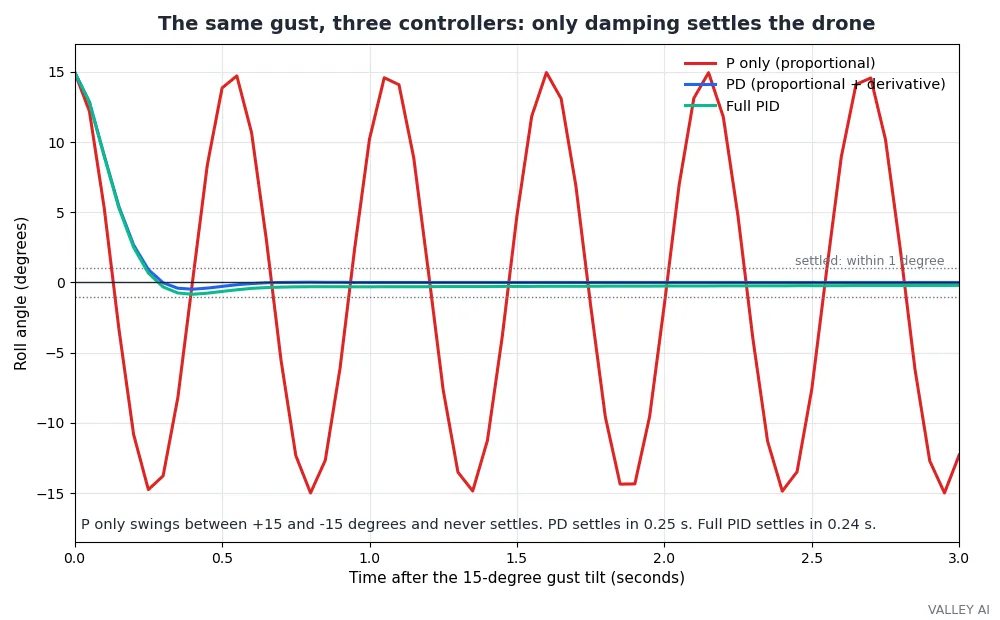
PID is easy to describe and hard to judge from words alone, so I ran the loop. The test is a single-axis roll simulation of a 249-gram quadcopter, run in Python on 16 November 2026. The loop runs at 500 Hz. A 15-degree gust tilt hits at time zero, and three controllers take turns correcting it: P only, PD, and full PID, with gains Kp 0.8, Ki 0.15, and Kd 0.1.
| Controller | Settles within 1 degree | Overshoot | Peak differential thrust | What happened |
|---|---|---|---|---|
| P only | Never | 15.00 degrees | 0.21 N | Swings between plus 15 and minus 15 degrees for the whole 3 seconds; ends at minus 12.29 degrees. |
| PD | 0.25 s | 0.48 degrees | 0.21 N | Settles fast with a small overshoot past level. |
| Full PID | 0.24 s | 0.84 degrees | 0.21 N | Settles fastest; ends 0.21 degrees from level. |
The pattern is clear. Proportional push alone cannot hold a line, because it has no way to brake the swing it starts. Adding the derivative term brakes that swing, and that one change turns endless oscillation into a settled hover in about a quarter of a second. Full PID overshoots a little more here, and its real value shows up over longer flights, where slow drift builds up and the integral term has time to work.
Limits sit here with the result. It models one axis only, with no sensor noise and no wind after the initial tilt. The arm length, the inertia, and the motor headroom are chosen model inputs. They are not measurements from a real drone. The I-term barely mattered over three seconds; PD did the work, and the I-term earns its place against slow drift such as a steady wind push, which this test did not include. The numbers are a simulation, not a flight log.
Sensors: How the Drone Knows Where It Is
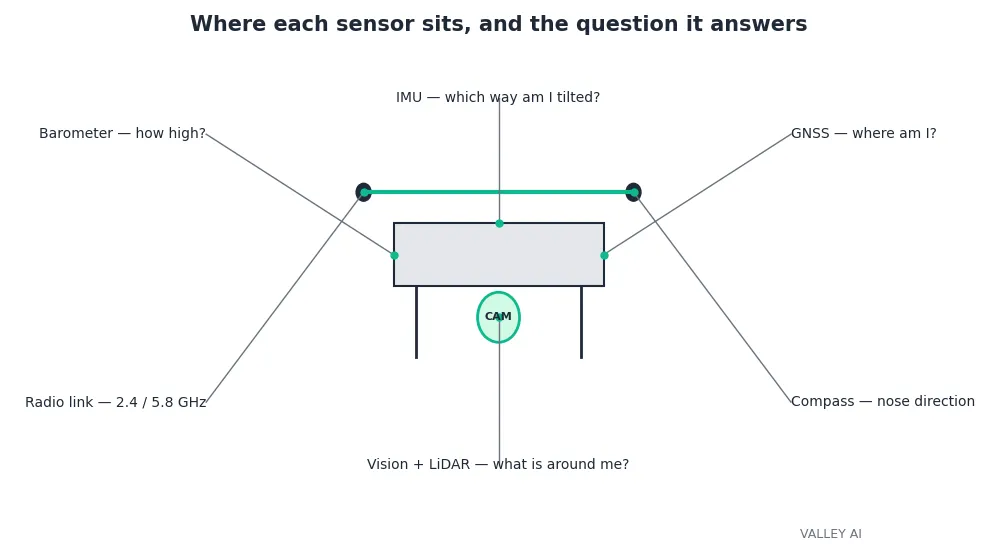
Stability needs tilt, position needs satellites, and height needs pressure. Each sensor answers one question, and the flight controller blends the answers into one estimate of where the drone is and how it moves.
| Sensor | Measures | Answers | Limit |
|---|---|---|---|
| IMU (gyro + accelerometer) | Rotation and acceleration on three axes | Which way am I tilted? | Drifts over time without outside fixes. |
| GNSS receiver | Position from satellites | Where am I? | A few metres of error; weak indoors. |
| Barometer | Air pressure | How high am I? | Weather changes shift the reading. |
| Compass | Heading against magnetic north | Which way does the nose point? | Metal structures and power cables disturb it. |
| Vision cameras | Ground texture and depth | What is below and around me? | Needs light and visible texture. |
| LiDAR / time-of-flight | Distance with laser or light pulses | How far is that branch? | Short range; cost and weight. |
The IMU does the fast work. A MEMS gyroscope measures rotation through the Coriolis force on a tiny vibrating structure, and a MEMS accelerometer measures acceleration, including the pull of gravity. Many drones carry two IMUs, so the controller can spot a faulty one.
GNSS gives position. Most drones listen to GPS, GLONASS, Galileo, and BeiDou at once, which puts more satellites in view and steadies the fix. Standard accuracy is a few metres. Survey drones add RTK correction and reach about a centimetre. Atomic clocks and trilateration do the positioning work behind those fixes.
The barometer handles height because GPS altitude is less precise than horizontal position. The compass gives heading, and metal structures and power cables can disturb it, which is why drones warn about magnetic interference before takeoff.
Vision covers the gaps. Downward cameras track ground texture so the drone can hover indoors, and pairs of forward, rear, and side cameras judge depth. LiDAR measures distance with laser pulses and keeps working in darkness and on thin branches. When GPS and vision both fail, the drone falls back to attitude mode: it stays level but drifts with the wind, and the pilot must correct by hand.
Why does a drone need a compass when it has GPS? GPS gives position. It gives no heading while the drone sits still. The compass gives the nose direction, and return-to-home and the camera both need it.
The Radio Link and the Video Feed
The controller and the drone talk on a digital radio link. The 2.4 GHz and 5.8 GHz bands are shared with Wi-Fi and Bluetooth, so the link hops between frequencies to dodge interference. Stick commands and telemetry travel up, and live video travels down. DJI O4, the link on the Mini 4 Pro and newer models, is rated to 20 kilometres under US rules with no obstacles, and real range runs much shorter. The law in most countries requires keeping the drone in sight in any case.
Video is the hard part of the link. It needs bandwidth with very little delay. FPV pilots choose between analog video, which has the lowest delay, and digital systems with a much clearer image.
Does a drone fall out of the sky if the radio link drops? No. A failsafe takes over: the drone holds position, lands, or flies home, depending on the model and the battery level. Link loss is a planned event, and the drone handles it by itself.
The radio also carries the drone’s identity. Under the FAA Remote ID rule, drones that must be registered broadcast their identity, position, altitude, speed, and the pilot location over Wi-Fi or Bluetooth, so anyone nearby with a phone app can see what is flying. The FAA has enforced the rule since 16 March 2024.
What the Battery Buys: Flight Time in Watts
A 2,590 milliamp-hour pack holds 18.96 watt-hours and weighs 77.9 grams, according to the DJI Mini 4 Pro specifications. That is close to a third of the whole aircraft.
Watt-hours divided by minutes gives the average draw. DJI rates the drone at 34 minutes of forward flight, so 18.96 watt-hours over 34 minutes is 33.5 watts. The hover rating is 30 minutes, which is 37.9 watts. Hovering draws more than forward flight because forward motion adds lift from the moving air.
The 34-minute figure comes with test conditions: forward flight at 21.6 kilometres per hour in a windless lab, photo mode, obstacle avoidance off, from a full battery to empty. Wind, cold, and extra weight cut the number, and the drone calls itself home well before the battery runs out.
An optional Plus battery shows the same arithmetic from the other side. It holds 28.4 watt-hours, and DJI rates it at 45 minutes, which is 37.9 watts on average, equal to hovering on the standard pack. More energy buys more minutes; the power the drone needs stays the same.
Quadcopter, Fixed-Wing, or FPV: Which Shape Fits Which Job
Most drones are quadcopters because hovering and taking off anywhere matter more than range for photos and video. Fixed-wing drones fly like airplanes: wings give the lift, so they cover kilometres on one battery, but they cannot hover and they need space to launch and land. VTOL hybrids take off like a quadcopter and cruise like a plane, at the cost of complexity. FPV drones drop the GPS help and fly by hand through goggles, trading stability for speed.
Autonomy sits on top of the same loop. Vision processors run neural networks on board, so the drone can track a subject, plan a path around an obstacle, or fly a mapping grid by itself. The tracking runs on the same kind of model that powers the AI systems that recognize images on the ground. The pilot stays responsible for the flight, whatever the automation does.
The shape follows the job. Photos and video from one spot call for a quadcopter. Kilometres of field, pipeline, or coastline call for a fixed wing or a VTOL hybrid. Speed and acrobatics call for an FPV build. Pick the shape first, then check the weight class: under 250 grams keeps the lightest rules in the US, and anything heavier or commercial needs registration and Remote ID.
First flights belong in an open field, away from people and roads, with the return-to-home altitude set above the tallest tree nearby. Fly low, watch how the drone holds position when the sticks go still, and land with a third of the battery left.
Frequently asked questions
What happens if a propeller breaks mid-flight?
A quadcopter with a broken propeller loses thrust on one corner and the torque balance with it. The flight controller cannot fix a missing propeller, so the drone spins and comes down fast. Larger multirotors with six or eight motors can sometimes limp to a landing on the remaining motors.
Can a drone fly in rain or strong wind?
Rain and strong wind are both bad ideas. Water reaches the electronics and the motors, and wind above the drone rated limit pushes it faster than the motors can correct. Most camera drones carry a rated wind limit, and the app warns when the wind is too strong to hold position.
Why do some drones cost $100 and others $10,000?
The price follows the sensors, the camera, and the autonomy. A toy drone has a basic gyro and a radio link. A cinema drone adds a large camera, a three-axis gimbal, omnidirectional sensing, and a long-range video link. An enterprise drone adds RTK positioning, thermal cameras, and docked charging. Each step up buys a capability, not just a brand name.
How do I know if my drone compass needs calibration?
The app asks for it. A compass warning before takeoff, a request to rotate the drone in a figure of eight, or a heading that does not match the map all point to calibration. Metal structures, car roofs, and reinforced concrete throw the reading off, so calibrate in an open area away from them.
Can drone batteries catch fire?
Lithium batteries can catch fire if punctured, overcharged, or charged with the wrong settings. The risk stays low with normal care: use the maker charger, never charge a swollen or damaged pack, and store batteries around half charge in a fireproof bag away from heat.
Do drones need internet to fly?
A drone needs no internet to fly. The control link runs direct between the controller and the drone, and position comes from satellites. Internet helps with maps, firmware updates, and authorizing flight in restricted zones, but the aircraft itself flies without it.

Kaleem
Kaleem is a Computer Science graduate (Virtual University of Pakistan) and the founder and editor of Valley AI, where he publishes in-depth, tested guides on computer hardware, artificial intelligence, and how the internet works. Every guide is researched from primary sources, tested hands-on where possible, and updated when the facts change.