
In the history of technology, few concepts have wielded as much power as Moore’s Law. It is the heartbeat of the modern world, the rhythm that has dictated the pace of innovation for over half a century. From the smartphone in your pocket to the massive data centers training Artificial Intelligence, every piece of digital technology owes its existence to this golden rule of semiconductor manufacturing.
But as we approach the physical limits of silicon, a pressing question arises: Is Moore’s Law still valid in 2026, or are we witnessing the end of an era?
This comprehensive guide goes beyond the basic definition. We will explore the physics of transistor density, the economic paradox of Rock’s Law, and the breakdown of Dennard Scaling, providing you with the expertise needed to understand where computing is heading next.
What is Moore’s Law? A Definition
At its core, Moore’s Law is about the exponential growth of computing power relative to cost.
Moore’s Law is the observation that the number of transistors on a dense integrated circuit (IC) doubles approximately every two years, while the cost of computers is halved. Proposed by Gordon Moore in 1965, it is not a law of physics, but an economic and technical projection that has driven the semiconductor industry’s roadmap for decades.
The History: 1965 to Present
The observation was first made by Gordon Moore, a co-founder of Intel, in a paper for Electronics Magazine.
- 1965: Moore originally predicted a doubling every one year.
- 1975: He revised the forecast to a doubling every two years.
- The Reality: For decades, engineers managed to shrink transistors the tiny switches that control the flow of electricity allowing billions of them to fit onto a chip the size of a fingernail.
This doubling effect is why the guidance computer used for the Apollo 11 moon landing was less powerful than a musical greeting card today.
Read also: computers to become smaller in size
How Moore’s Law Works: Transistor Density
To understand the law, you must understand the Integrated Circuit (IC). An IC is a set of electronic circuits on one small flat piece (or chip) of semiconductor material, usually silicon.
The metric of success here is transistor density.
- Miniaturization: By using advanced photolithography, engineers print smaller features onto silicon wafers.
- Performance: Smaller transistors require less voltage to switch on and off, allowing for faster processing speeds.
- Efficiency: Historically, smaller transistors consumed less power (though this relationship has become complicated, see Dennard Scaling below).
The Law Under Siege: Three Major Hurdles
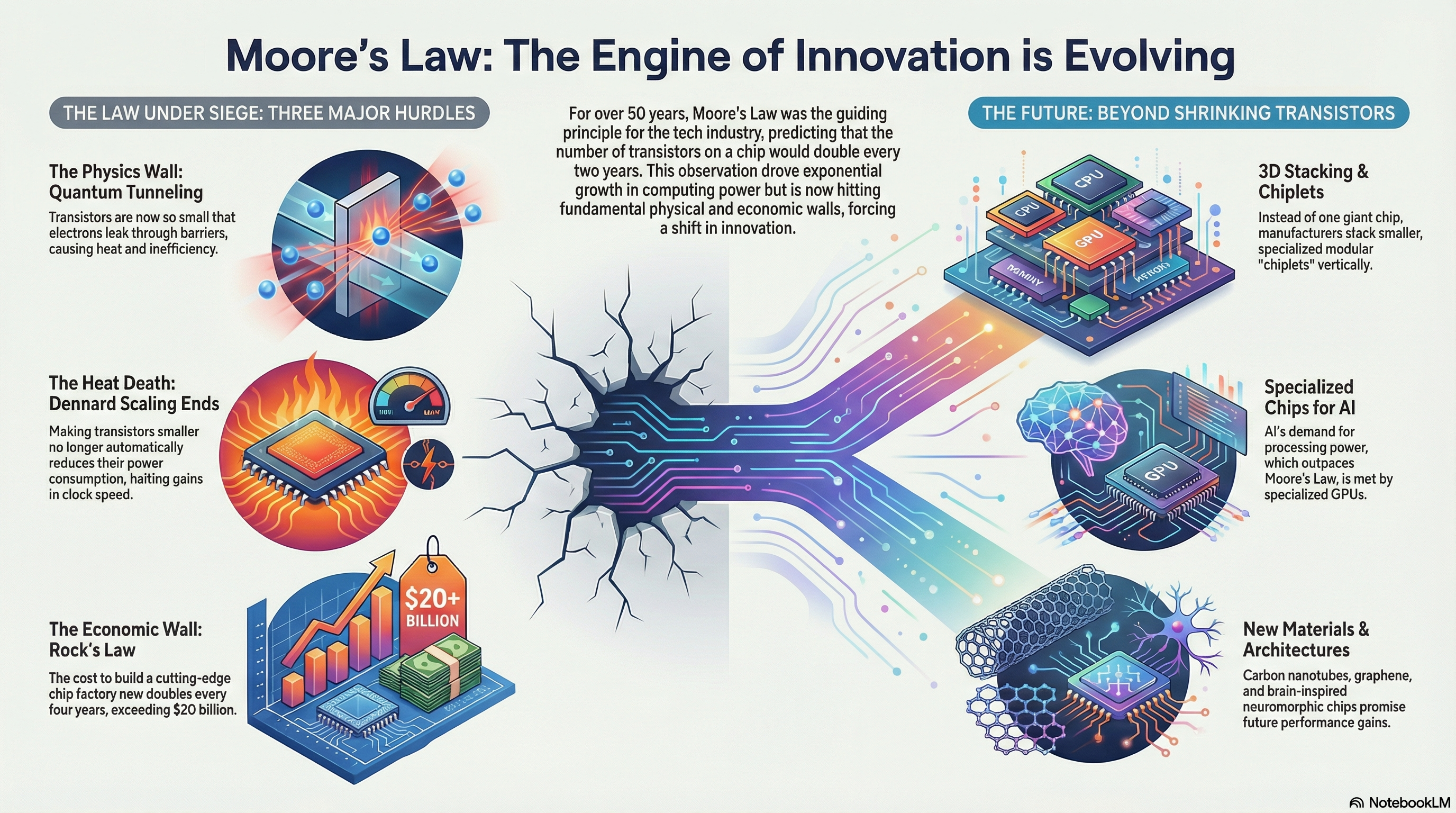
While the industry successfully rode this wave for 50 years, maintaining this pace has become excruciatingly difficult. If you ask, Why is Moore Law ending?, the answer lies in physics and economics.
1. The Physics Wall: Quantum Tunneling
As transistors shrink to the size of just a few atoms, the laws of classical physics break down and quantum mechanics take over.
- The Problem: When the barriers inside a transistor become too thin (under 5 nanometers), electrons can jump or leak across the barrier even when the switch is supposed to be off. This is called Quantum Tunneling.
- The Result: This leakage causes massive power inefficiency and heat generation, making the chip unreliable.
2. The Heat Death: Breakdown of Dennard Scaling
For a long time, Moore’s Law had a partner called Dennard Scaling. This rule stated that as transistors got smaller, their power density stayed constant, meaning you could run them faster without overheating.
Dennard Scaling broke down around 2005. Shrinking transistors no longer automatically yielded power savings due to current leakage. This forced the industry to stop chasing raw clock speed (Gigahertz) and start adding multiple cores to chips instead.
3. The Economic Wall: Rock’s Law
While Moore’s Law says the cost of the chip drops, Rock’s Law (named after Arthur Rock) states that the cost of the equipment needed to manufacture those chips doubles every four years.
- The Reality: Building a cutting-edge semiconductor fabrication plant (Fab) today costs over $20 billion. Only a few companies (TSMC, Intel, Samsung) can afford to stay in the race.
Is Moore’s Law Still Valid in 2026?
The answer is nuanced: Strictly speaking, no. Practically, yes.
- The Slowdown: The doubling time has lengthened. It is no longer a strict 24-month cycle; it is now closer to 30 or 36 months.
- The Shift: We are no longer just shrinking transistors on a 2D plane. The industry has moved to More than Moore technologies.
The Angstrom Era
We have surpassed the nanometer (nm) era. Intel and others are now using the Angstrom (A) as the unit of measurement (10 Angstroms = 1 Nanometer).
- Gate-All-Around (GAAFET): New transistor structures that surround the channel on all four sides to prevent quantum tunneling leakage.
- Backside Power Delivery: Moving power wires to the back of the chip to save space for logic on the front.
Moore’s Law and Artificial Intelligence
How does Moore’s Law affect Artificial Intelligence? The relationship is critical.
Modern AI, specifically Large Language Models (LLMs) like GPT-5, requires a staggering amount of compute. The demand for AI compute is actually outpacing Moore’s Law, doubling roughly every 3.4 months.
- The GPU Shift: Because standard CPUs (Central Processing Units) hit the physical limits mentioned above, AI relies on GPUs (Graphics Processing Units). GPUs utilize parallel processing to handle billions of calculations simultaneously.
- The Bottleneck: The limitation for AI in 2026 is not just processor speed, but memory bandwidth how fast data can move between the memory and the chip.
What Comes Next? Beyond Silicon
If silicon pushes us to the brink of atomic physics, what replaces it? Future advancements focus on architecture rather than just shrinking.
1. 3D Stacking and Chiplets
Instead of making one giant chip, manufacturers are creating Chiplets modular blocks of chips and stacking them vertically (3D packaging). This allows for higher density without needing to shrink the individual transistors further.
2. Neuromorphic Computing
Designing chips that mimic the physical structure of the human brain (synapses and neurons) rather than the traditional logic gates.
3. Carbon Nanotubes & Graphene
Materials that conduct electricity better than silicon and can be made much smaller without the heat issues, potentially reviving the speed gains seen in the 1990s.
Summary: The Legacy of Gordon Moore
So, what is Moore’s Law? It was a self-fulfilling prophecy that turned science fiction into reality. While the strict mathematical doubling is slowing down due to Quantum tunneling and extreme costs, the spirit of the law persists.
Through the Angstrom era, 3D stacking, and specialized AI accelerators, the exponential growth of computing power continues just not in the straight line Gordon Moore drew in 1965.

Kaleem
My name is Kaleem and i am a computer science graduate with 5+ years of experience in Computer science, AI, tech, and web innovation. I founded ValleyAI.net to simplify AI, internet, and computer topics also focus on building useful utility tools. My clear, hands-on content is trusted by 5K+ monthly readers worldwide.