
You ask a chatbot for a fact, and it answers with total confidence. A name, a date, a study title, formatted exactly the way a true fact would be. The only problem: it never happened. The person is real, the paper is not, and the date belongs to something else entirely. That confident invention is called an AI hallucination, and it is one of the most misunderstood behaviors in modern AI.
Hallucinations are not glitches, bugs, or lies. They are what you get when a system built to predict language is treated like a system that knows facts. To understand why chatbots make things up, you have to understand the one job they were actually trained to do: guess the next word. Everything in this article follows from that single fact.
What an AI hallucination actually is
In AI research, a hallucination is a statement generated by a language model that is factually incorrect, fabricated, or unsupported by its source material, yet presented as if it were true. The defining feature is not that the answer is wrong. It is that the wrongness comes with zero hesitation. The model does not know it is wrong, cannot know it is wrong, and has no way to distinguish a claim it is confident about from a claim it is inventing on the spot.
IBM describes hallucinations as outputs that sound plausible but are factually wrong, irrelevant, or entirely fabricated, including fake facts, invented studies, nonexistent URLs, and incorrect details about real entities. In practice they range from small distortions (a slightly wrong date, a misattributed quote) to wholesale invention (a legal case that never existed, a paper no one ever wrote). The most dangerous kind is the one buried inside an otherwise accurate answer, where a single false detail hides among several true ones.
So does the chatbot know it is lying? No, and that is the part most people get backwards. Lying requires knowing the truth and choosing to hide it. A chatbot has no internal fact-checker, no sense of uncertainty, and no private awareness of what it does or does not know. It has learned what plausible-sounding text looks like, and it produces more of it. When that text happens to be false, researchers sometimes call it confabulation, a term borrowed from neuroscience for patients who sincerely fill memory gaps with fabricated stories.
How a chatbot builds an answer, one word at a time
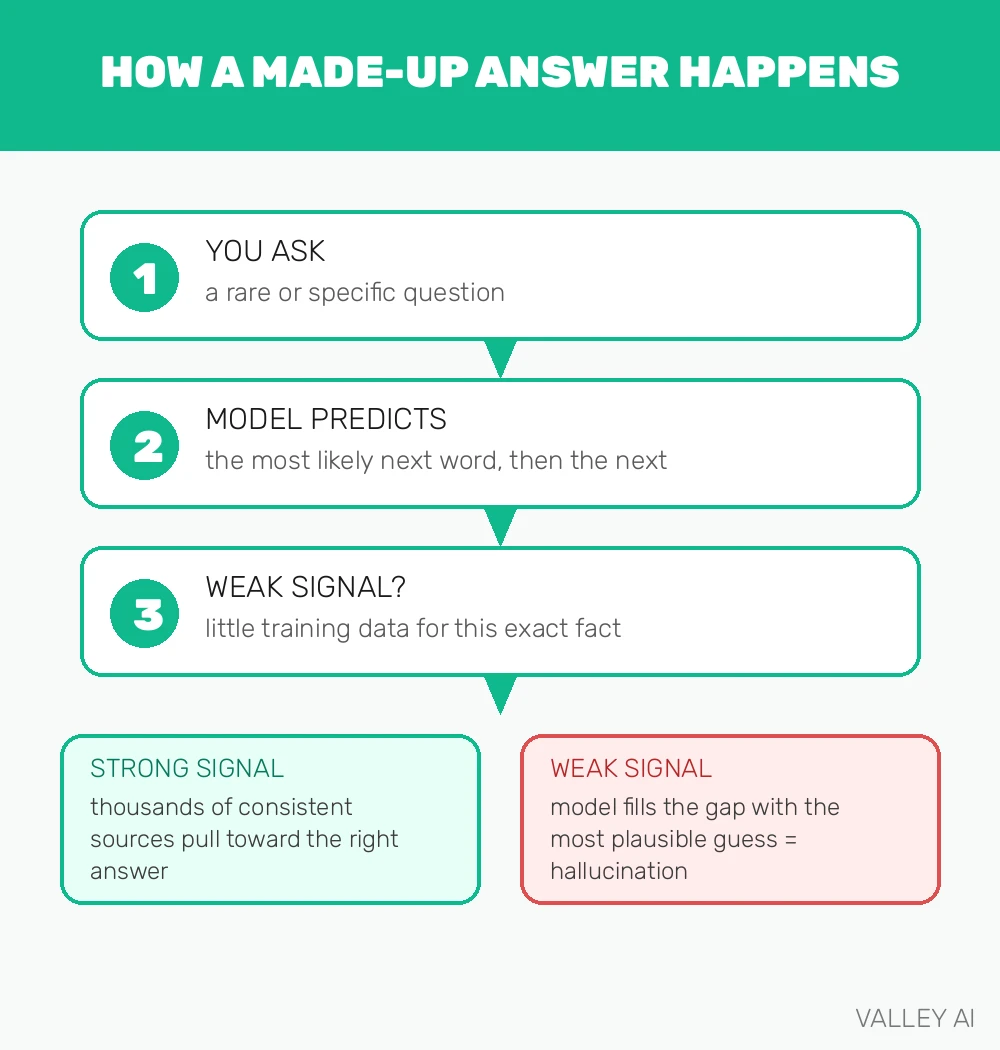
A chatbot does not retrieve facts from a database the way a search engine pulls up a webpage. Instead, it predicts the next token (roughly, the next word or word fragment) based on statistical patterns learned during training on vast amounts of text. Every response is a probability game: pick the most likely next token, then the next, then the next, until the answer reads naturally. The machinery behind this is the large language model, and its training objective was always fluency, never truth.
Picture the model mid-sentence, continuing the phrase “The capital of France is”. In its training data, the token “Paris” followed that phrase thousands of times, so it wins the probability contest and the answer is correct. But now picture a far rarer question, such as the dissertation title of a little-known academic. The model has almost no training signal for that exact fact. It does not stop and admit the gap. It fills it with whatever continuation scores highest on its internal probability distribution, which is usually the phrasing that sounds most like how such answers are normally written. The result can be a beautifully formatted, completely fictional dissertation title.
Tokens are not the bottom layer: before a model ever sees a word, your computer has already turned every character into numbers. Our guide to how ASCII and Unicode work shows that hidden layer of text encoding underneath tokenization.
OpenAI’s own researchers demonstrated this concretely in 2025. They asked a widely used chatbot for the PhD dissertation title of one of their own co-authors. The model produced three different answers. All three were wrong. Asked for his birthday, it gave three different dates. Also all wrong. This was not an edge case or a trick question. It was a simple factual query about a named academic, and the model failed it three times in a row because low-frequency facts cannot be recovered from statistical patterns alone.
If the model can write so well, why can it not just check its facts? Because there is nothing to check against. During pretraining, the model saw only positive examples of fluent language, with no true-or-false labels attached to statements. As the researchers put it, spelling and grammar follow consistent patterns, so errors there disappear with scale, but an arbitrary low-frequency fact, like a pet’s birthday, cannot be predicted from patterns alone. The model is approximating the shape of language, not maintaining a record of reality.
Why the model sounds so sure when it is wrong
The deepest reason hallucinations persist has almost nothing to do with the model’s architecture and everything to do with how we grade it. A September 2025 paper by OpenAI researchers Kalai, Nachum, Vempala, and Zhang, titled “Why Language Models Hallucinate,” argues that training and evaluation procedures reward guessing over acknowledging uncertainty.
Think of it like a multiple-choice exam with strict binary grading: one point for a correct answer, zero for a wrong one, and zero for leaving it blank. The rational strategy is to guess on everything and never leave a question blank, because “I don’t know” guarantees zero while a guess has at least a chance. The researchers analyzed ten of the most popular AI benchmarks and found that nine of ten use exactly this kind of binary scoring. Under that system, saying “I don’t know” is mathematically identical to being wrong, so models learn never to say it.
The paper illustrates this with OpenAI’s own SimpleQA evaluation: one model declined to answer on 52 percent of questions with an error rate of 26 percent, while an older model answered nearly everything with an error rate of 75 percent. Yet the older model looked slightly better on the headline accuracy number, the metric most leaderboards publish. Accuracy-only scoreboards dominate the field, so developers keep building models that guess rather than hold back.
There is a second, more mechanical confidence problem. The model has no reliable internal signal for how sure it should be. A hallucinated sentence can carry exactly the same apparent confidence as a well-established fact. Confidence in the output reflects fluency, never truth.
The kinds of questions that trigger made-up answers
Hallucination rates are not uniform across topics. The questions most likely to produce confident fabrications are the ones where the model has the least training signal and the most room to sound plausible. Knowing these patterns makes you a much harder target.
- Obscure factual details. Specific dates, niche academic citations, minor historical figures, exact statistics. The less often a fact appears in training data, the more the model has to invent.
- Questions about named individuals who are not famous. The model blends facts from similar-sounding people or invents plausible biographical details. This is where the dissertation-title failures came from.
- Recent events. Models are trained on data up to a cutoff date. Ask about anything after that date and the model has no learned signal at all, but it will still try to answer, drawing on older patterns that no longer apply.
- Precise numerical claims. Statistics, study sample sizes, percentages. Models are notoriously prone to generating numbers that feel right without being right.
- Legal and medical specifics. Small errors carry serious consequences here, and the training data is dense with varied, sometimes contradictory sources. The 2023 case of Mata v. Avianca, where lawyers filed a brief citing court opinions invented by ChatGPT and were sanctioned $5,000, remains the most famous example.
The truly treacherous zone is the middle ground: a moderately obscure topic where the model has enough training data to sound convincing but not enough to get the details right. The context reads correctly, the specific claim is fabricated, and nothing in the tone warns you.
Hallucination vs bias vs outdated info: know the difference
Not every wrong AI answer is a hallucination, and the distinction matters because each failure needs a different response. This is where most explainers stop at a one-line definition, so here is the full picture.
| Failure type | What it looks like | Example | How to handle it |
|---|---|---|---|
| Hallucination | The model invents a fact that never existed, stated with full confidence | A citation to a court case or paper that was never published | Verify the specific claim against an independent source; it will not exist |
| Bias | A systematic skew in how the model frames real things, repeated across answers | Consistently describing one group more positively than another in hiring advice | Reframe the prompt neutrally, ask for multiple perspectives |
| Outdated knowledge | A fact that was true when the model was trained but is no longer true | Naming the CEO who left the company two years ago | Check the model’s knowledge cutoff, confirm with a current source |
| Faithfulness failure | The model contradicts the material you gave it in the prompt itself | A summary of your document that adds claims the document never made | Ask the model to quote only, and compare against your source line by line |
| Opinion disagreement | The model takes a defensible but different position on a genuinely contested topic | A different interpretation of an economic policy’s effects | Not an error at all; consult domain experts |
Notice the pattern: only hallucination involves inventing something with no grounding. Outdated knowledge is a calendar problem, bias is a weighting problem, and faithfulness failure is an attention problem. They look similar on the surface, which is why a quick label check saves a lot of confusion.
How to spot a hallucination in 60 seconds
No model is hallucination-free, so the practical skill is learning to catch fabrications before you act on them. These are the warning signs researchers and experienced users actually rely on.
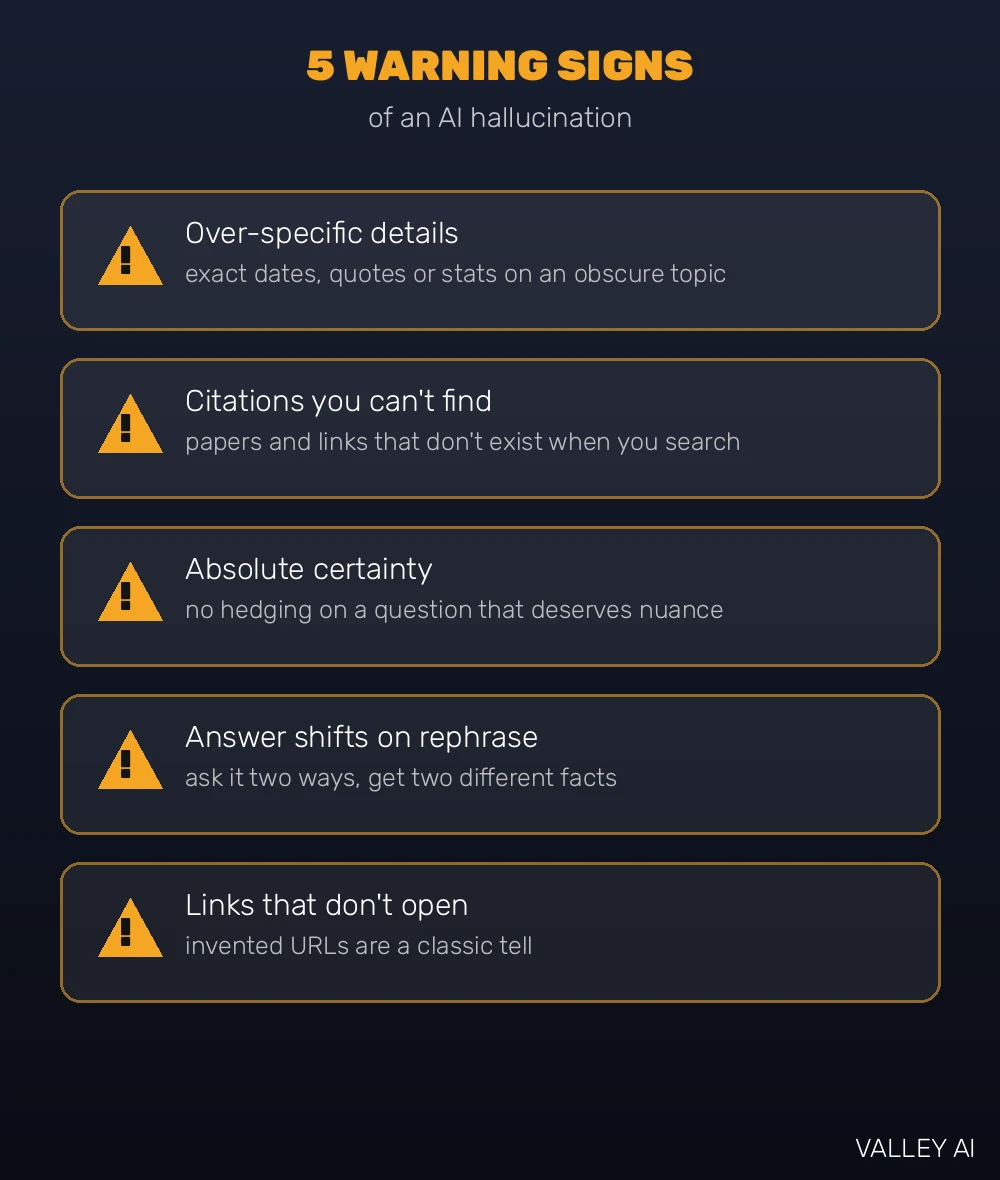
- Overly specific details on an obscure topic. A precise date, a direct quote, or an exact statistic for something you cannot easily verify should be treated as suspect until confirmed. Models fabricate exactly the granular details that make claims feel authoritative.
- Citations you have never seen. Chatbots frequently invent academic papers with realistic titles, author names, and journal names. Search for the citation directly. A significant share of AI-generated citations correspond to no real publication.
- Absolute certainty about an ambiguous question. When a question deserves a hedged or nuanced answer and the model responds with total confidence, that confidence may be masking uncertainty it cannot express.
- A different answer when you rephrase. Ask the same question two different ways. If the answers differ in substance, the model has weak grounding on the topic. Consistent answers suggest, but never guarantee, reliability.
- Links that do not open. Invented URLs are a classic tell. If the link 404s or goes somewhere unrelated, the surrounding claims deserve the same scrutiny.
Should you ever want a model to hallucinate? Yes, in one specific sense. When you ask for brainstorming ideas, story concepts, or creative alternatives, invention is the entire point. Google’s CEO Sundar Pichai has said that in those contexts hallucination is a feature, not a bug. The failure only exists when you needed facts and got fiction instead. Matching the tool’s mode to your goal is the whole game.
The verify-before-you-trust routine
Here is a short routine that fits a normal person’s workflow. Match your effort to the stakes: a brainstorming list needs a glance, but anything involving legal, medical, money, safety, or facts about real people needs the full check.
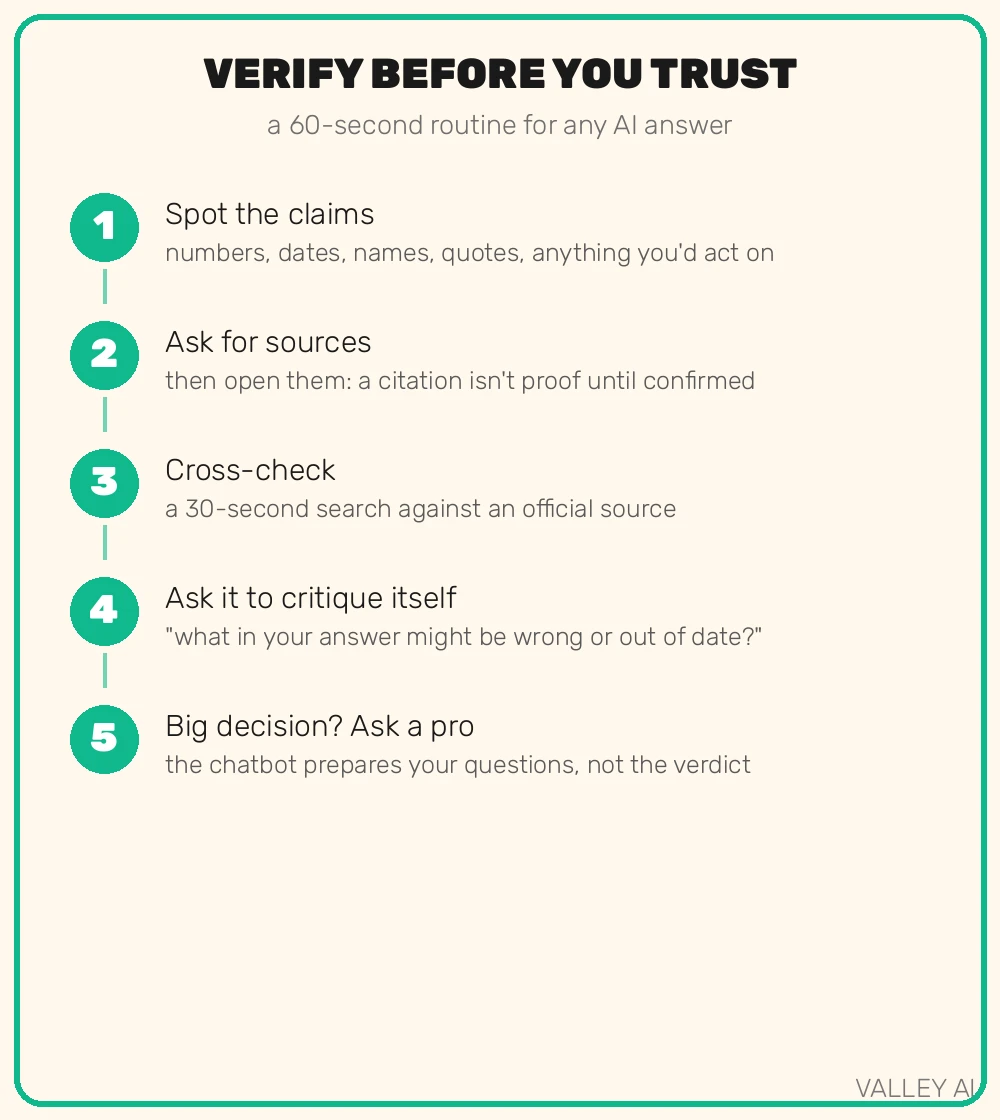
- Spot the claims that matter. Numbers, dates, names, quotes, and anything you would act on. Opinions and explanations can wait; verifiable facts go first.
- Ask for sources, then open them. A citation is not proof until you have confirmed it exists and says what the AI claims it says. This single step catches most fabrications.
- Cross-check with a trusted source. A 30-second search on any precise claim, against an official or primary source, is usually enough to catch a confabulation.
- Ask the model to critique itself. Prompt it with “What in your answer might be wrong or out of date?” This does not eliminate hallucinations, but it often surfaces hedged language that signals lower-confidence claims.
- For big decisions, talk to a professional. The chatbot prepares your questions; it does not replace the expert.
Two habits make the routine stronger. First, give the model good context: paste in the document you want summarized, and tell it to say “not found” rather than guess when information is missing. Vague prompts invite the model to fill gaps, which is exactly where fabrication starts. Second, where factual accuracy matters, prefer tools with retrieval built in, such as chatbots with live web search enabled. Systems that fetch real documents before answering (the technique called retrieval-augmented generation, or RAG) ground their responses in actual sources instead of pure pattern memory, and measurably reduce fabrication.
Can hallucinations ever be fully fixed?
The honest answer is that researchers disagree about the endpoint, but agree on the direction. Better training data, careful fine-tuning, RAG, and improved evaluation all reduce hallucination rates, and newer models do hallucinate less than older ones. But the September 2025 OpenAI paper argues the problem cannot be patched away while the industry’s scoreboards reward guessing: fixing the benchmarks so they penalize confident errors more than honest uncertainty is, in the authors’ view, the single most important step toward trustworthy models.
There is a useful reframing here. Hallucinations are not a temporary flaw waiting for the right software update. They are a structural consequence of building systems that predict language rather than verify truth. The smartest users are not the ones who distrust AI completely. They are the ones who know exactly when to trust it and when to check.
This failure mode is part of the broader story of artificial intelligence: today’s systems are powerful but narrow, excellent at patterns and poor at understanding. Our guides to large language models, key AI concepts, generative AI, and AI agents each pick up the thread from a different angle. Hallucinations compound in multi-agent workflows, where one agent’s invented fact becomes the next agent’s assumption, and they are why narrow AI systems need human oversight in high-stakes work. Researchers document the technical side in IBM’s overview of AI hallucinations, OpenAI’s research on why language models hallucinate, and the full arXiv paper by Kalai, Nachum, Vempala, and Zhang.
Frequently asked questions
What is an AI hallucination in simple terms?
An AI hallucination is when a chatbot generates a statement that sounds confident and correct but is factually wrong or entirely made up. The model is not lying, because it has no awareness of truth. It is predicting what the next words should sound like based on patterns in its training data, and sometimes those patterns produce fiction instead of fact.
Why do AI chatbots make things up instead of saying they do not know?
Two reasons combine. First, the model’s training taught it to always produce the most likely continuation, never to admit a gap. Second, the benchmarks used to evaluate models mostly use binary scoring, one point for a right answer and zero for a wrong answer or a blank. Research from OpenAI (September 2025) shows that nine of ten popular benchmarks work this way, so saying ‘I do not know’ is mathematically identical to being wrong, and the model learns to guess.
How can I tell if a chatbot is hallucinating?
Watch for overly specific details on obscure topics, citations or links you cannot verify, absolute certainty about questions that deserve a nuanced answer, links that do not open, and answers that change in substance when you rephrase the question. The single most reliable habit is to verify any claim that matters against an independent, trusted source before acting on it.
Which questions are most likely to get a hallucinated answer?
Obscure factual details, biographical facts about people who are not famous, precise numbers and statistics, recent events past the model’s training cutoff, and legal or medical specifics carry the highest risk. Broad, heavily documented topics are relatively safe because thousands of consistent sources pull the model toward the correct answer.
Can AI hallucinations ever be completely eliminated?
Most researchers consider complete elimination unlikely for current-generation models, because the architecture rewards fluent guessing at a fundamental level. Retrieval-augmented generation, better training techniques, and reformed evaluation scoring all reduce hallucinations significantly. Newer models hallucinate less than older ones, but no publicly available model is hallucination-free, so verification remains essential.
How do I reduce hallucinations when using a chatbot?
Give the model specific context and tell it to say ‘not found’ rather than guess when information is missing. Ask for sources and open them yourself. Cross-check precise claims with a 30-second search against an official source. Ask the model to flag anything it is less than highly confident about. Where factual accuracy matters, use a chatbot with live web search or retrieval built in, and keep a human in the loop for anything high-stakes.

Kaleem
Kaleem is a Computer Science graduate (Virtual University of Pakistan) and the founder and editor of Valley AI, where he publishes in-depth, tested guides on computer hardware, artificial intelligence, and how the internet works. Every guide is researched from primary sources, tested hands-on where possible, and updated when the facts change.