
We are currently witnessing a paradigm shift in technology comparable to the advent of the internet or mobile computing. Generative Artificial Intelligence (Generative AI) has moved beyond theoretical research labs and into the hands of millions, transforming how we create, code, and strategize.
Unlike traditional AI, which focuses on analyzing existing data to make predictions, Generative AI possesses the novel ability to create new content ranging from complex software code and photorealistic images to poetry and strategic business reports.
This comprehensive guide explores the mechanics behind the magic, provides a strategic framework for implementation, and analyzes the future of this disruptive technology.
What is Generative AI?
At its core, Generative AI refers to a class of artificial intelligence algorithms capable of generating new data instances that resemble the training data. While traditional AI recognizes patterns (e.g., Is this an image of a cat?), generative models create patterns (e.g., Draw a picture of a cat in the style of Van Gogh).
Definition: Generative AI is a type of artificial intelligence technology that uses deep learning models to generate new content including text, images, audio, and code in response to user prompts. Unlike discriminative AI, which classifies data, generative AI learns patterns from vast datasets to produce original, synthetic outputs.
Generative AI vs. Discriminative AI
To understand what is generative AI, it helps to contrast it with its predecessor.
| Feature | Discriminative AI | Generative AI |
|---|---|---|
| Primary Function | Classify, predict, or cluster data. | Create new data instances. |
| Mechanism | Learns the boundary between classes (decision boundary). | Learns the distribution of classes. |
| Example | Detecting spam emails (Spam vs. Not Spam). | Writing a new email subject line. |
| Analogy | The Critic (judges art). | The Artist (creates art). |
Is ChatGPT a generative AI? Yes. It is a text-based generative model that predicts the next most likely word in a sequence to construct coherent sentences.
How Generative AI Works: The Architecture
How generative AI works relies on sophisticated machine learning frameworks, specifically deep learning and neural networks. These systems are trained on massive datasets (images, text, code) to learn the underlying structure and relationships within the data.
Foundation Models AI
Modern generative AI is built on foundation models. These are expansive models trained on broad data that can be adapted (fine-tuned) to a wide range of downstream tasks. The most prominent types include:
1. Large Language Models (LLMs)
LLMs like GPT-5.1 (OpenAI), Claude (Anthropic), and Llama (Meta) are trained on petabytes of text. They utilize Transformers, a neural network architecture introduced by Google in 2017. Transformers use a mechanism called “self-attention” to weigh the significance of different words in a sentence, regardless of their distance from one another, allowing for deep contextual understanding.
2. Image Generation Models (Diffusion)
Tools like Midjourney and DALL-E 3 utilize Diffusion Models. These models learn by adding noise (static) to an image until it is unrecognizable, and then learning to reverse the proces reconstructing a clear image from pure noise based on a text prompt.
3. GANs (Generative Adversarial Networks)
GANs consist of two neural networks competing against each other: a Generator (creates fake data) and a Discriminator (tries to spot the fake). This competition pushes the generator to create highly realistic outputs. GANs are often used for synthetic data generation and hyper-realistic video.
4. VAEs (Variational Autoencoders)
VAEs are used to encode input data into a compressed representation and then decode it back into new data. They are efficient for anomaly detection and drug discovery.
Generative AI Applications and Use Cases
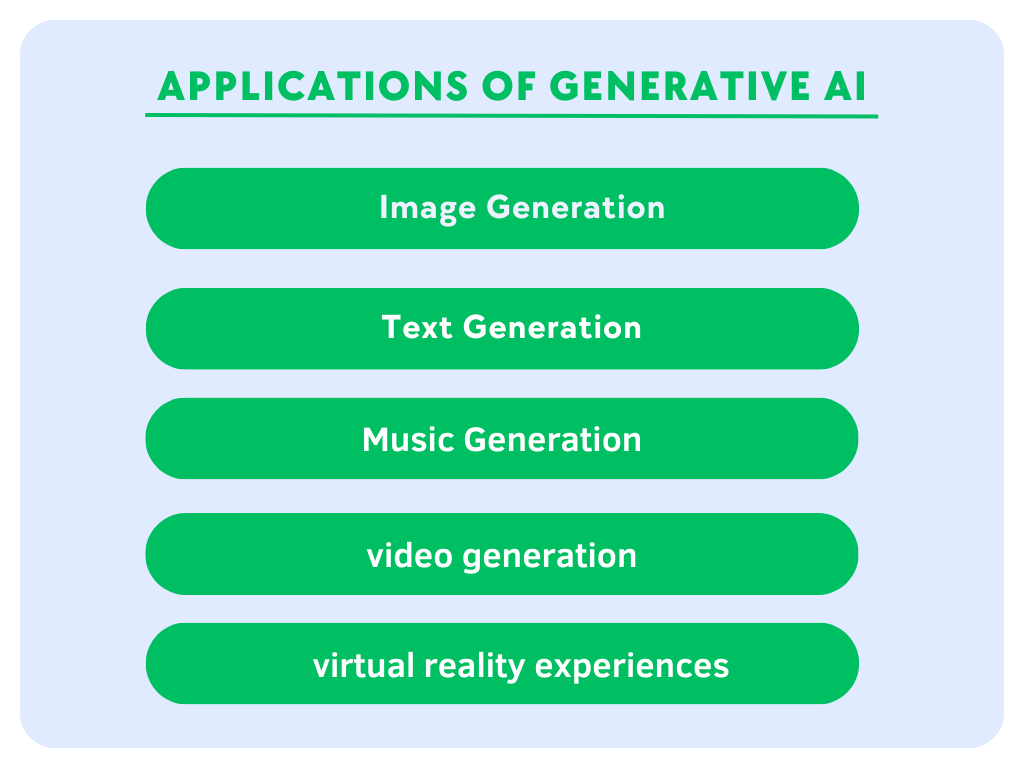
The applications of generative AI span every major industry. It is not just about AI content creation; it is about AI automation and process optimization.
1. Generative AI in Business and Enterprise Workplaces
Enterprise AI is shifting from predictive analytics to generative capabilities.
- Marketing: Automating ad copy, personalized email campaigns, and SEO blog posts.
- Customer Support: Intelligent chatbots that resolve complex queries rather than just routing tickets.
- Legal: Summarizing contracts and generating first drafts of legal documents.
2. AI for Software Development
AI code generation tools like GitHub Copilot and Amazon CodeWhisperer are revolutionizing engineering. Developers use prompts to generate boilerplate code, debug errors, and translate code between languages, increasing productivity by upwards of 40%.
3. Visual and Creative Arts
Text-to-image AI and AI image generation are reshaping design.
- Product Design: Rapid prototyping of product concepts.
- Entertainment: Creating storyboards, assets for video games, and Natural Language Generation (NLG) for scriptwriting.
4. Healthcare and Science
Generative models are accelerating drug discovery by predicting protein structures and generating novel molecular candidates, significantly reducing the R&D timeline.
Strategic Implementation: A Guide for SMEs
While Generative AI tools are powerful, implementation is where many businesses fail. Here is a framework for Small to Medium Enterprises (SMEs) to adopt this technology effectively.
Step 1: Identify High-Impact, Low-Risk Use Cases
Don’t try to overhaul your entire operation. Start with Generative AI use cases that offer immediate value.
- Example: Use AI to transcribe and summarize internal meetings or to draft responses to common customer emails.
Step 2: Select the Right Tool Stack
Navigating the best Generative AI software requires understanding your needs:
- For Text: ChatGPT Plus (versatile), Claude 3 (nuanced writing/coding), Jasper (marketing focus).
- For Images: Midjourney (artistic high-quality), Adobe Firefly (commercially safe).
- For Code: GitHub Copilot, Cursor.
Step 3: Prompt Engineering Techniques
To get the best results, teams must upskill in prompt engineering.
- Context: Give the AI a role (Act as a Senior SEO Strategist).
- Constraints: Set limits (Use bullet points, under 200 words).
- Few-Shot Learning: Provide examples of the desired output to guide the model.
Step 4: Data Quality and Customization
What role does data quality play in generative AI? It is paramount. Generic models produce generic results. For true competitive advantage, consider RAG (Retrieval-Augmented Generation), which connects an LLM to your private business data, ensuring answers are relevant to your specific company context.
The Cost of Generative AI: ROI Analysis
A gap in many guides is the discussion of cost. While many tools have a low entry price (e.g., $20/month for ChatGPT), Enterprise AI scaling costs differ.
- Token-Based Pricing: Most APIs charge per token (roughly 0.75 words). Generating long-form content or processing massive codebases can accrue significant costs.
- Hidden Costs: Human-in-the-loop review (essential for accuracy), data cleaning, and vector database management for RAG systems.
- ROI Calculation:
- Cost: Subscription + API fees + Implementation time.
- Gain: Hours saved x Hourly wage of employee + Value of increased output.
- Example: If a developer saves 10 hours a week using AI code generation, the ROI on a $20/month subscription is exponential.
Challenges and Limitations of Generative AI
Despite the hype, there are significant Generative AI limitations and challenges of generative AI that leaders must manage.
1. Hallucinations
What are the limitations of generative AI? The most prominent is the tendency to confidently present false information as fact. Models predict the likely next word, not necessarily the true one.
2. Bias and Fairness
Models trained on internet data inherit the biases of the internet. Without careful tuning, outputs can perpetuate stereotypes related to gender, race, and culture.
3. Intellectual Property and Copyright
Legal frameworks are still catching up. Who owns the copyright to AI image generation outputs? Is training on copyrighted data fair use? These questions pose legal risks for enterprises.
4. Security Risks
Prompt injection attacks can manipulate models into revealing sensitive training data or bypassing safety filters.
Ethics, Governance, and Responsible AI
What are the ethical considerations of using generative AI? Organizations must establish a Responsible AI framework.
- Transparency: Clearly label AI-generated content.
- Human Oversight: High-stakes decisions (hiring, lending, medical diagnosis) should never be fully automated.
- Auditing: Regularly test models for drift, bias, and accuracy.
AI ethics and governance are not just moral obligations; they are becoming regulatory requirements (e.g., the EU AI Act).
The Future of Generative AI and Trends
How will generative AI change the world? We are moving toward multimodal models. AI that can simultaneously understand and generate text, audio, video, and code seamlessly.
Future of Generative AI trends include:
- Agents: AI that doesn’t just write text but executes actions (booking flights, sending emails, coding and deploying software).
- Hyper-Personalization: Content and interfaces that adapt in real-time to the user’s preferences.
- Video Generation: High-fidelity text-to-video (e.g., OpenAI’s Sora) will disrupt the film and advertising industries.
FAQ: Generative AI Quick Guide
What are the 3 types of generative AI?
Broadly, they are categorized by output modality: Text generation (LLMs), Image/Video generation, and Audio/Speech generation.
What are examples of generative AI?
ChatGPT (Text), Midjourney (Images), Suno (Music), GitHub Copilot (Code), and Runway Gen-2 (Video).
What are the benefits of generative AI?
Key generative AI benefits include massive efficiency gains, scalability of content creation, democratization of creative skills, and acceleration of scientific research.
What skills are essential for working in generative AI?
Prompt engineering, data literacy, understanding of model architecture, ethical AI implementation, and Python programming (for developers).
Conclusion
Generative AI technology is more than a trend; it is a fundamental shift in the digital landscape. From Generative AI in business streamlining operations to AI content creation unlocking new forms of art, the impact is profound. However, success lies not just in accessing the latest generative AI tools, but in applying them with a strategy rooted in data quality, ethical governance, and human-centric design.
By understanding how generative AI works and respecting its limitations, businesses and individuals can harness this power to innovate faster than ever before.

Kaleem
My name is Kaleem and i am a computer science graduate with 5+ years of experience in Computer science, AI, tech, and web innovation. I founded ValleyAI.net to simplify AI, internet, and computer topics also focus on building useful utility tools. My clear, hands-on content is trusted by 5K+ monthly readers worldwide.