
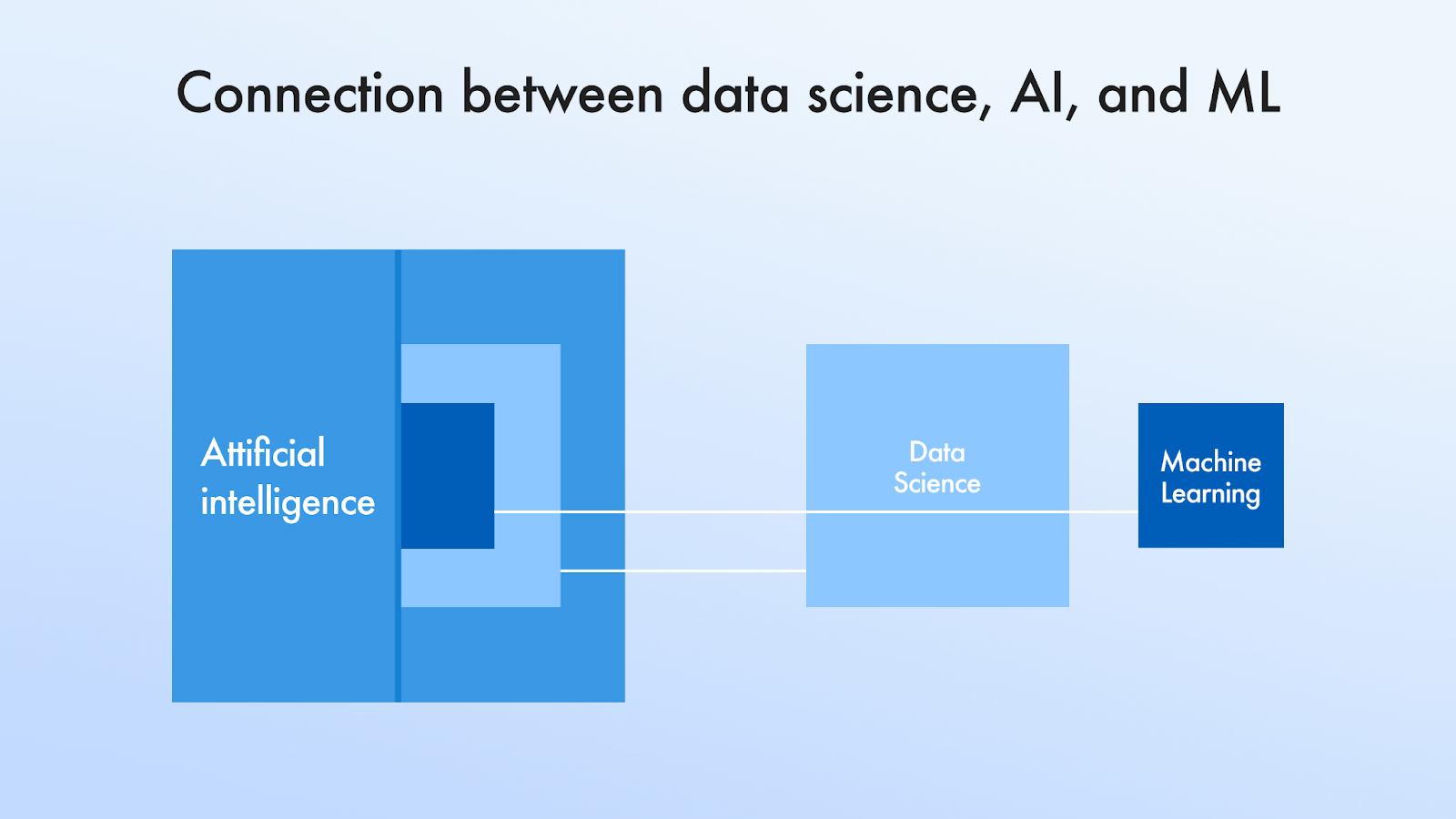
The architecture of intelligence. The most common mistake organizations and beginners make is treating Artificial Intelligence (AI), Machine Learning (ML), and Data Science as three separate, competing pillars. They are not distinct options on a menu; they are layers of a hierarchy.
To understand how they fit together, you have to move past the definitions and look at their relationship:
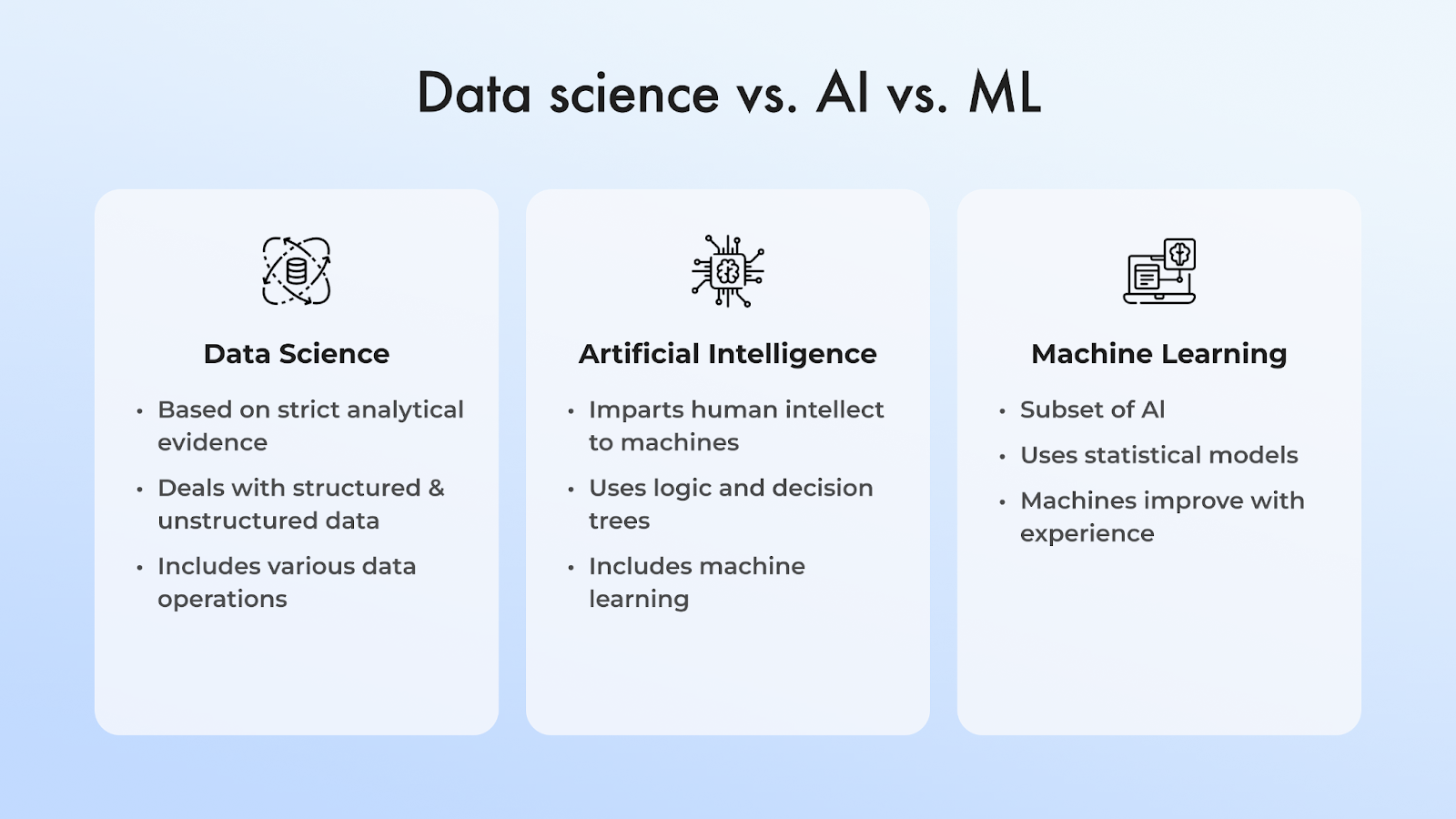
- Artificial Intelligence is the Goal. It is the broad aspiration to create systems that simulate human behavior or decision-making.
- Machine Learning is the Method. It is the specific subset of AI that uses statistical algorithms to learn from data rather than being explicitly programmed with rules.
- Data Science is the Discipline. It is the overarching scientific process of extracting meaning from data. It intersects with AI and ML, but also includes data engineering, statistics, and visualization.
Think of it like building a high-performance race car. Data Science is the engineering team analyzing wind tunnel data to improve aerodynamics. Machine Learning is the engine that improves its own efficiency the more it runs. Artificial Intelligence is the self-driving capability that steers the car on the track.
The Output Litmus Test
If you are looking at a project and struggling to classify it, stop looking at the code. Look at the output. The fundamental difference between these fields lies in what they deliver and who consumes it.
1. Data Science delivers Insights for Humans.
The end product of a pure data science project is often a report, a dashboard, or a recommendation presented to a human decision-maker. The goal is to reduce uncertainty so a human can make a smarter choice.
- Example: A report analyzing why customer churn increased last quarter.
- Output: “We should lower prices in the Northeast region.”
2. Machine Learning delivers Predictions for Systems.
Machine learning models output values probabilities, classifications, or numbers based on input data. These predictions are often fed into other software applications rather than presented directly to humans.
- Example: An algorithm scoring a credit card transaction for fraud probability.
- Output: “Transaction ID #554 has a 92% probability of being fraudulent.”
3. AI delivers Actions for Agents.
AI takes the predictions from machine learning and closes the loop by acting on them. It simulates agency. It doesn’t just know what might happen; it interacts with the environment based on that knowledge.
- Example: A system that automatically blocks the credit card transaction and sends an SMS alert to the user.
- Output: Action taken: Card Blocked.
Deconstructing the Silos: A Unified Scenario
To see where the boundaries blur and sharpen, let’s look at a single product a ride-sharing app like Uber or Lyft and identify the role of each discipline.
The Data Science Role (Strategic Optimization)
Before a car ever moves, Data Scientists are analyzing historical trip data. They might answer questions like, Which neighborhoods have the highest demand on rainy Tuesdays? They aren’t building the app’s features directly; they are analyzing patterns to advise operations teams on driver incentives. Their work ensures the business model functions.
The Machine Learning Role (Predictive Utility)
When you open the app, the ETA: 4 minutes notification is powered by Machine Learning. The system doesn’t know the future. It uses a regression algorithm that ingests current traffic speed, driver location, and weather conditions to predict a time. This is pure math adjusting to new data.
The AI Role (Autonomous Agency)
The route optimization engine acts as the AI. It takes the ML prediction (traffic conditions) and the user’s request, then autonomously navigates the driver through the city, rerouting in real-time if an accident occurs. If we look further ahead to self-driving cars, the AI is the system physically steering the vehicle, using computer vision (a type of ML) to perceive the road.
The Gray Areas: Where Practitioners Disagree
The boundaries are not rigid walls. There are specific overlaps that cause confusion even among professionals.
Is Linear Regression Statistics or Machine Learning?
This is the most common debate. Linear regression is a fundamental statistical method used in Data Science to understand relationships (e.g., “How does ad spend impact sales?”). However, when that same equation is trained on a massive dataset to predict future sales automatically, it is considered Machine Learning. The math is identical; the intent (explanation vs. prediction) changes the label.
Can you have AI without Machine Learning?
Yes. This is often called “Good Old-Fashioned AI” (GOFAI) or Symbolic AI. These are rule-based systems. A tax preparation software that navigates thousands of tax codes to maximize your refund is technically a form of AI (an expert system), but it doesn’t learn. It simply follows a complex tree of if-then logic pre-programmed by humans.
Can you have Data Science without Machine Learning?
Absolutely. A massive portion of corporate data science involves SQL, data cleaning, and descriptive statistics. If a Data Scientist analyzes sales data to find that 80% of revenue comes from 20% of customers, they have provided immense value without writing a single line of ML code.
Functional Summary: The Use-Case Matrix
Instead of comparing features, compare the intent of the problem you are solving.
| If you want to… | The Dominant Field | The Why |
|---|---|---|
| Explain why sales dropped last month. | Data Science | Focus is on root-cause analysis and human insight. |
| Forecast what sales will be next month. | Machine Learning | Focus is on pattern recognition and predictive accuracy. |
| Automate inventory ordering based on forecasts. | Artificial Intelligence | Focus is on closing the loop and taking action without human intervention. |
| Identify if a customer is angry from email text. | Machine Learning (NLP) | This is a classification task (Angry vs. Happy). |
| Chat with the customer to resolve the issue. | Artificial Intelligence | This requires maintaining context and generating human-like responses. |
Career Alignment: Which Path is Yours?
If you are deciding which skill set to pursue, do not choose based on buzzwords. Choose based on the type of problem-solving you enjoy.
Choose Data Science if: You are a detective at heart. You love digging through messy data to find the “aha!” moment that changes a business strategy. You need strong communication skills because your job is to persuade humans with data.
- Core Skills: SQL, Python/R, Statistics, Data Visualization, Storytelling.
Choose Machine Learning if: You are an engineer at heart. You care less about why the data looks the way it does and more about how to build a model that achieves 99.9% accuracy with low latency. You enjoy optimization and mathematics.
- Core Skills: Python, Calculus/Linear Algebra, TensorFlow/PyTorch, MLOps, Cloud Infrastructure.
Choose AI if: You are a systems architect. You want to build products that interact with the world. This often requires understanding ML, but also involves robotics, sensor integration, ethics, and software engineering.
- Core Skills: Software Engineering, Robotics, Control Systems, Cognitive Science, Integration.
Explore our comprehensive AI Key Concepts and Definitions article for detailed explanations and essential terms.
Recommended Next Steps:
- Explore: Supervised vs. Unsupervised Learning to understand how ML models actually work.
- Deep Dive: The Difference Between Data Analytics and Data Science for a granular look at the analysis hierarchy.
- Action: Try building a simple regression model in Python to see the transition from raw data to prediction.

Kaleem
My name is Kaleem and i am a computer science graduate with 5+ years of experience in Computer science, AI, tech, and web innovation. I founded ValleyAI.net to simplify AI, internet, and computer topics also focus on building useful utility tools. My clear, hands-on content is trusted by 5K+ monthly readers worldwide.