
ML and NLP are two popular technologies that are used in online paraphrasing tools. You may have seen some tools boasting about how their paraphrasing process incorporates ML and NLP for accurate results.
If you don’t know what that means, don’t worry. We will clear it all up for you here in this post.
What are ML and NLP?
Let’s take a look at what NLP and ML are.
1. What is ML?
ML stands for machine learning. Machine learning is basically the field of AI that involves trainingcomputer software to learn from the inputs they are provided. In other words, computer software that is equipped with ML is able to improve itself over time, and they are able to enhance the quality of its outputs.
A very common example of ML is in the predictive text seen on most smartphone
keyboards. When you use the keyboard for a while, the predictions get tuned to your
writing habits. It then starts to offer you suggestions according to what you typically type.
2. What is NLP?
NLP stands for natural language processing. This is basically the technology that allows computersto understand and process natural languages such as the ones spoken by humans in their everyday conversations.
For context, computers can’t really understand natural languages. They understand their
instructions in the form of 1’s and 0’s. Now, to make a binary machine like this understand the stuff you tell it in a natural language, you need to make use of NLP.
For example, once a computer is equipped with NLP, it will be able to understand languages like English and German, etc.
Read also: ML and NLP Difference
What Role Do These Two Technologies Play in Online Paraphrasing?
Now that we’re done looking at what these technologies are, let’s take a look at the role they play in online paraphrasing tools.
NLP: NLP plays a simple enough role in online paraphrasing. It is the technology that
allows paraphrasing tools to understand the content they are given, after which they can
move on to make changes accordingly.
Even in very simple tools, NLP plays a pivotal role since it allows the tool to understand the meaning of the words it wants to change.
ML: Moving on, let’s discuss what ML does in this whole business.
Paraphrasing tools receive a lot of inputall the time, and they have to process different
types of content day in and day out. When these tools are equipped with ML, they are able to learn from the provided inputs so that they can improve the overall quality of their
results.
A paraphrasing tool that is equipped with ML will be able to get better the more it is used.
Inside the Pipeline: How a Paraphrasing Tool Processes Your Text
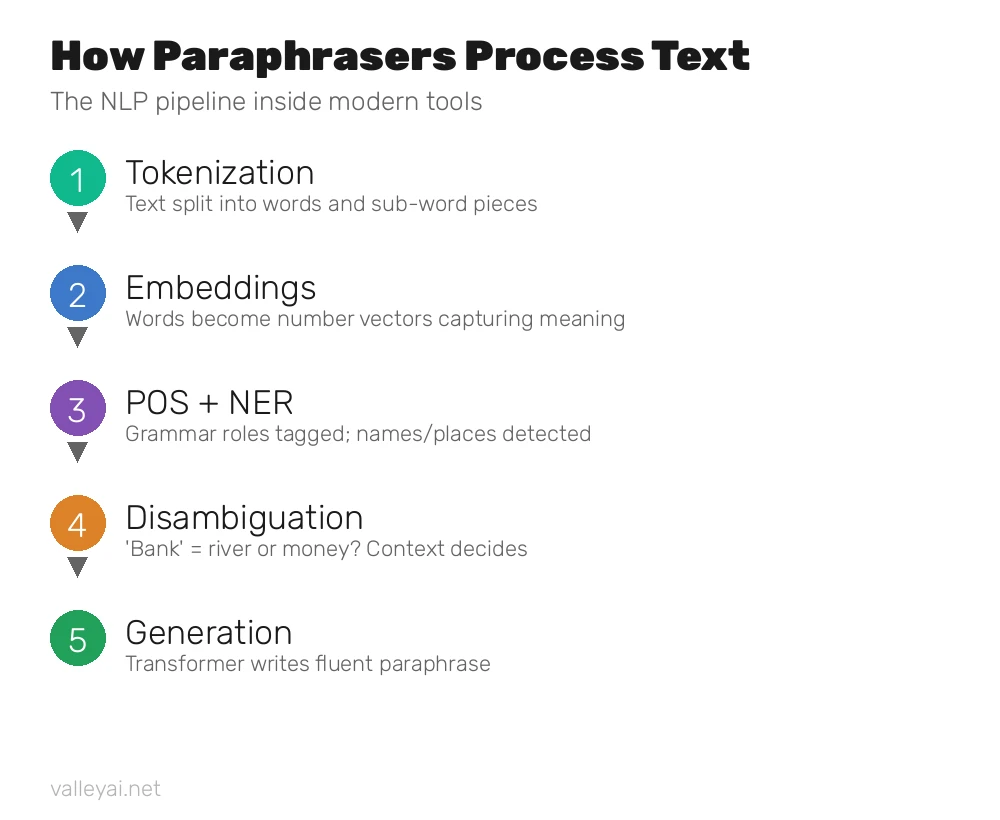
The descriptions above sound simple: the tool understands, then rewrites. But what happens between those two steps is where the real work lives. A modern paraphrasing tool runs your text through a chain of specialized NLP steps, each one adding a layer of understanding before a single word gets changed.
1. Breaking Your Text into Machine-Readable Pieces
First, the tool cuts your text into small pieces called tokens. A token can be a whole word, part of a word, or even a single character, depending on the tool. Each token is then converted into a list of numbers called an embedding. Embeddings are the trick that lets a machine handle meaning: words with similar meanings end up with similar number patterns, so the tool can tell that “happy” is close to “joyful” but far from “hammer”. This numeric version of your text is what every later step actually works on.
2. Reading the Grammar and Protecting Names
Next, the tool labels every token with its grammatical role, a step called part-of-speech tagging. It figures out which words are nouns, verbs, and adjectives, so the rewritten sentence keeps valid grammar instead of collapsing into word salad. In the same pass, named entity recognition spots proper names: people, companies, places, dates. This matters because names usually must survive paraphrasing untouched. If you feed the tool “Apple launched a new chip”, entity recognition knows Apple is a company, so the tool will not turn it into “the fruit company launched a new chip”.
3. Figuring Out What Ambiguous Words Mean
Many words have more than one meaning, and picking the wrong one is how paraphrases go wrong. In “he sat on the bank of the river”, bank means the edge of the water; in “she opened a bank account”, it means a financial institution. A step called word sense disambiguation looks at the surrounding words to pick the right meaning. Related to this, topic modeling scans the whole passage to identify its main theme, so the tool keeps technical, medical, or legal vocabulary consistent instead of swapping in casual synonyms that change the register.
4. Writing a Fresh Sentence from the Meaning
Only now does the tool generate the new text. Modern paraphrasers use transformer-based large language models that read the entire sentence at once, holding the full context in memory while they write. Instead of replacing words one by one, they compose a brand-new sentence that carries the same meaning, which is why the output can change the sentence structure completely and still sound natural.
Why Modern Paraphrasers Beat the Old Synonym Swappers
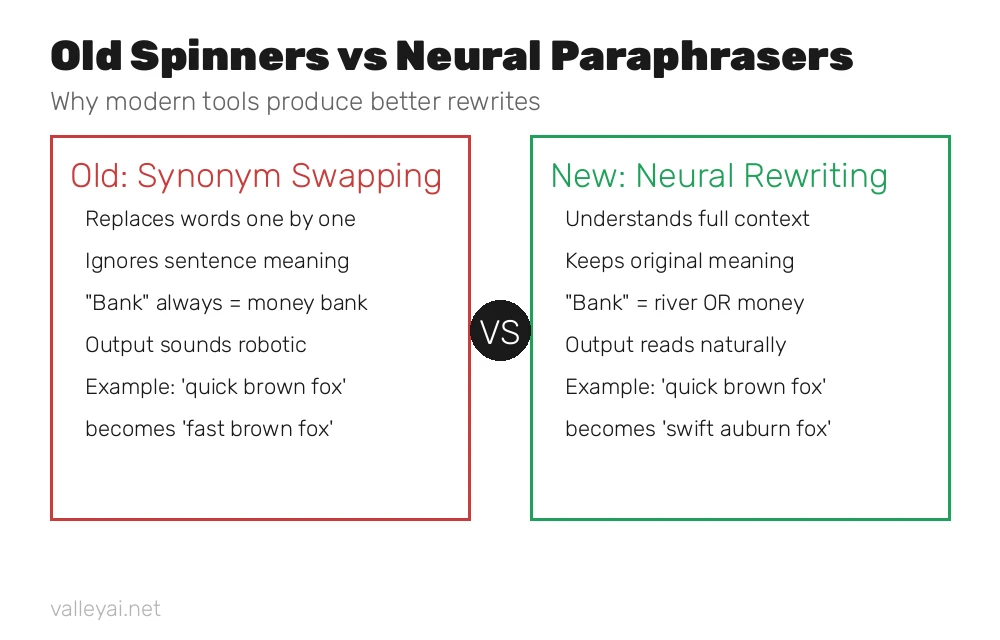
The first generation of paraphrasing tools did not understand anything. They worked like an automated thesaurus: look up each word, swap in a synonym, done. The results were famously strange. Feed an old spinner “The quick brown fox jumps over the lazy dog” and you might get “The speedy chocolate fox leaps over the idle dog”. Every word was replaced, yet the sentence got worse: a fox is not chocolate, and “idle dog” sounds like a machine, not a writer.
Modern tools start from meaning instead of words. The same sentence comes back as “A fast brown fox leapt over the sleeping dog”. Fewer words changed, but the structure shifted and the meaning stayed intact. That is the practical difference the ML and NLP pipeline makes: the rewrite happens at the level of ideas, not vocabulary.
How Paraphrasing Tools Keep Getting Smarter
This is where machine learning earns its keep. Every correction you make, every thumbs down you give a bad rewrite, and every edit you accept becomes training signal. Tools collect this feedback and train on high-quality training data to fine-tune their models, so the paraphrases improve the more people use them. It is the same learning loop behind your keyboard’s predictive text, just applied to full sentences.
None of this makes the tools perfect. Idioms, sarcasm, and cultural references still trip them up, and they can quietly shift emphasis in ways that matter for academic or legal writing. Treat the output as a strong first draft, and give anything important one careful read before you use it.
How do paraphrasing tools actually understand my text?
They convert your text into tokens and then into embeddings, which are lists of numbers that capture meaning. Words with similar meanings get similar number patterns, so the tool can compare ideas numerically instead of just matching words. Grammar analysis, entity recognition, and disambiguation then add context before anything gets rewritten.
Why did old paraphrasing tools produce such strange results?
Old tools worked like an automated thesaurus: they swapped each word for a synonym without understanding the sentence. Without context, the quick brown fox could become the speedy chocolate fox. Modern tools rewrite from the meaning of the whole sentence, so the grammar and sense survive.
Can a paraphrasing tool change the meaning of my text?
Yes, especially with idioms, sarcasm, or ambiguous words. A good tool gets it right most of the time, but for academic, legal, or published writing, always read the output carefully and check that the emphasis and facts are unchanged.
Do paraphrasing tools get better over time?
The ones built on machine learning do. Corrections, accepted edits, and feedback signals become new training data, and the models are retrained on large curated datasets. The more a tool is used and corrected, the more accurate its paraphrases become.
Conclusion
Nowadays, there are a lot of paraphrasing tools available on the internet, and the only way for existing tools to make themselves stand out is by making their performance and
outputs high-quality.
This is possible by incorporating the use of AI models such as NLP and ML. Hopefully, after going through the above, you have a good idea of what these two technologies are and how they can be used to improve the quality of paraphrasing tools. And the next time a tool promises ML and NLP inside, you will know exactly what that promise means.

Kaleem
Kaleem is a Computer Science graduate (Virtual University of Pakistan) and the founder and editor of Valley AI, where he publishes in-depth, tested guides on computer hardware, artificial intelligence, and how the internet works. Every guide is researched from primary sources, tested hands-on where possible, and updated when the facts change.